12 min read
Garden edging: which edge for lawn, gravel and a sandpit
Which garden edging suits a terrace, gravel, lawn or sandpit? Types, sizes, Dutch prices per metre from €4.49, and its lifespan next to lawn, gravel or paving.
Garden edging is the strip that holds a surface in place: the sand under your terrace, the gravel in your path and the grass outside your border. Under tiles and clay pavers you use a concrete edging kerb, around gravel and borders a steel strip. A one-metre concrete kerb costs €4.49 at a Dutch DIY store.
Without an edge, the gravel ends up in the lawn after one winter, and the pavers on the outside of the terrace sink. Which edge you need depends on two things: what lies inside it and what lies against it.
Which edging goes with which surface?
A terrace or path on a sand bed gets a concrete edging kerb (opsluitband in a Dutch shop). Gravel and borders get a thin strip of steel, corten steel or plastic. Along a wall, a fence with a concrete base panel or a pond, you need no edge at all.
| Surface | Which edge | Why |
|---|---|---|
| Terrace or path of tiles or pavers | Concrete kerb, 5 or 6 cm thick | It holds the sand under the paving, so no hollows form |
| Driveway | Kerb of 8 x 20 or 10 x 20 cm | Pulling away, braking and turning push the stones outwards |
| Light terrace without cars | Steel strip | You tap it in after the paving is laid, so you dig less |
| Gravel path or gravel area | Steel, corten steel or plastic | Keeps the gravel out of lawn and border |
| Border beside a lawn | Steel or plastic border edging, or a wide strip the mower can run over | Without an edge, the grass grows into the border |
| Sandpit or play area | Rubber, or timber with a rounded top | No sharp edge for a child to fall on |
| Pond | None | You finish the liner with stones that overhang the water slightly |
| Along the house wall or a raised border | None | The wall already holds the ground |
The kerb under a terrace holds the sand under the stones in place. If the sand stays put, the stones stay level. A driveway needs a thicker kerb.
For a light terrace, a galvanised steel strip is a good alternative. Concrete weathers over the years: it gets coarser and the colour fades. You set a steel strip along the edge after the paving is laid, so there is less digging.
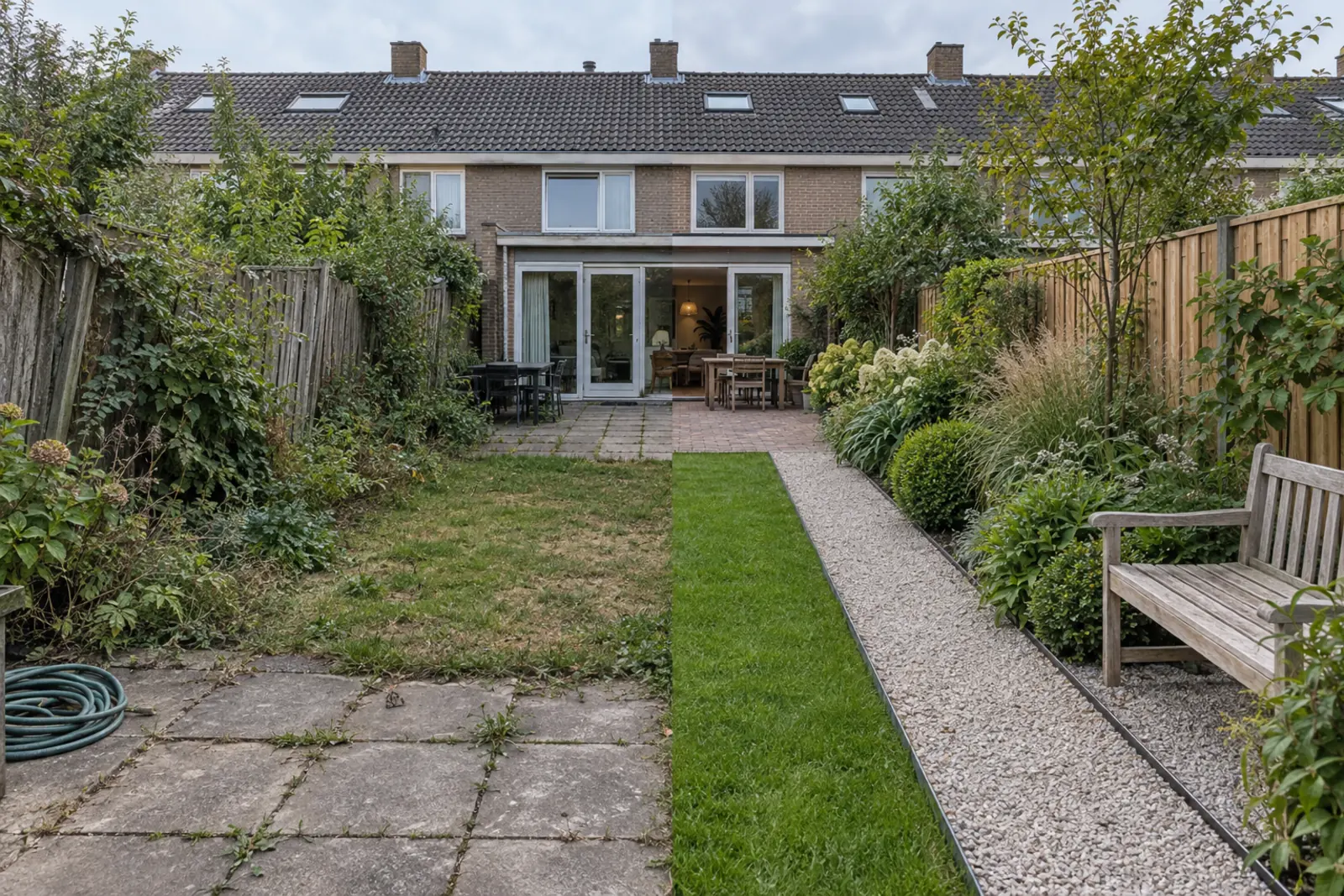
Gravel is loose, so the edge mainly has to stop the stones from spreading. A thin strip of steel or plastic is enough there. Plastic bends most easily into a curve. Steel stays straighter in a straight line.
Seven types of edging, with sizes and price per metre
There are seven common types: steel, corten steel, concrete, bricks on edge, timber, plastic and natural stone. Aluminium is a variant of the steel strip. The prices below are Dutch shop prices on 3 October 2026, converted to one metre. Posts, pins and sand come on top.
| Type | Sizes in Dutch shops | Price per metre | Suits |
|---|---|---|---|
| Galvanised steel | 2 or 3 mm thick, 7 to 39 cm high | €8.65 to €13.15 | Gravel, border, light terrace |
| Corten steel | 2 or 3 mm thick, 7 to 39 cm high | about €15.80 | Gravel, border, lawn |
| Aluminium | 10, 14 or 24 cm high | not found | Gravel, border |
| Concrete kerb | 5 x 15, 6 x 15, 6 x 20, 8 x 20, 10 x 20 cm, 1 m long | €4.49 (6 x 15 cm) | Terrace, path, driveway |
| Natural stone (granite) | 8 x 20 cm, 1 m long | €49.80 | Terrace, path, driveway |
| Bricks on edge | one or two rows | not found | Lawn, border |
| Hardwood | board of 2 x 20 cm | about €7.50 | Border, raised bed, sandpit |
| Pressure-treated pine | board of 2.8 x 19.5 cm | about €9 | Border, sandpit |
| Plastic | 14 cm high, 0.7 to 1 cm thick | about €7 | Gravel, lawn, curves |
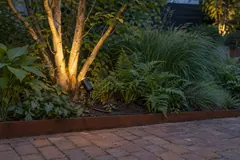
Steel edging is a thin plate. A galvanised strip does not rust, because a layer of zinc covers it. Corten steel arrives unrusted and takes about 4 to 5 months to grow its orange-brown layer of rust. While that happens, rusty water can run off the strip.
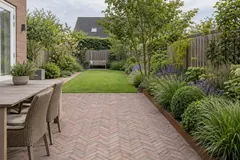
Bricks on edge, a soldier course, stand firmer with a row laid flat in front of them. That flat row sits level with the grass. One mower wheel runs along it, and a wide strip like this also lets a robot mower cut right up to the edge.
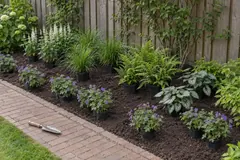
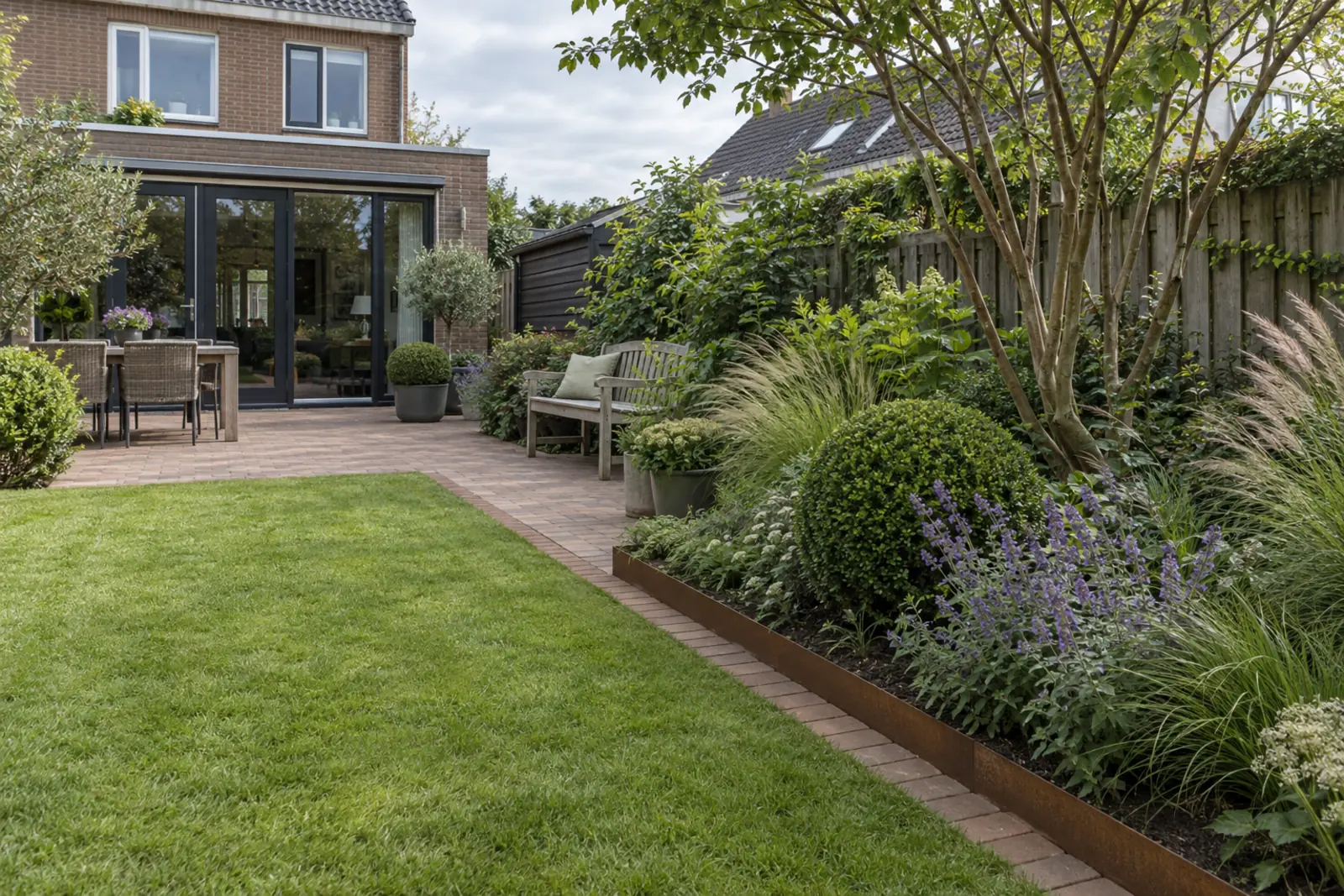 A flat row of bricks beside the grass is a mowing strip. The corten steel strip behind it keeps the soil of the border in place.
How high should garden edging be?
High enough that most of it sits in the ground. Of a concrete kerb 15 cm high, 10 to 12 cm goes into the ground. Its top sits about 1 cm below the paving, so you barely see it.
A steel border edge shows even less. A linking strip 17.5 cm high, pins included, leaves about 4 cm in view. A low strip 6 cm high is 16 cm long with its pins.
You need a taller edge where the ground is higher on one side. Think of a raised planting bed or a small step between terrace and lawn. There the edge also has to retain the soil. Steel strips come up to 39 cm high. A hardwood board 20 cm high is made to retain small differences in level.
For a driveway the thickness matters most. A kerb 5 to 6 cm thick is enough for a footpath. A driveway needs one 8 to 10 cm thick, because the car pushes the stones outwards on every turn.
How long does garden edging last?
That depends on the material and on where it sits. Timber and steel in wet ground last less long than above it. This table gives what the sources say for each type, including where they give no figure.
| Type | Lifespan | What shortens it |
|---|---|---|
| Hardwood, durability class 1 | more than 25 years in the ground | little, it is made for the waterside |
| Pressure-treated pine, class 3 | 10 to 15 years in the ground | ground that is always wet |
| Untreated pine or spruce, class 4 | 5 to 10 years in the ground | any place in contact with soil |
| Galvanised steel | decades in open air; no figure found for the ground | salt, acid soil, lasting damp |
| Corten steel | in the air a rust layer that protects it; in the ground it rusts like ordinary steel | compost against the strip, the coast, wet clay |
| Concrete | no figure found | the surface gets coarser and the colour fades |
| Clay brick | 125 years on average, according to the maker | little |
| Plastic | no test found; 2 years of warranty on a common brand; pinned, more than 20 years in one Canadian garden | frost, if the edge is not held with pins |
The years for timber come from the stake test that Centrum Hout, the Dutch timber information centre, uses to sort wood into durability classes. Pressure-treated pine falls in class 3. For an edge you do not want to replace in ten years, choose hardwood.
For corten steel, the lifespan depends most on where it sits. Above ground it gets wet and dry in turn, and that builds the protective rust layer. In the ground that does not happen. Straightcurve, a maker of steel edging, measures 0.1 to 0.3 mm of rust a year just at the soil line, in moderately aggressive Australian soil. A 1.6 mm strip can rust through there in 5 to 15 years under harsh conditions. A strip of 2 or 3 mm lasts proportionally longer. On the coast, makers advise against corten steel within 2 km of the sea.
Zinc rusts in open air about thirty times more slowly than steel, according to the same guide. Salt, acid and lasting damp do attack the zinc layer. For concrete we found no figure, for plastic only one report from practice.
How long does edging last next to lawn, gravel, paving or concrete?
What lies against the edge matters at least as much as the edge itself. Next to gravel, steel lasts longer than in a border with compost, which holds damp against the steel. In border soil, steel rusts and timber rots at the soil line. Along a lawn, mower and frost wear the edge down; along paving, a sinking sand bed does.
| Next to | Best edge | What shortens its life | What you see when it fails | Lifespan according to the sources |
|---|---|---|---|---|
| Lawn | Plastic or steel held with pins, or a flat row of bricks | mower and strimmer hitting the edge; frost under an edge without pins | a strip that rises, or one the mower blade hits | plastic with pins: more than 20 years in one Canadian garden; no other source found |
| Gravel | Steel, corten steel or plastic | a gravel grid against the edge, which pushes it out as it expands | gravel running over or past the edge into the lawn | no source found |
| Border soil | Steel or hardwood | wet soil, compost and wood chips against the edge; soil that settles | steel rusting through or timber rotting at the soil line | timber: 5 to more than 25 years, measured in ground contact; steel: no figure for Dutch soil |
| Terrace tiles | Concrete kerb | a sand bed you cut back after paving; high groundwater; a ride-on mower | tiles that sink or tilt at the edge | no source found |
| Pavers, path or driveway | Kerb, or a soldier course of clay bricks | cars pushing the stones outwards; road salt on concrete | stones that shift outwards at the edge | clay brick 125 years on average, according to the maker; concrete kerb: no source found |
| Concrete | Galvanised steel or concrete, not corten steel | rust run-off from corten steel; road salt | orange rust stains on the concrete | no source found |
Along a lawn, the top of the edge sits best about 1 cm above the ground. The mower then rolls over it without the blade hitting the edge. Fix a plastic edge with pins, or frost can push it up.
In a border, the weak point is the soil line, where damp and air meet. Fungi in timber and rust in steel need both. When the soil settles, the soil line moves down and rust starts in a new place, so top up sunken soil. A loose plastic sheet between steel and soil traps damp behind it. Bitumen paint on the buried part works, because it sticks to the steel.
Under tiles and pavers, the sand bed decides how long the edge does its job. Set the kerb before you lay the paving. Cutting back the sand bed afterwards makes subsidence much more likely. With high groundwater or a ride-on mower, choose a kerb 6 cm thick. Salt attacks the surface of concrete paving, but not clay pavers.
Against concrete, skip corten steel, because its rust run-off leaves stains.
A safe edge for a sandpit or play area
Choose an edge without a sharp top. A thin steel strip sticking up above the sand or the grass is an edge a child can land on with a knee or a hand. Use rubber or timber there.
Rubber sandpit edges are made for exactly this. They are rounded and give a little, and they are meant to replace sharp concrete or iron edges. A common size is 100 x 15 x 15 cm, and you cut them to length with a knife.
For a sandpit in a back garden we prefer a timber board with a rounded top. It matches a border and you can sit on it. Hardwood lasts longest. A plastic edge 1 cm thick is a second option.
When do you not need garden edging?
Along the wall of your house, a raised border or a fence with a concrete base panel. These already hold the base of your terrace in place. You only need an edge where paving meets something loose: grass, gravel or a border.
A pond gets no edging either. You finish the edge of the liner with large stones that overhang the water slightly, so the liner is out of sight.
A lawn without an edge works, but it costs effort. The grass grows into the border, so you cut the edge back regularly. And the mower drops into the border at the edge. If you do not want to do that every month, lay an edge or a flat row of stones.
Edging in your garden design
Which edge goes where is easiest to see on a plan of your own garden. In tuinontwerp.app you put your plot on screen to scale and draw your terrace, paths, gravel, lawn and borders on it. Each surface automatically gets an edge that suits it.
A terrace and a path get a concrete kerb, except a timber deck. Gravel and a planting bed you drew get steel. A lawn and a sandpit get no edge by default. The app draws no edge along a building, and where two surfaces meet there is one strip. In the Edging section you pick another type: none, steel, corten steel, concrete, brick, timber or plastic.
The app then counts the metres per type of edging, rounded up to whole metres, because you buy it by the metre. Designing on your own plot is free. More about the border behind that edge is in how to make a planting plan, and what a whole design costs is in what a garden design costs. Every post about materials is listed in the materials category.
Concrete under the terrace, steel around gravel and borders, rubber or timber at the sandpit, and nothing along the wall. Start at the address field at the bottom of this page and draw your own garden with its edges.
Frequently asked questions
What is the best garden edging for gravel?
A steel strip, galvanised or corten, or a plastic edge. They are thin, they bend into a curve, and they keep the gravel out of the lawn and the border. A concrete edging kerb works too, but it is 5 to 10 cm wide and needs more digging.
How long does timber garden edging last?
It depends on the wood. Hardwood in durability class 1 lasts more than 25 years in the ground. Pressure-treated pine falls in class 3 and lasts 10 to 15 years. Untreated pine or spruce in class 4 lasts 5 to 10 years in the ground.
Why does my steel garden edging rust through?
Usually at the soil line. Damp and air meet there, and compost or wood chips against the strip hold the damp. Keep organic material a few centimetres from the steel, top up soil that has sunk and give the buried part a coat of bitumen paint. A loose plastic sheet traps the damp instead.
Do I need edging along the wall of my house?
No. Along the house wall, a raised border or a fence with a concrete base panel, the ground already holds your paving in place. A concrete kerb only goes where the terrace meets grass, gravel or a border.
What does garden edging cost per metre in the Netherlands?
On 3 October 2026 a concrete edging kerb of 6 x 15 x 100 cm cost €4.49 a metre at GAMMA, a Dutch DIY chain. Plastic costs about €7 a metre, galvanised steel €8.65 to €13.15 and corten steel about €15.80. Posts, pins and sand come on top.
Which edging is safe around a sandpit?
An edge without a sharp top. Rubber sandpit edges have a rounded, cushioned top and are made to replace sharp concrete or iron edges. A timber board with a rounded top works too. Do not let a thin steel strip stick up above the sand.
How many metres of edging do I need?
Measure the edges that meet grass, gravel or a border, and leave out the stretches along your house wall. Tuinontwerp.app does this for you: draw your terrace, path or gravel area on your own plot and the app counts the metres per type of edging, rounded up to whole metres.
Sources (29)
- Centrum Hout — Houtinfoblad Levensduur houten damwanden (2017), tabel duurzaamheidsklassen
- Tuincentrum Osdorp — De duurzaamheidsklassen van (tuin)hout
- ADEZZ — Kantopsluitingen, productblad cortenstaal en verzinkt staal
- Straightcurve — Longevity Guide 2026 (cortenstaal en verzinkt staal in de grond)
- Wienerberger — Kleiklinkers voor openbare toepassingen
- Bestratingsweb — Hoe plaats je opsluitbanden
- The Stone Discounter — Uw bestrating opsluiten
- The Stone Discounter — Stalen kantopsluiting verzinkt 130 x 3000 mm
- GAMMA — Stonewish opsluitband grijs 6 x 15 x 100 cm
- GAMMA — Talen Tools borderrand koppelbaar zilver staal 100 cm
- GAMMA — Talen Tools borderrand koppelbaar corten staal 100 cm
- GAMMA — Ecolat borderrand opgerold 10 m x 14 cm
- GAMMA — Tuinplank grenen geïmpregneerd 2,8 x 19,5 x 400 cm
- Gadero — Hardhouten beschoeiingsplank 2 x 20 cm
- Stenenwebshop — Graniet opsluitband 8 x 20 x 100 cm
- Borderrand-kantopsluiting.nl — Ultra sterke aluminium borderrand
- Hubo — AVR Ecolat grasrand 200 x 14 x 1 cm
- Praxis — Ivol rubber zandbakrand 100 x 15 x 15 cm
- Tuinshop — Stappenplan grindpad aanleggen
- MamsatWork — Kantopsluiting voor gazon en border
- Klusidee forum — Klinker als border tussen planten en gazon
- Vijverhandboek — Randafwerking vijver
- Gardeners' World tuinwinkel — Kantopsluiting zwart 6 cm (MA-Edge)
- Zandcompleet — Kantopsluiting en afboording voor de tuin
- Laidback Gardener (Larry Hodgson) — Lawn edging: time saving when you install it correctly
- RVO — How fungi and bacteria attack timber piles (in Dutch)
- Wikiwijs — Paving and edging, landscaping course material (in Dutch)
- Excluton — Information sheet on pavers and stones, road salt (in Dutch)
- HG — How to remove rust stains from stone (in Dutch)