7 min read
How to make a planting plan from sun hours and soil
Make a planting plan per section: sun hours first, then the soil map for your region and a roll test for your border, then the plants. Example: six plants.
To make a planting plan, work one section at a time. Check how much direct sun that spot gets, then its soil type, and only then pick the plants that suit both. In tuinontwerp.app you draw those sections on a plan of your own plot, with each plant at a grown plant's width. You test the soil yourself.
The usual order runs the other way. You see a lovely border in a photo, copy down the plants and bring them home from the garden centre. That photo was taken in another garden, with other light and other soil. What grows there says little about your section of border.
How do you make a planting plan in four steps?
A planting plan is a drawing of your border that shows which plants go in each section. The plan only works if every plant can grow where it is put. So you start from the spot, not from the plant.
- Divide the border into sections. A section is a stretch of border where the light is roughly the same. To find them, look at what surrounds the border: the house, the fence and the neighbours.
- Note the sun hours for each section. The number of hours of direct sun decides whether a section counts as full sun, partial shade or shade.
- Find out the soil type. Not every plant tolerates every soil, even when the light is right.
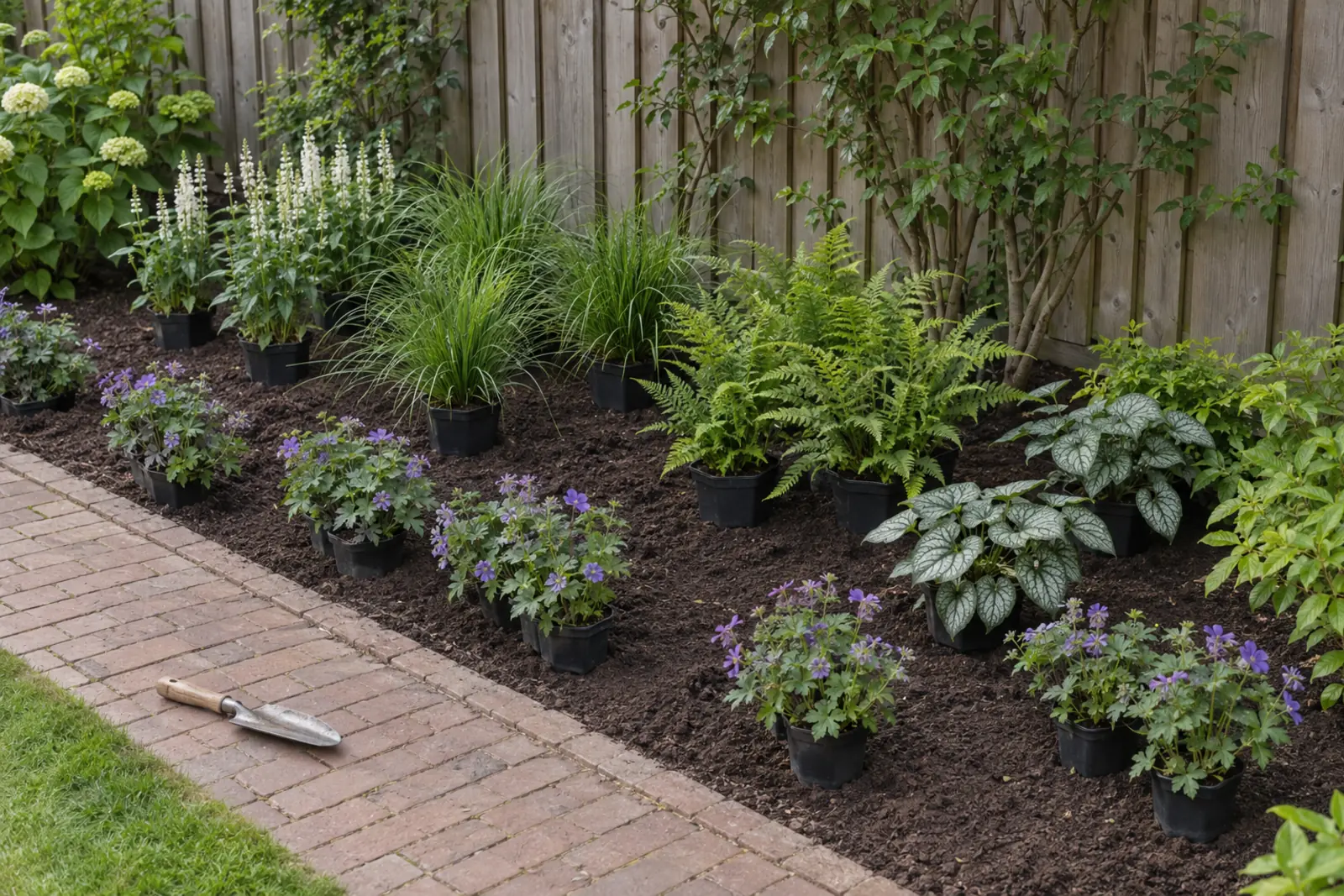
- Keep the plants that suit both, section by section. A plant that suits the light but not the soil drops out. Arrange the rest by height: low at the front, tall at the back.
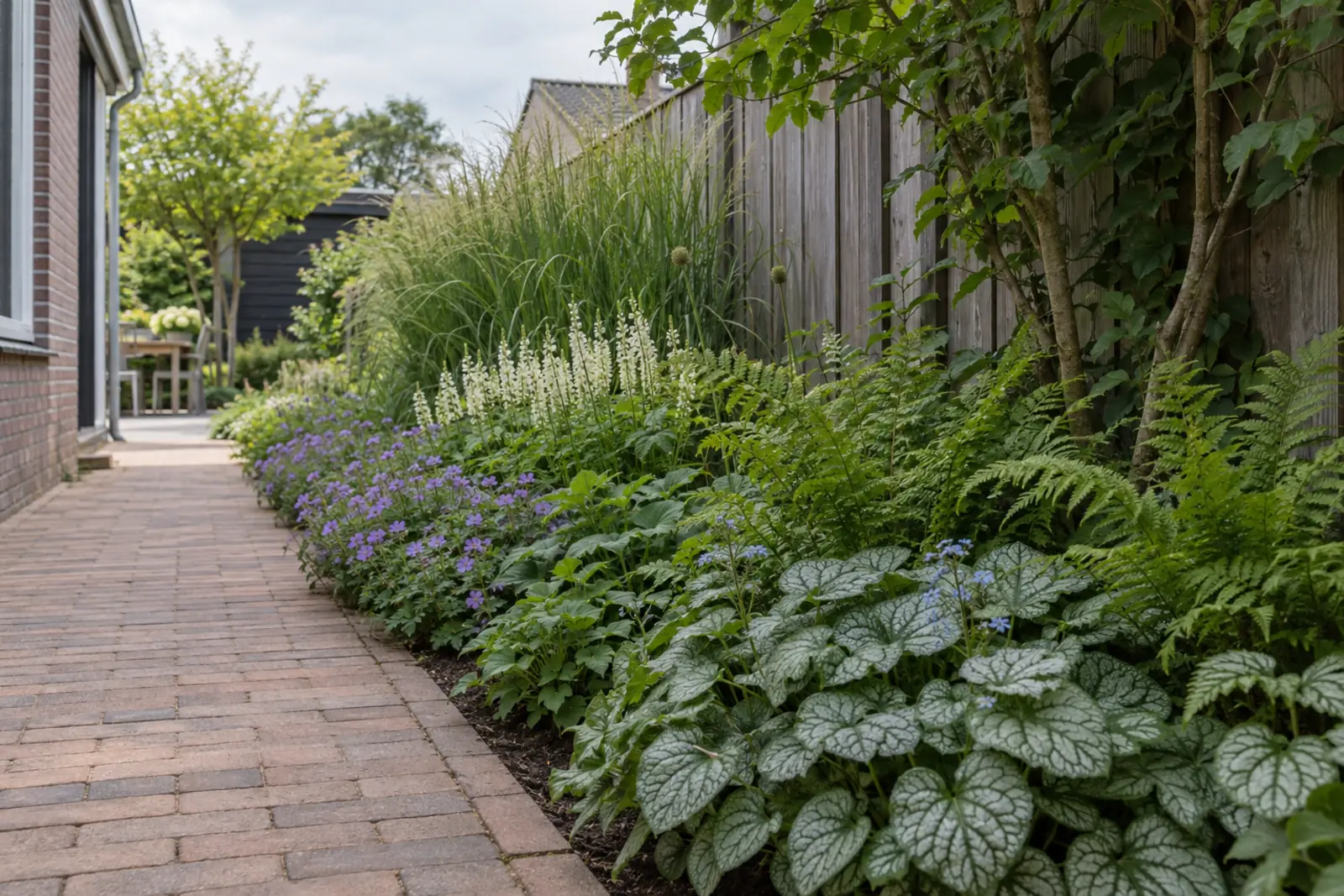 Two sections in one border, each with its own plant list, from low at the path to tall against the fence.
Steps two and three are exactly what a photo of someone else's garden cannot give you. More on designing from the plot is in the garden design category; what each species needs is under Plants.
How much sun does each section get?
That depends on what surrounds it: houses, fences and your own property line. Two worked examples from tuinontwerp.app show how large the difference can be. Both are for 15 May; a garden sun hours calculator that starts from your address explains why that day.
The first is a row of terraced houses six metres high, with a plot 5.5 metres wide. In that row, a spot three metres behind the middle house gets about 2.0 hours of direct sun. The property line does most of that, because the app counts it as a wall of 1.8 metres.
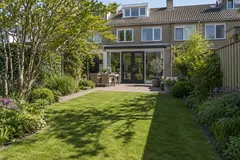
The second is a detached house six metres high on a plot of twenty by twenty metres. A spot eight metres behind that house gets about 13.2 hours.
The first section stays under the three-hour limit and counts as shade. The second is well above six hours and counts as full sun. Both figures hold only for those two plots and say nothing about your border.
If you would rather count the hours yourself, the method is in how to measure sunlight in your garden.
For your own border, you draw the sections on a plan of your plot in tuinontwerp.app. Place a plant in one, and you also see the most sun that spot can get.
What soil does your garden have?
You find out in two steps: first on the soil map, then with a handful of soil from your own border. The map shows the region. The test shows your garden.
The Soil Map of the Netherlands from Wageningen University & Research describes the soil down to 1.20 metres, at a scale of 1:50,000. You can view it at bodemdata.nl. The map is meant for national and regional use, not for individual plots. In urban areas it holds little or no information.
For your own border you therefore do the roll test. Wet a patch of soil thoroughly and knead a handful into a ball. Then read the result:
- If the wet ball falls apart at once, you have sand.
- If you can roll the soil out as thin as a pencil, you have clay.
- If it only rolls out as thick as a sausage, you have loam.
- If the soil is reddish brown to black and feels moist and spongy, you have peat.
Do the test in every section you plant and write the result next to the sun hours. Then both measurements sit on one line of your plan.
Planting plan example: six plants, two sections
The table lists six perennials and grasses from the app's plant list, with the light the app gives them, the soil they tolerate and their height.
| Plant | Light in the app | Soil | Height in the app |
|---|---|---|---|
| Geranium 'Rozanne' (cranesbill) | sun, partial shade | chalk, clay, loam, sand | 0.4 m |
| Salvia 'Schneehügel' | sun, partial shade | chalk, loam, sand | 0.4 m |
| Persicaria 'Firedance' | sun, partial shade | clay, loam | 0.9 m |
| Miscanthus 'Kleine Silberspinne' | sun, partial shade | chalk, clay, loam, sand | 1.2 m |
| Brunnera 'Jack Frost' | partial shade, shade | chalk, clay, loam, sand | 0.4 m |
| Dryopteris erythrosora (fern) | partial shade, shade | chalk, clay, loam, sand | 0.6 m |
On one point the sources disagree. The app lists Salvia 'Schneehügel' and Miscanthus for partial shade too. The RHS, the Royal Horticultural Society in the United Kingdom, lists them for full sun only. Follow the stricter one and plant them only in a section that gets six hours or more.
Start with the sunny section on the wide plot. The four sun plants all suit the light there, so the soil decides. On sand, Persicaria 'Firedance' drops out, because it wants clay or loam. That leaves Geranium 'Rozanne', Salvia 'Schneehügel' and Miscanthus. The geranium and the salvia, both 0.4 metres, go at the front, and the 1.2 metre Miscanthus at the back. On clay it turns round: the salvia drops out and Persicaria comes back.
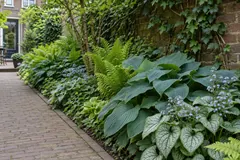
Then the shade section behind the terraced house. The four sun plants drop out there, because the app lists them for sun and partial shade. Brunnera 'Jack Frost' and Dryopteris erythrosora remain. Both tolerate every soil in the table, so here the light decides and not the soil. Peat is not in the table. On peat, ask how a plant copes with wet soil when you buy it.
From your address to a plant list for each section
You start at the address field at the bottom of this page. The app draws your plot to scale with the buildings around it: the plot from the cadastral map, the buildings from 3DBAG. You draw your borders and sections on it and place the plants, each at a grown plant's width. So before you buy anything, you see how much room each plant will take. Designing on your own plot is free.
Each plant also shows the most sun its spot can get on 15 May, with your property line counted. If a plant's spot is too dark for it, the app warns you. A warning for too much sun is not in the app yet.
Neighbours' trees and hedges do not count, so the figure is an upper bound. Soil type is not in the calculation either. You fill that in yourself with your roll test. Put a plant in each section, read off the sun and write the soil next to it. Your plant list then follows from your own garden.
Frequently asked questions
Can I make a planting plan for free?
Designing on your own plot is free in tuinontwerp.app. The app draws your plot to scale from public registers, with the buildings around it, and you place your plants on it, each at a grown plant's width. Every plant also shows the most sun its spot can get. Soil type and your neighbours' trees are not part of that; you test the soil yourself with a roll test.
How do I find out what soil my garden has?
Look up your area on the Soil Map of the Netherlands at bodemdata.nl first, then do a roll test in your own border. The map is meant for national and regional use, not for individual plots. If a wet ball of soil falls apart at once, you have sand; if you can roll it out as thin as a pencil, you have clay.
Which perennials grow on clay in full sun?
According to the RHS, Geranium 'Rozanne', Persicaria amplexicaulis 'Firedance' and Miscanthus sinensis 'Kleine Silberspinne' all tolerate clay and full sun. The RHS lists Salvia 'Schneehügel' for chalk, loam and sand only.
What can I plant in a spot with less than three hours of sun?
Choose plants for partial shade and shade. According to the RHS, Brunnera macrophylla 'Jack Frost' and the fern Dryopteris erythrosora both grow in partial shade and full shade, on chalk, clay, loam and sand.
Sources (11)
- Wageningen University & Research — Bodemkaart van Nederland
- PDOK — BRO Bodemkaart (SGM)
- Bodemdata.nl — Bodemkundig Informatiesysteem Nederland
- 3DBAG (3D geoinformation-onderzoeksgroep en 3DGI, CC BY 4.0), documentatie
- DCM — Welke grond heb ik in mijn tuin?
- RHS — Geranium Rozanne
- RHS — Salvia × sylvestris 'Schneehügel'
- RHS — Persicaria amplexicaulis 'Firedance'
- RHS — Miscanthus sinensis 'Kleine Silberspinne'
- RHS — Brunnera macrophylla 'Jack Frost'
- RHS — Dryopteris erythrosora