6 min read
A garden sun hours calculator that starts from your address
How many hours of direct sun does each spot in your garden get? Tuinontwerp.app draws your plot to scale with 3DBAG building heights and works out the most sun each spot gets on 15 May.
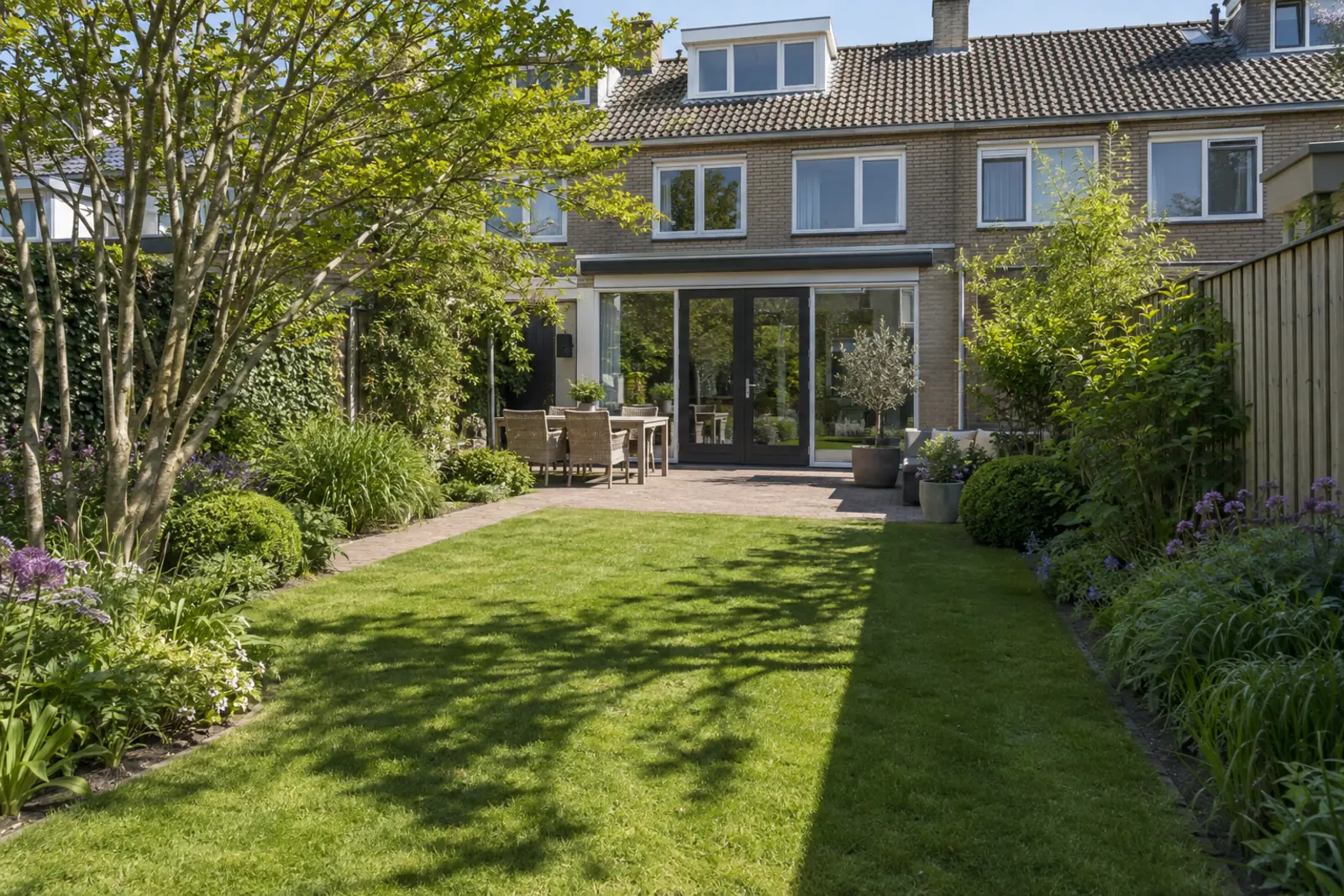
A garden sun hours calculator works out how many hours of direct sun one spot gets on a chosen day. From your address, Tuinontwerp.app draws your plot to scale with the buildings and their heights around it. On that plan it works out the sun on each spot for 15 May: a figure per spot, not a general sun chart.
A general sun chart does not know your garden. It cannot tell how tall the house behind yours is, or where your fence meets the border. Those two things decide how much light is left over.
Which public data does the calculation start from?
The calculation starts from public registers, not from a photo of your garden. Your address goes to the PDOK Locatieserver, the address search of the Dutch government's geodata platform, which turns it into a coordinate. With that point the app fetches your plot from the cadastral map, through PDOK. The building volumes from 3DBAG are added after that.
3DBAG combines the building outlines from the BAG, the national register of addresses and buildings, with the heights from the AHN, the national elevation map. The whole dataset is published under CC BY 4.0. The December 2024 release counted over 10.7 million buildings with a 3D model, each with a roof height.
Those two sources do not move at the same pace. PDOK updates its BAG service daily. 3DBAG comes out in separate releases: on 22 September 2026 the newest one carried version number 2025.09.03, from September 2025. If the house behind yours was built recently, its 3D volume may still be missing. The app then assumes less shade than actually falls.
Everything else that casts shade comes from the garden itself. The property line counts automatically as a wall of 1.8 metres, even before you have drawn anything. A fence you draw is also 1.8 metres by default. A shed or pergola is 2.5 metres high by default. Paths and terraces lie on the ground and cast no shade. Plants you place do cast shade, in the months their leaves are out.
How much sun does my garden get in a day?
That depends more on the distance to whatever stands south of you than on which way the garden faces alone. A bare worked example with nothing but a six-metre house shows how strongly this works. An open spot there gets about 15.5 hours of sun on 15 May. One metre behind the house, about 7.3 hours remain. Three metres back from the house, the figure is back to about 10.0 hours.
Those three figures belong to one free-standing house, with no property line, no fence and no plants. They show the shape of the calculation, not what your garden gets. In a real garden the property line alone takes hours away from every point close to it.
The app works through the whole day in ten-minute steps. At each step it checks whether the sun reaches that point, then adds up the hits. The answer is an upper bound: at most this much sun, never more.
Those hours fit the three bands on a plant label. According to the RHS, the Royal Horticultural Society in the United Kingdom, more than six hours counts as full sun and three to six hours as partial shade. Less than three hours is shade. The app uses the same limits.
| Band | Hours of direct sun |
|---|---|
| Full sun | 6 or more |
| Partial shade | 3 to 6 |
| Shade | less than 3 |
If you would rather count the hours in the garden yourself, that method is in how to measure sunlight in your garden. If you only want the sun hours of your own plot, the sun hours calculator works them out spot by spot, for every month of the year.
Why does the calculation use 15 May?
Because every deciduous tree in the app's plant list is in leaf in May. On the spring equinox that same tree would stand bare and cast no shade. The shade your garden really lives with in summer would then stay out of view. Mid-May is also the cautious reading of when the Dutch growing season starts.
That day has over an hour less daylight than 21 June, the longest day of the year. The app applies the limits of six and three hours to that shorter day on purpose, because a cautious result is more useful than a flattering one. You do not need to scale the six- and three-hour limits up to 21 June yourself.
The canvas works differently. Its time slider starts at 21 June, 12:00, so you can watch the shadows move. The sun hours figure is something else: a total over a whole day.
What does the calculation leave out?
Your neighbours' tree is not part of the calculation. The app counts only the buildings from 3DBAG, your property line and whatever you draw yourself. Anything outside that casts nothing. The same goes for the neighbours' hedge, and for a shed too small to be in the BAG.
The ground is one flat plane, so differences in height and a sloping bank are left out. Weather does not count either. The app uses only the position of the sun in the sky, so a week of rain does not change the figure.
That is why the result is an upper bound. Your garden gets at most this many hours, and in practice often fewer. Use the figure to compare spots with each other, not as a promise about one spot.
The geometry itself comes from cadastral and elevation data and is accurate to within decimetres. That is the scale at which to read the result. For a border that is plenty. For setting out a foundation it is not. More on light in the garden is in the sun and shade section of the blog.
From a sun hours figure to a plant choice
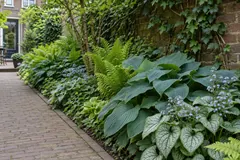
A sun hours figure is only worth something when it changes what you plant. Lavender is in the app's plant list as a species for full sun. A blue-leaved hosta is listed for partial shade and shade. If a bed reaches six hours, lavender fits. If it stays below that, the hosta is the better choice. Which shade plants suit which number of hours is in north-facing garden plants, by hours of sun.
Put a plant in a spot that is too dark for it, and the app tells you. The opposite warning, too much sun, is calculated but not yet shown in the interface. So do not count on the app to say anything about a spot that is too bright. For now you judge that side yourself, with the sun hours figure beside it.
You start at the address field at the bottom of this page. The app draws your plot to scale with the buildings around it, and you place your terrace, borders and plants on it, each plant at a grown plant's width. On that plan you see the most sun each spot can get on 15 May, worked out for your plot and not for an average garden. Designing on your own plot is free.
Frequently asked questions
How many hours of sun count as full sun?
Six hours or more of direct sunlight a day counts as full sun. Three to six hours is partial shade, and less than three hours is shade. Tuinontwerp.app uses the same three bands to match plants to each spot.
Can I work out my garden's sun hours without measuring them myself?
Yes. From your address, Tuinontwerp.app draws your plot to scale with the building heights from 3DBAG around it, and works out the shade on each spot of that plan. The result is an upper bound: at most that much sun, and in practice often less.
Which day does the sun hours figure apply to?
To 15 May. Every deciduous tree in the app's plant list is in leaf in May, so the shade of your own planting counts. The time slider on the canvas is a separate thing: it starts at 21 June at 12:00.
Does my neighbour's tree count in the calculation?
No. The app uses only the buildings from 3DBAG, your property line and what you draw yourself. Anything outside that casts no shade, so in practice your garden gets less sun than the figure shows.