8 min read
Measure sunlight in your garden: count sun hours per spot
Measure sunlight in your garden on a clear day in mid-May: one stake per spot, a tally mark every hour. More than six marks is full sun, under three is shade.
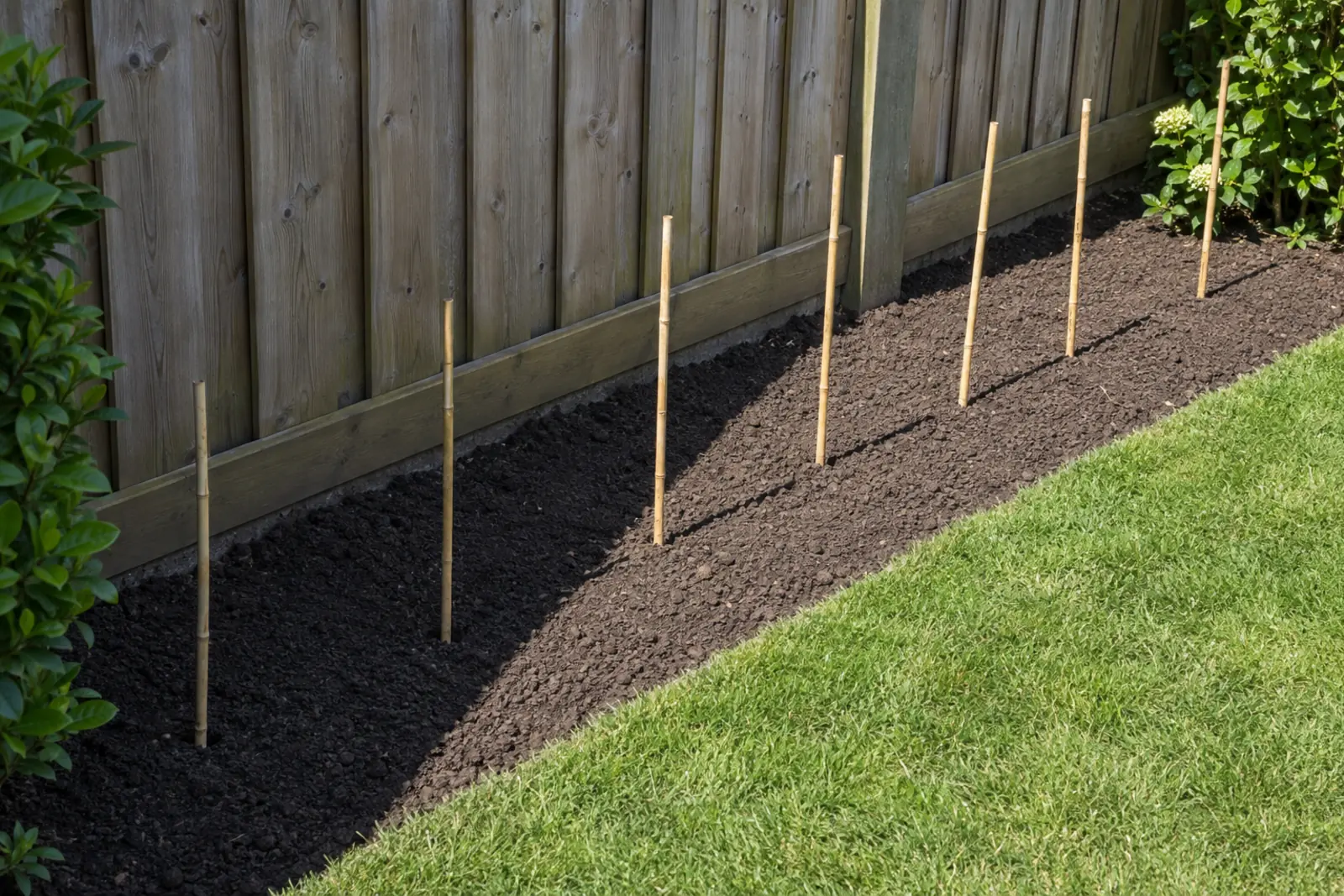
To measure sunlight in your garden, put a stake in every spot you want to plant and pick one clear day around mid-May. Walk past the stakes on the hour and make a tally mark when the foot of a stake is in the sun. The number of marks is that spot's hours of direct sun.
An estimate by eye catches one moment of the day. A border in full sun around noon can lie in the shade of the neighbours' shed later in the afternoon. An hourly count sees both moments, and the result fits the three bands printed on a plant label.
What do you need to count sun hours?
A cloudless day around mid-May, one stake per spot, a sheet of paper and a pencil. Garden stakes or bamboo canes half a metre long work well. They are tall enough to see from the patio and thin enough not to shade the spot next to them.
Mid-May is not a random choice. The trees are in leaf by then, so you measure the shade your plants live with all summer. The sun hours calculation from cadastral data uses the same day, so your count and the app describe the same day. If you want an estimate before you start counting, the sun hours calculator works out spot by spot how many sun hours your plot gets at most.
Wait for a day without clouds. A cloud that hangs in front of the sun for an hour costs every stake a mark, and then you are measuring the weather instead of your garden. According to the KNMI, the Dutch national weather service, the sun shone at De Bilt for an average of 217.5 hours in May (1991-2020). That is 44.8 per cent of the longest possible time. In an average May, more than half of the possible sun is lost behind cloud.
Clear days are rare as a result. The KNMI counts an average of 5 days in May at De Bilt on which the sun shines for at least 80 per cent of the possible time. Keep an eye on the forecast and put the stakes out the evening before. If May brings no clear day, take one in June. The trees are still in leaf then. The day is longer, though, so write the date next to your count.
How to count the sun hours for each spot
Counting takes one day of rounds, in this order:
- Put a stake in every spot you want to plant, and one where you sit most often. Give each stake a number.
- Draw the garden on paper, with the house, the fences and the stake numbers.
- Start at sunrise. On 15 May the sun rises in Utrecht at 5.45 and sets at 21.27.
- Walk past every stake on the hour. If the foot of a stake is in the sun, put a tally mark next to its number.
- Not sure? Look at the shadow of the stake itself. A sharp shadow means direct sun. No shadow, or only a faint smudge, means the stake is in shade.
- After sunset, add up the marks for each stake. That figure is the number of hours of direct sun on that spot.
Between sunrise and sunset there is room for sixteen rounds on the hour, from 6.00 to 21.00. A spot that has sun all day therefore scores sixteen marks. That matches the day length of 15 hours and 41 minutes closely.
Not at home all day? Put your phone in a fixed spot and let a timelapse app take a photo every hour. Check first that every stake is in the frame. Afterwards, count for each stake the photos in which its foot is in the sun.
An hourly round misses what happens between two rounds. A stake that ends up on two, three, five or six marks sits close to one of the boundaries on the plant label. Walk those stakes every half hour on the next clear day, and count two half marks as one hour.
Where should the stakes go?
Put them where the shade changes, not only in the middle of the border. Three spots always deserve a stake: the strip right behind the house, the foot of the fence and the back of the garden. The fence matters at all three, as the two example gardens below show.
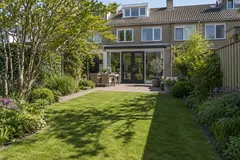
The app treats every property line as a wall of 1.8 metres, even if you draw nothing. Two worked examples from tuinontwerp.app show what that wall does. The terraced house stands in a row of seven houses six metres high, on a plot of 5.5 by 20 metres with 12 metres of garden behind the house. The spacious plot has a detached house six metres high at the front of a 20 by 20 metre plot, also with 12 metres of garden behind it. Both were calculated with the property line in place:
| Spot | Garden | Sun, approximately |
|---|---|---|
| 1 metre behind the house | terraced house | 0.0 hours |
| 3 metres behind the house | terraced house | 2.0 hours |
| 8 metres behind the house | spacious plot | 13.2 hours |
| Half a metre from the rear boundary | spacious plot | 11.0 hours |
With the buildings alone, the spot one metre behind the terraced house would still get just over six hours. The property line takes away the whole day there. North-facing garden plants, matched to their sun hours explains why that strip is so dark in a narrow garden.
On the spacious plot, the spot just in front of the rear boundary is darker than the spot eight metres behind the house. The last metres towards the back cost over two hours there. In mid-May the sun rises north of east and sets north of west. On that plot, this early and late sun comes in over the rear fence, and the fence holds part of it back. So count the first and the last round of the day as well, and put a stake just in front of the rear boundary.
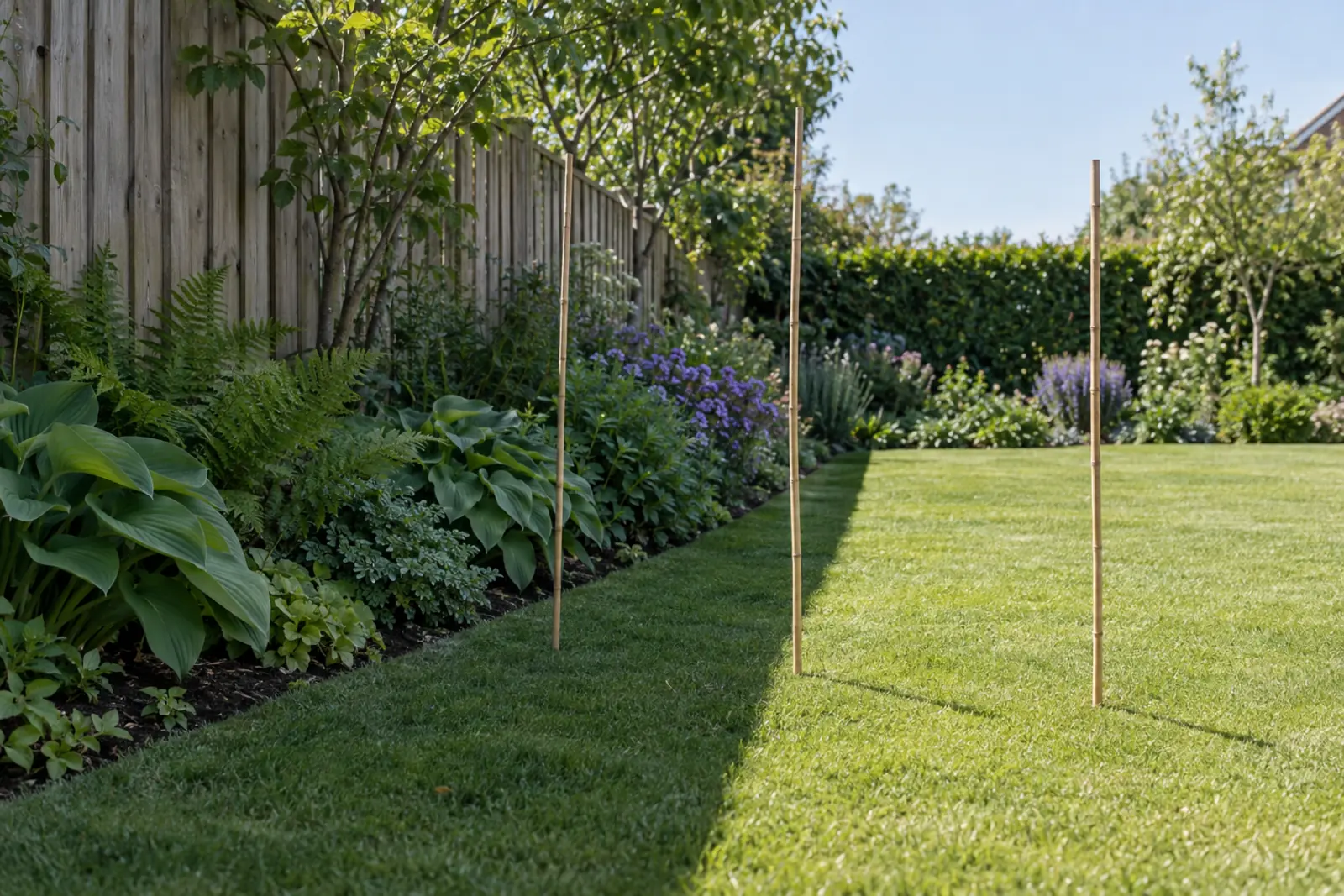 An example, not a measurement: the shadow of a fence has a sharp edge. A stake on each side of it shows how far the shadow moves each hour.
Along a side fence, the edge of the shadow runs as a sharp line across border and lawn. Put a stake on each side of that line, because one metre can move a spot into a different band on the plant label.
Those figures belong to two example gardens, not to yours. Tuinontwerp.app draws your own plot to scale and works out the same figures on it, spot by spot. That shows you in advance where the shade falls and where a stake will tell you the most.
Is a spot full sun or partial shade?
Set the number of marks beside the band on the plant label. The limits in the table come from the RHS, the Royal Horticultural Society in the United Kingdom, and the app uses the same ones.
| Tally marks | Band on the label |
|---|---|
| More than 6 | Full sun |
| 3 to 6 | Partial shade |
| Fewer than 3 | Shade |
Those limits are meant for midsummer. In mid-May the day is shorter than at the end of June, so a count in May comes out on the tight side rather than the generous one.
For each stake, also note when its marks fall. Midday sun gives far more light than morning or evening sun. Six marks between noon and six in the evening are therefore worth more than six marks that all fall before midday. A plant for full sun does better in the first spot.
North-facing garden plants and the other posts on sun and shade match each species to the hours it needs. Once each stake has a figure, you can make a planting plan bed by bed instead of for the garden as a whole.
How does your count compare with the app's sun hours?
A count with stakes sees everything that stands in your garden. The neighbours' tree counts, their hedge too, and the shed that is too small to be registered. The app uses the buildings from 3DBAG, the open dataset of measured building heights for the Netherlands, plus your property line and whatever you draw yourself. Anything outside that does not count for the app.
So put the two side by side. If a stake has fewer marks than the hours the app gives, something the app does not know about stands between the sun and that spot. Look for a tree or a hedge beyond your property line. If a stake close to the property line has more marks instead, look at your fence. When that fence is lower than the 1.8 metre wall the app assumes, or there is no fence at all, that spot gets more sun than the app shows.
Your stakes give you six or ten figures in one day. The plan gives you the whole garden. Start at the address field at the bottom of this page: the app lays out your plot to scale, with the houses around it. On that plan you draw your patio, borders and plants, each plant at a grown plant's width. For each spot you see the most hours of sun it can get, and you set your tally marks beside them plant by plant. Designing on your own plot is free.
Frequently asked questions
How do I measure how much sun my garden gets?
Put a stake in every spot you want to plant, and on a cloudless day around mid-May walk past on the hour, marking a stake whenever its foot is in the sun. The number of marks is the number of hours of direct sun on that spot. From your address, Tuinontwerp.app draws your plot to scale and works out those hours for each spot on it. The neighbours' trees are not part of that, and the property line counts as a wall of 1.8 metres.
How many tally marks does a spot need to count as full sun?
More than six. According to the RHS, more than six hours of direct sun a day in summer is full sun, three to six hours is partial shade and less than three hours is shade.
When is the best time to measure the sun in a garden?
On a cloudless day around mid-May, when the trees are in leaf. Such days are rare: according to the KNMI, De Bilt averages 5 days in May on which the sun shines for at least 80 per cent of the possible time (1991-2020).
Can I measure the sun in my garden when I'm not at home?
Yes. Put your phone in a fixed spot with every stake in view, and let a timelapse app take a photo every hour. Afterwards, count for each stake the photos in which its foot is in the sun.
Why does the strip right behind my house get so little sun?
In a worked example in tuinontwerp.app, with a row of seven terraced houses six metres high, the cause is the fence and not the house. A spot one metre behind the house gets just over six hours of sun there with the buildings alone, and 0.0 hours once the property line counts as a wall of 1.8 metres.