8 min read
North-facing garden plants, matched to their sun hours
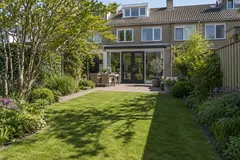
North-facing garden: in a worked example with terraced houses, the strip 1 m behind the house gets 0 hours of sun on 15 May. Shade plants for it, by sun hour.
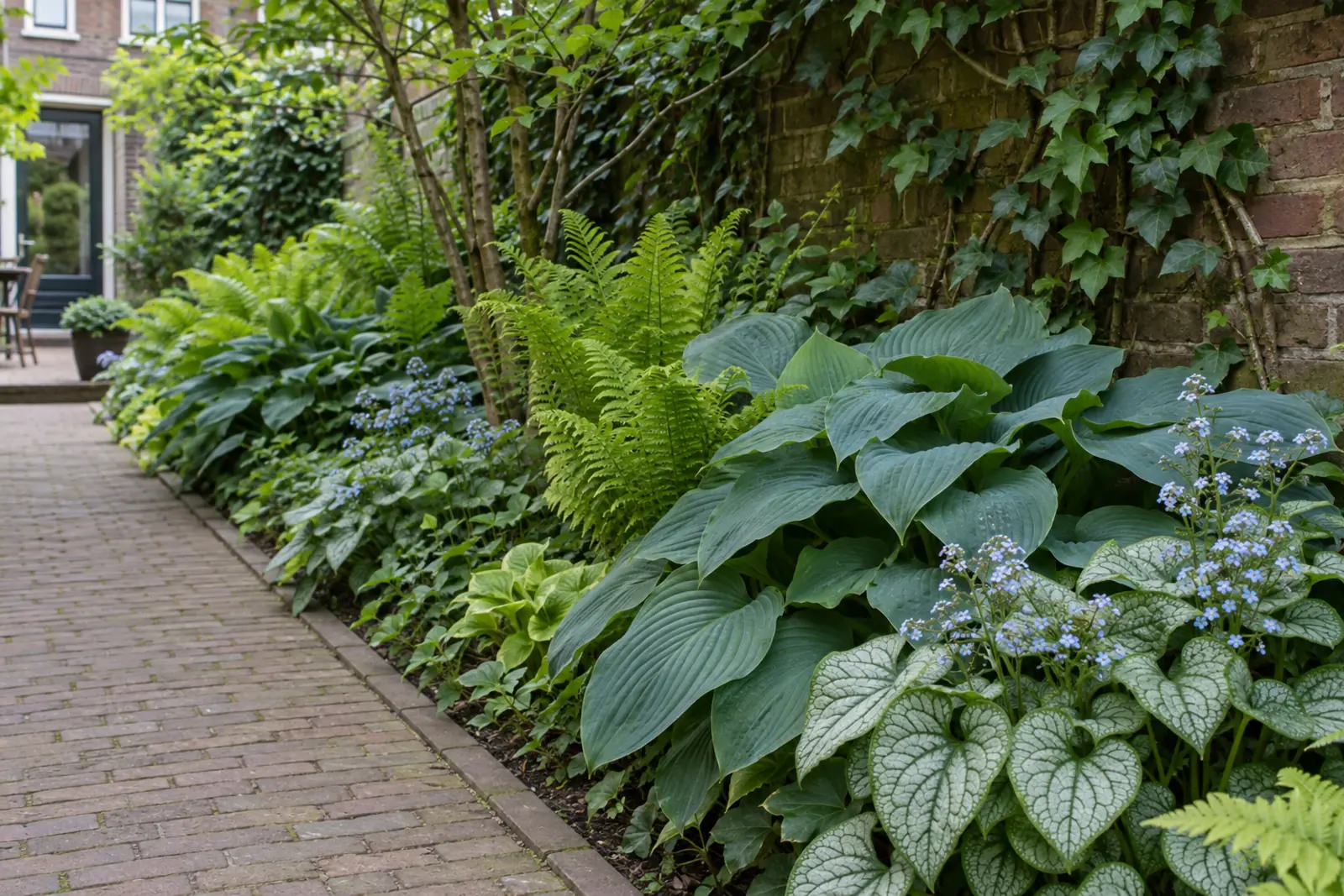
A north-facing garden has the house between it and the midday sun. In a worked example with terraced houses and a property line, the strip one metre behind the house gets 0.0 hours of sun. Brunnera, the fern Dryopteris erythrosora and ivy fit there. The hosta wants more light. Tuinontwerp.app shows your plants on a plan of your own plot.
That one strip says nothing about the rest of the garden. So each species below comes with the number of hours it suits.
How much sun does a north-facing garden get?
That depends on the spot. Three worked examples from tuinontwerp.app show how much, all for 15 May. Why that date, and how the app works it out, is in a garden sun hours calculator that starts from your address.
The first is bare: one detached house six metres high, with no property line and no neighbours. A spot six metres behind that house gets all of that day's daylight there: about 15.5 hours, as much as an empty field. The position of the sun explains it. In mid-May the sun rises north of east and sets north of west. Only around midday does the house cast its shadow due north. For the rest of the day the sun shines round the sides of a free-standing house.
A garden is not an empty field. The app always treats the property line as a wall of 1.8 metres, on every side of the plot. It is precisely the low sun from the north-east and the north-west that this wall blocks. The two other worked examples show what that costs. The terraced-house garden sits in a row of seven houses six metres high, on a plot 5.5 metres wide. The wide plot measures twenty by twenty metres, with one detached house six metres high.
| Spot, on 15 May | Buildings only | With the property line |
|---|---|---|
| Terraced-house garden, 1 m behind the house | about 6.5 h | 0.0 h |
| Terraced-house garden, 3 m behind the house | about 9.5 h | about 2.0 h |
| Wide plot, 8 m behind the house | 15.5 h | about 13.2 h |
| Wide plot, 0.5 m in front of the rear boundary | 15.5 h | about 11.0 h |
Full sun starts at six hours, and shade means less than three hours. With the property line in place, both spots in the terraced-house garden are in shade. Both spots on the wide plot are in full sun.
Which shade plants suit a north-facing garden?
Four species in the app's plant list are marked for shade. The table sets them against three spots from the worked examples: one and three metres behind the terraced house, and eight metres behind the house on the wide plot.
| Species | Light in the app | Terraced house, 1 m: shade | Terraced house, 3 m: shade | Wide plot, 8 m: full sun |
|---|---|---|---|---|
| Blue-leaved hosta | partial shade, shade | fits, prefers more light | fits, prefers more light | too sunny, the app does not flag it |
| Brunnera 'Jack Frost' | partial shade, shade | fits | fits | too sunny, the app does not flag it |
| Dryopteris erythrosora | partial shade, shade | fits | fits | too sunny, works if the soil is moist |
| Ivy | sun, partial shade, shade | fits | fits | fits |
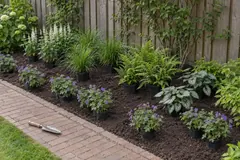
The app lists the blue-leaved hosta for shade as well. The RHS, the Royal Horticultural Society in the United Kingdom, gives it partial shade only: three to six hours of sun. Neither spot in the terraced-house garden reaches that. Plant the hosta where your garden gets between three and six hours, and give the darkest strip to brunnera, Dryopteris erythrosora and ivy.
Brunnera 'Jack Frost' stays low at 0.4 metres and flowers blue from April through June. The fern Dryopteris erythrosora grows to 0.6 metres and stays green all year. Ivy is the only one of the four that the app places in all three bands.
Those spots belong to worked examples, not to your plot. Tuinontwerp.app draws your own north-facing garden to scale, with your plot boundary and the buildings around it. On that plan the app works out the sun at every spot where you place one of these species.
Why is the strip behind the house so dark in a narrow garden?
In the terraced-house garden the property line causes it, not the house. The house alone leaves that strip in the sun. The two side fences of a plot 5.5 metres wide hold back the low morning and evening sun, which is exactly the sun the house left over. On that narrow plot the rear boundary therefore costs nothing extra.
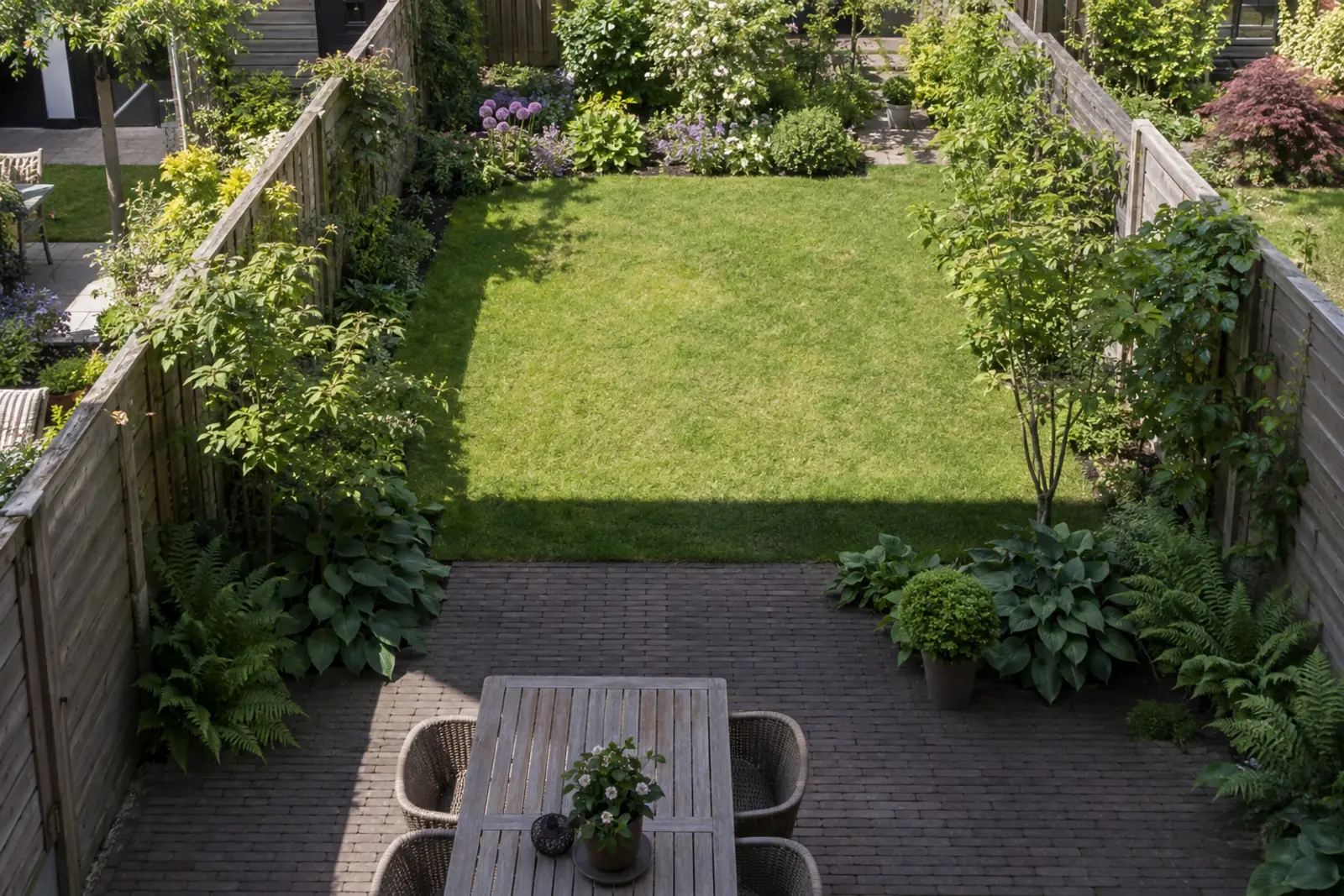 Illustration, not a calculation: in a narrow north-facing garden the property line puts shade over the strip behind the door and along both fences. How much lighter it gets further back was not measured in the worked example.
The wide plot works differently. There the side fences stand far away, and the rear boundary is the wall that counts. Half a metre in front of that boundary it is over two hours darker than eight metres behind the house. On the wide plot the back of the garden gets darker, not lighter.
For your border that means two things. In the terraced-house garden, the shade plants belong in the strip behind the house. Whether your own north-facing garden works out the same depends on the width of your plot and on the buildings around it.
So do not copy the sun hours for your strip from a worked example. Work them out spot by spot, or count them yourself on a sunny day, as how to measure sunlight in your garden describes. The sun hours calculator does the working out for your own plot, and sun hours in a north-facing garden puts the hours by distance from the house in a table.
What grows in the sunny spots of a north-facing garden?
A wide north-facing garden, with the side fences far from the house, can also have spots in full sun. On the wide plot, the spot eight metres behind the house is in full sun, property line included.
Hosta and brunnera do not belong there. The app lists both for partial shade and shade, so a spot like that is too sunny for them. The app does calculate that difference but does not flag it yet: only a spot that is too dark for a plant gets a warning. So check a hosta in a sunny spot yourself, with the sun hours figure beside it. The app's plant list also has the hosta down as needing a lot of water.
Dryopteris erythrosora sits in between. The app does not list the fern for sun, but in soil that stays moist it does grow there. Play safe and keep it out of the sunny spot.
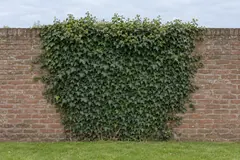
Ivy fits all three spots from the worked examples. The app lists it for sun, partial shade and shade. Ivy tolerates a remarkable amount of shade and also grows well in full sun. A climbing ivy hides a bare wall or shed, and gives other planting a green backdrop all year. Ivy is toxic; what that means is covered in common ivy: where it grows, pruning and what it feeds.
A wide north-facing garden can get two borders this way. Where it stays under three hours, a shade border goes in with brunnera, Dryopteris erythrosora and ivy, and the hosta gets the spots between three and six hours. Where it reaches six hours, a border for full sun goes in. A planting example for that sunny part, with cranesbill and sage, is in how to make a planting plan. More on light in the garden is in the sun and shade section of the blog.
Designing your own north-facing garden
Start at the address field at the bottom of this page. Tuinontwerp.app draws your plot to scale from the cadastral map, through PDOK, the Dutch government's geodata platform. Around it go the buildings from 3DBAG, the open dataset of measured building heights for the Netherlands. On the plot you place your borders and plants, each at a grown plant's width: brunnera, Dryopteris erythrosora and ivy in the dark strip, the hosta where it gets lighter. Each plant shows the most sun its spot can get, with your property line counted as a wall of 1.8 metres. Put one in too dark a spot and the app tells you. Designing on your own plot is free.
Neighbours' trees and hedges do not count. Nor does the weather: the app works from the position of the sun, not from clouds. According to the KNMI, the Dutch national weather institute, the sun shone in De Bilt for an average of 217.5 hours in May, over the years 1991 to 2020. That is 44.8 percent of the longest possible time. So the app's figure is an upper bound: at most that much sun, in practice often less. The geometry comes from cadastral and elevation data and is accurate to decimetres, not centimetres.
Before you buy a single plant, you then know which species goes in which strip of your own garden.
Frequently asked questions
What plants grow in a north-facing garden?
Brunnera 'Jack Frost', the fern Dryopteris erythrosora and ivy: the tuinontwerp.app plant list and the RHS both put all three in shade. The RHS places the blue-leaved hosta in partial shade, on a spot with three to six hours of sun. The app shows which spots in your own garden stay under three hours once you place your plants on your plot.
Does a north-facing garden get no sun at all?
Not everywhere. In a bare worked example with nothing but a six-metre house, a spot six metres behind that house gets about 15.5 hours of sun on 15 May, while in a worked example with terraced houses and a property line the strip one metre behind the house gets 0.0 hours. Tuinontwerp.app draws your own plot to scale and works it out per spot on it, as an upper bound without the neighbours' trees and without clouds.
Does the shadow of the fence count in the calculation?
Yes. The property line always counts as a wall of 1.8 metres, even if you draw nothing. In a worked example with terraced houses, one metre behind the house that is the difference between about 6.5 hours with the buildings alone and 0.0 hours with the property line added.
Does the app warn me when a shade plant gets too much sun?
No, only when a spot is too dark for the plant you put there. The app does calculate too much sun, but that warning is not shown yet. So judge a hosta in a sunny spot yourself, with the app's sun hours figure beside it.