7 min read
January garden jobs, and the right spot for each
January garden jobs: pruning, bare-root planting and looking at your garden's structure, with the spot each job deserves in the growing season.
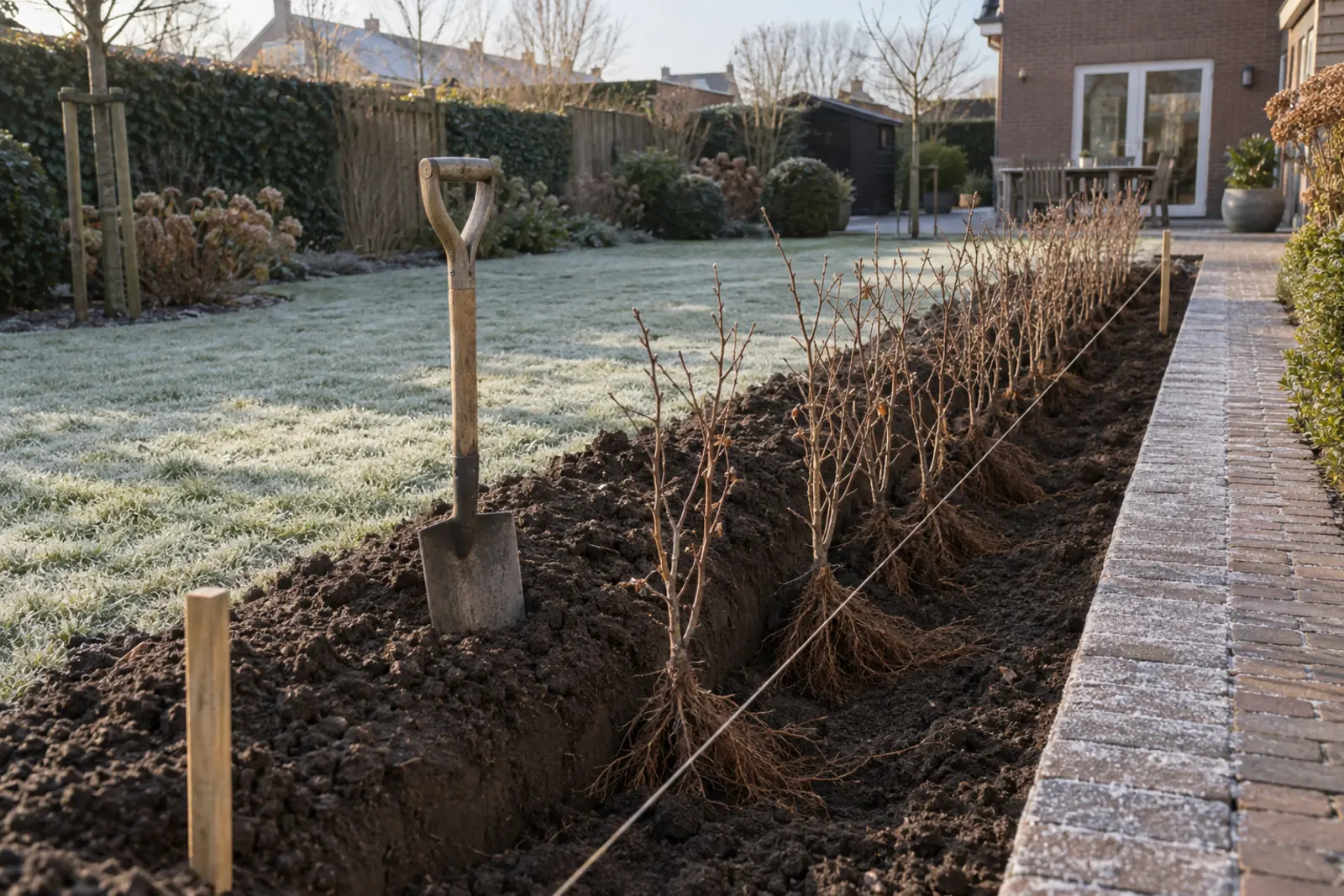
January garden jobs come down to three. Prune apple and pear while they are dormant. Plant bare-root trees and hedges, which are sold without a pot or root ball. And look at the fixed shapes your garden keeps through the winter. Do not choose the spot for a new tree by January light.
At De Bilt the sun shone for an average of 66.6 hours in January and 217.5 hours in May. Those are the averages of the KNMI, the Dutch national weather institute, for the years 1991 to 2020. The light you judge a spot in now is not the light the plant will grow in.
What should you do in the garden in January?
Three jobs belong in January: pruning, bare-root planting, and seeing what stays upright through the winter. Leave the hydrangea and the box alone. The table gives each job its timing, the thing to watch and the spot it needs.
| Job | When | Watch out for | Which spot |
|---|---|---|---|
| Pruning apple and pear | While dormant, usually November to early March | No more than 10 to 20 percent of the canopy | The tree is already there; look where its crown falls in May |
| Planting a bare-root tree or hedge | On sale from November to March | Not in frozen or waterlogged soil | Fruit tree: full sun, six hours or more |
| Hydrangea | Leave the faded flower heads, prune in early spring | The heads protect the buds from frost | Partial shade, three to six hours |
| Box | Trim in August | Yellow leaf tips in winter usually come from cold | Full sun, partial shade or shade |
Two smaller jobs go with them:
- Pruning wisteria. In January or February, cut the side shoots you shortened in summer back to two or three buds.
- Feeding birds. When it freezes, put out fresh food and water every morning before sunrise.
The weather decides which days are any use. The KNMI figures for De Bilt count an average of 12.0 days in January when the temperature drops below zero. On 2.6 days it stays below zero all day. Frozen ground is no place to plant, so save the planting for a day when the spade goes in.
If you cannot plant a bare-root tree straight away, heel it in for the time being: lay the roots in moist soil, firm the soil down and water it. That keeps the roots from drying out until you can plant.
Why not choose a planting spot by January light?
Because the shade in January is not the shade of summer. A deciduous tree stands bare now and lets light through. In May its crown is full and casts shade.
So a plant in your design casts shade as a crown, in the months it carries leaves. An evergreen plant does so all year. Tuinontwerp.app works out sun hours for 15 May, and why that day was chosen is explained in garden sun hours, calculated per spot from your address.
Where should you plant a bare-root tree?
A fruit tree belongs in full sun, with room for its branches to spread. Which spot reaches six hours depends on your plot. In a worked example with terraced houses, a spot three metres behind the house keeps only about 2.0 hours, because the fences cut off the low sun. How that works is set out in north-facing garden plants, matched to their sun hours.
Think as well about what a new tree will do itself. A tree you plant now as a thin whip grows to its mature size. Put it on the plan of your own garden, and it stands there at a grown plant's width, among your terrace, your borders and the houses around it. The shade of that crown counts as well.
Two things matter for the planting itself. Soak the roots in water for about 30 minutes before planting. You can plant from October to April, as long as the spade still goes into the ground.
Which plants should you prune in January?
Apple and pear, yes; the hydrangea, no. Winter pruning of apple and pear belongs in the dormant period, after leaf fall and before the buds break.
Do not take off too much at once. Prune harder than the routine 10 to 20 percent and the tree answers with a mass of upright shoots, known as watershoots.
January is also the time to look at that crown. Right now you can see exactly where the branches are. In May they carry leaves, and those leaves cast shade. Before you put a new plant nearby, check what that spot gets in the growing season.
Leave the hydrangea alone. Its faded flower heads protect the young buds beneath them from frost. In early spring, cut the stem back to the first strong pair of buds below the old flower.
On where a hydrangea should go, the sources differ. The app's plant list puts Hydrangea macrophylla in partial shade and shade. The RHS, the British horticultural society, recommends full sun and partial shade. Choose the band where both meet: partial shade.
Full sun is not listed for the hydrangea in the app's plant list. You get no warning in such a spot, though: the app only flags a spot that is too dark. A hydrangea in the sun is yours to check.
Judging your garden's structure: what still stands in January?
What stands in January is the fixed structure of your garden: the fence, the houses around it and the evergreen shrubs. In the plan of your garden they count all year. A fence you draw, the buildings from 3DBAG and evergreen plants cast shade in every season. 3DBAG is the open dataset of measured building heights for the Netherlands.
Box is the clearest example. The app gives it leaves in all twelve months, a height of 1.0 metre and a crown 1.0 metre wide. Box suits any spot: full sun, partial shade and even deep shade. In full sun it needs soil that stays moist, or the leaves scorch.
Do not trim it now. Mature box is trimmed in August, once the new shoots have firmed up. Yellow leaf tips in winter usually come from the cold. Box is very toxic, especially the bark and the leaves, and that includes dogs, cats and horses.
Walk through the garden once in January, looking for those fixed lines. Where are the box balls, the hedge and the fence? In a bare garden they show most sharply. Write them down, because your new planting will go around them. More on light through the seasons is in the seasons section of the blog.
Your January jobs on a plan of your own garden
Put this month's jobs on a plan of your own garden. Type your address into the address field at the bottom of this page. Tuinontwerp.app lays out your plot to scale from the cadastral map of the Kadaster, the Dutch land registry, through PDOK, the Dutch government's geodata platform. The buildings from 3DBAG stand around it. On that plan you draw your terrace and your borders, and place the fruit tree, the hydrangea and the box balls in the spots you chose in January. Drawing on your own plot costs nothing.
Each plant shows the most sun its spot gets on 15 May. Your neighbours' trees and hedges are not in that calculation, and neither is the weather. So the figure is an upper bound, and the measurements are right to within decimetres, not centimetres. Before your first planting day, you can see whether the fruit tree has room and light enough where you put it.
Frequently asked questions
What should I do in the garden in January?
Prune apple and pear while the tree is dormant. Plant bare-root trees and hedges, sold without a pot or root ball, as long as the ground is not frozen or waterlogged. Leave the faded flower heads on your hydrangea. Box is not trimmed until August.
Can you prune a hydrangea in January?
No. Leave the faded flower heads on over winter, because they protect the buds beneath them from frost. In early spring, cut back to the first strong pair of buds below the old flower.
How much sun does a fruit tree need?
Six hours or more of direct sun. A fruit tree belongs in full sun, and in the sun hours calculation of tuinontwerp.app full sun starts at six hours. Put the tree on the plan of your own garden, among your terrace, your borders and the buildings around it. That spot then shows the most sun it gets on 15 May. Designing on your own plot is free.
Why does tuinontwerp.app not calculate with the January sun?
Because a bare tree in January casts none of the shade your garden gets in summer. The plan of your garden therefore calculates for 15 May, a day on which every deciduous tree in the app's plant list is in leaf. Each plant then shows what its spot gets in the season it grows in.
Sources (11)
- KNMI — De Bilt, langjarige gemiddelden, tijdvak 1991-2020
- RHS — Apples and pears: winter pruning
- RHS — Trees and shrubs: planting guide
- RHS — Hydrangea pruning guide
- RHS — Hydrangea macrophylla
- RHS — Box, growing guide
- Gardeners' World — Plant nu een fruitboom met kale wortels
- RHS — Wisteria pruning guide
- Vogelbescherming — Help vogels bij winterse omstandigheden
- NDFF Verspreidingsatlas — Buxus sempervirens
- ASPCA Animal Poison Control — Boxwood