6 min read
Common yew: where it grows, pruning and poison
Taxus baccata
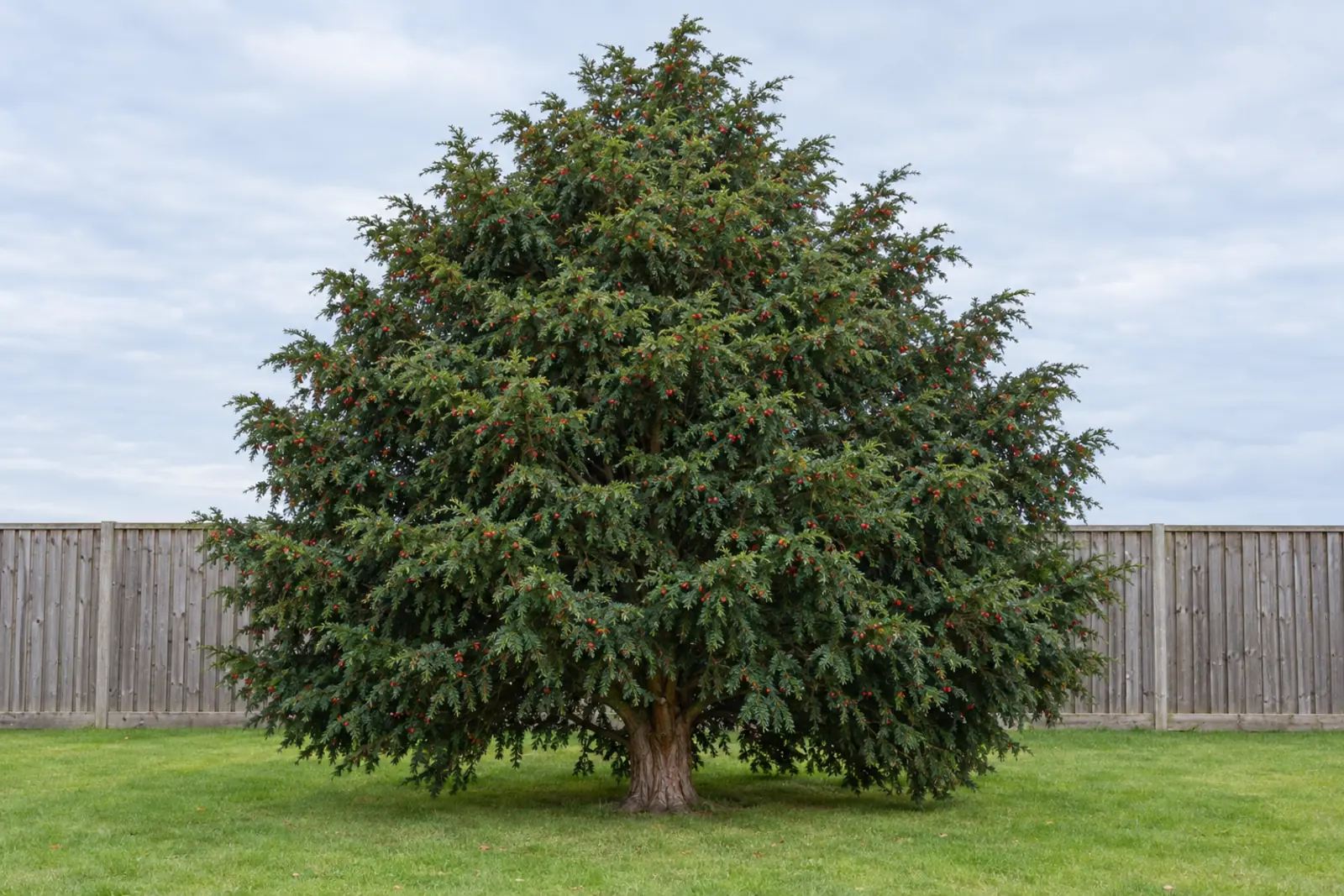
Common yew (Taxus baccata) is a native conifer that stays green all year. The tree grows slowly, up to 18 metres tall, and clips well into a hedge. Yew grows in sun and even in deep shade, but not in wet soil. Female trees bear red berries in September and October. Almost every part of yew is poisonous.
Common yew at a glance
| Feature | Common yew |
|---|---|
| Height | 3 to 18 m |
| Spread | 8 to 12 m |
| Full grown after | 20 to 50 years |
| Sun | Full sun to full shade |
| Soil | Any soil that drains well |
| Water | Average |
| Maintenance | Low: no pruning needed |
| Flowers | March to May, yellow, inconspicuous |
| For bees | Yes: pollen, March to May |
| Hay fever | Not or weakly allergenic |
| Leaves | Stay green |
| Hardy | Yes |
| Native | Yes |
| Poisonous | Yes: everything except the red berry flesh |
| Pricks or stings | No |
| Price, young | About €5 to €11 each, 40-60 cm, in a pot or with a root ball |
| Price, grown | About €43 to €80 each, 150-200 cm, with a root ball |
- Leaf
- all year
- Flower
- March to May
- Fruit
- September to October
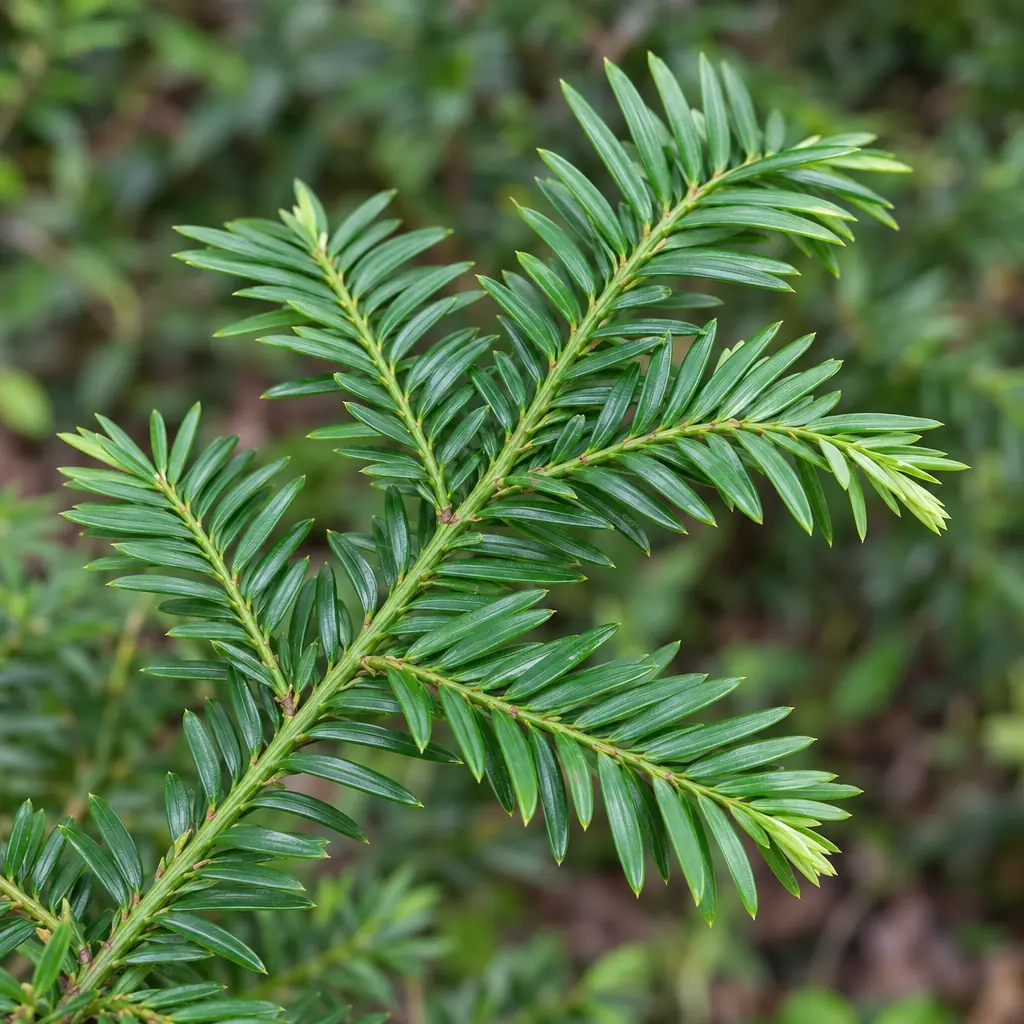
Leaf 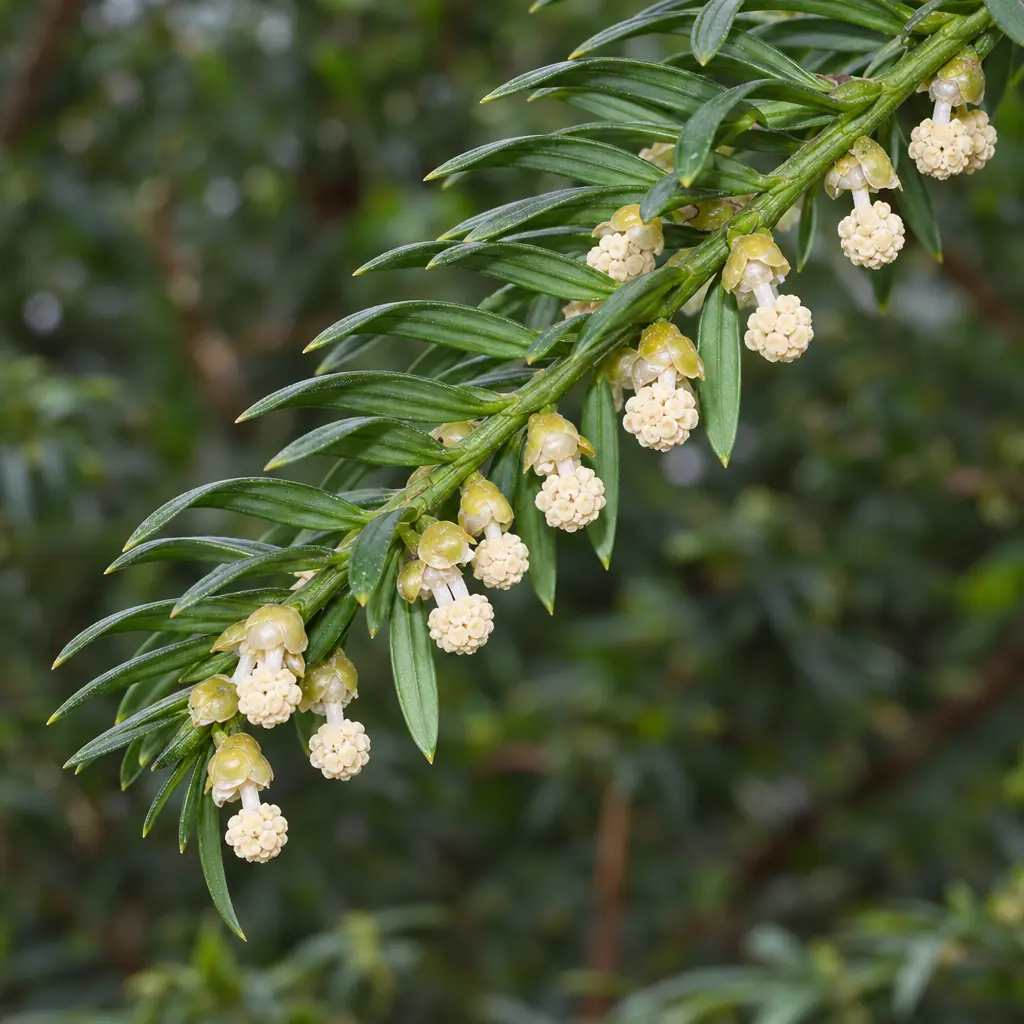
Flower 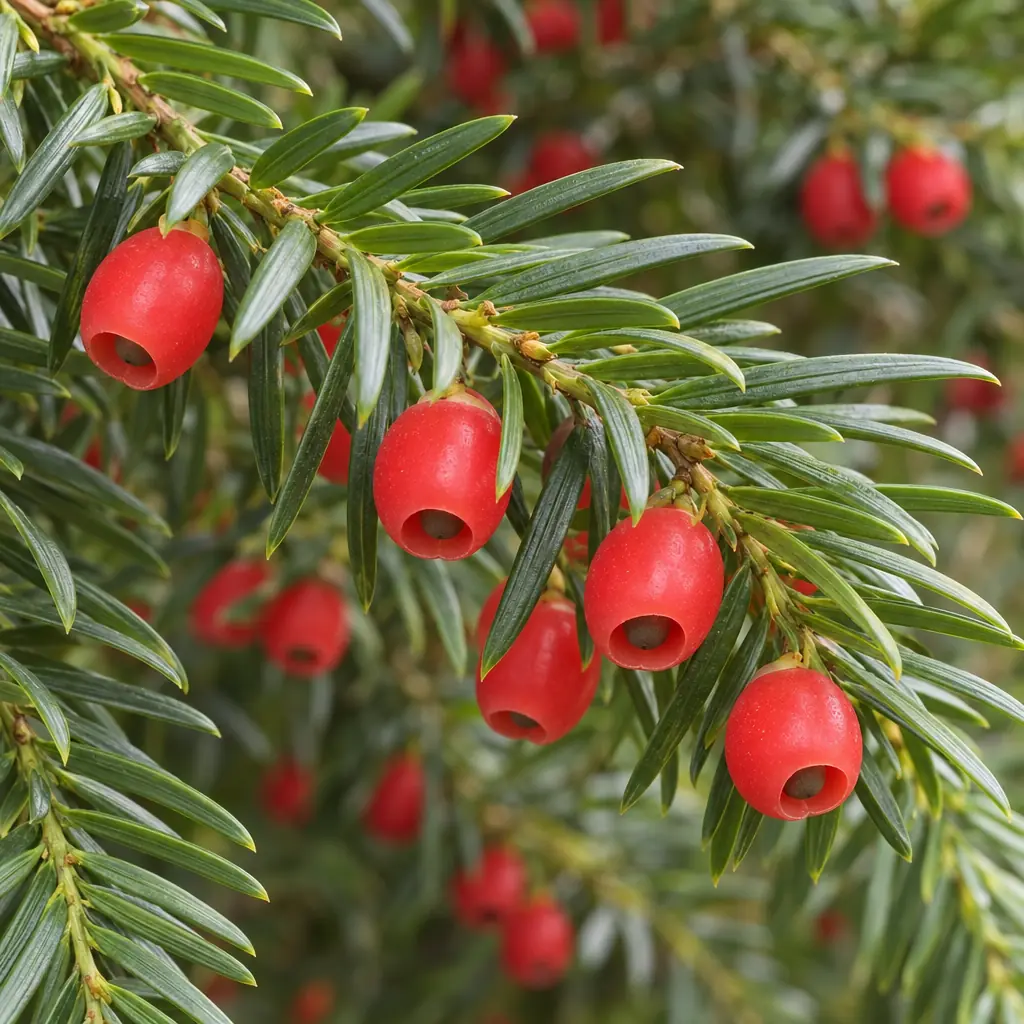
Fruit
How do I recognise common yew?
Start with the needles. Each one is 1 to 1.5 centimetres long, flat and pointed. The upper side is a glossy dark green, the underside paler. Along a side shoot the needles grow in two flat rows, like the teeth of a comb. Young shoots are bright green and turn brown in their second year. The bark is thin and flakes off, reddish brown at first and greyish brown later.
A yew tree is male or female, never both. A male yew bears small, pale yellow balls full of pollen. The female flowers are hard to spot. Each grows into a red, fleshy berry of about 1 centimetre, with one seed inside.
Note the difference from the Irish yew, a form of the same species. As a young plant the Irish yew grows narrow and upright, like a column. Its needles grow all round the shoot, not in two rows. Green shoots are what set yew apart from a spruce.
Where does common yew grow best?
Yew grows in full sun and in partial shade. Even deep shade works: a spot where the sun shines for less than two hours a day. Sandy, loamy, clay or chalky soil all suit it, as long as water can drain away. In the wild, yew grows in broadleaf woods and scrub. Wild yews grow in the Achterhoek region and in Limburg.
A yew declines, or becomes a risk, in these spots:
- Ground where puddles remain after rain. The roots then rot. On heavy clay, plant yew on a ridge at least 15 centimetres high.
- A planting hole in the middle of paving. Yew roots need well-aerated soil.
- Beside a field with horses, sheep or goats. For those animals, 100 to 200 grams of yew is enough to kill. So the clippings do not belong over the fence either.
In winter, yew keeps its dark green needles. A male tree already stands out then, with its yellow flower buds.
Left to grow freely, a yew takes up a lot of room. The app shows your own plot to scale, with the surrounding houses. On that plan you measure for yourself whether a free-standing tree has enough space around it. If it does not, yew fits better as a hedge along the property line.
Planting and caring for common yew
The best time to plant yew is from late October to mid-December, or in March. A potted plant can go in almost all year, except in frost or severe heat. A yew with a root ball, a ball of soil wrapped in cloth, usually costs less than a potted one. For a hedge, choose plants no more than 60 centimetres tall.
Plant a yew you leave to grow freely 4 to 6 metres from the fence. That is half the spread of a full-grown tree. The distance looks excessive at first, but the tree only fills it after many years. Keep it small with shears, and it can stand closer. Water regularly in the first year.
| When | What to do |
|---|---|
| Summer or early autumn | Trim a yew hedge or topiary once |
| When needed | On a free-standing tree, shorten a stray shoot; regular pruning is not needed |
| Mid-spring, three years running | Renovate an overgrown hedge: the top first, then one side each year, back into the old wood |
Many bird species breed from March through July, and a few start in February. Both the renovation and the summer trim fall in or just after that period. So look between the branches for a nest first.
What can go wrong with common yew?
The needles turn yellow or sparse, and branches die back. That can be root rot, a disease of heavy or wet soil. Yew is very susceptible to it. Improve the drainage. Often the problem still gets steadily worse until the tree dies.
A young yew wilts between autumn and spring. Vine weevil larvae may be eating the roots. In August or early September, apply nematodes against the larvae. Those nematodes tackle the next generation of larvae before it does damage.
You see no berries. Berries only grow on a female tree. The pollen has to arrive through the air, from a male tree nearby.
Which birds and insects use common yew?
Blackbirds, starlings and waxwings eat the red berries. These birds swallow them whole, without chewing. So the poisonous seed passes through undamaged. A free-standing yew is dense enough for blackbirds, dunnocks and house sparrows to shelter and nest in.
The caterpillar of the satin beauty (Deileptenia ribeata), a moth, feeds on conifers and broadleaf trees, yew among them. This moth lives mainly in mixed woods with old yews.
Is common yew poisonous or edible?
Yew is a very poisonous plant. Only the bright red flesh of the berry is not poisonous. The seed inside that berry is very poisonous, and so are the needles and the bark. The needles hold the most poison, a substance called taxine. That poison stays active after drying or boiling. Eating seeds or needles causes vomiting, diarrhoea, stomach cramps and dizziness. A large amount disrupts the heart rhythm and can be fatal. Yew is poisonous to pets too.
The photos on this page were made with AI, based on real photos and descriptions of this plant.
Frequently asked questions
How big does a common yew get?
A freely grown common yew reaches 3 to 18 metres tall and 8 to 12 metres wide. Left unpruned in a garden, a yew easily reaches 4 to 6 metres over time. With yearly pruning it stays a hedge or a shape.
Is common yew poisonous?
Yes, yew is very poisonous. Only the red flesh of the berry is not. The seed inside that berry is poisonous, and the needles hold the most poison.
When should you prune common yew?
Clip a hedge or a shape once a year, in summer or early autumn. Yew regrows from old wood, so hard pruning works too. Check for a nest first.
Can common yew grow in shade?
Yes. Yew grows in sun and partial shade, and even in deep shade, where the sun shines for less than two hours a day. Wet soil with standing water does not suit it.
Why does my common yew have no berries?
Only a female yew bears berries. The pollen has to arrive through the air, from a male tree nearby.
Sources (29)
- Duistermaat, Sparrius & Denters, Standaardlijst van de Nederlandse flora 2020 (Gorteria 43)
- NDFF Verspreidingsatlas — Taxus baccata
- Wilde planten in Nederland en België — Taxus
- Flora van Nederland — Taxus
- RHS — Taxus baccata (common yew)
- RHS — How to grow yew
- RHS — Taxus baccata 'Fastigiata' (Irish yew)
- RHS — Gardening in shade
- RHS — Phytophthora root rot
- RHS — Vine weevil
- Beeldenbank Gewasbescherming — Taxuskever
- Van den Berk Boomkwekerijen — Taxus baccata
- Heijnen Planten — Hoe groot wordt Taxus baccata?
- LUMC — Bomenkompas voor allergeniciteit
- Imkerpedia — Drachtplanten (nectar- en pollenwaarde voor de honingbij)
- Vogelbescherming — Buxus dood? Dit is de oplossing
- Vogelbescherming — Uw tuin een vogeltuin (vogelvriendelijk tuinadvies)
- Vogelbescherming — Snoeien in het broedseizoen, mag dat?
- De Vlinderstichting — Satijnen spikkelspanner
- De Vlinderstichting — Schaduwspikkelspanner
- Antigifcentrum — Taxus (Taxus baccata)
- GD Diergezondheid — Taxus of venijnboom
- Taxuskweker — Taxus baccata (prijs)
- Heijnen Planten — Taxus baccata 40-60 cm met kluit (prijs)
- Hedgy Haagplanten — Taxus baccata 150-175 cm met kluit (prijs)
- Heijnen Planten — Taxus baccata 180-200 cm met kluit (prijs)
- Wikimedia Commons — Leaf: photo by Tournasol7 (CC BY 4.0)
- Wikimedia Commons — Flower: photo by Velela (Public domain)
- Wikimedia Commons — Fruit: photo by Tendilo (CC0)