5 min read
Blackthorn: where to plant it, flowering and care
Prunus spinosa
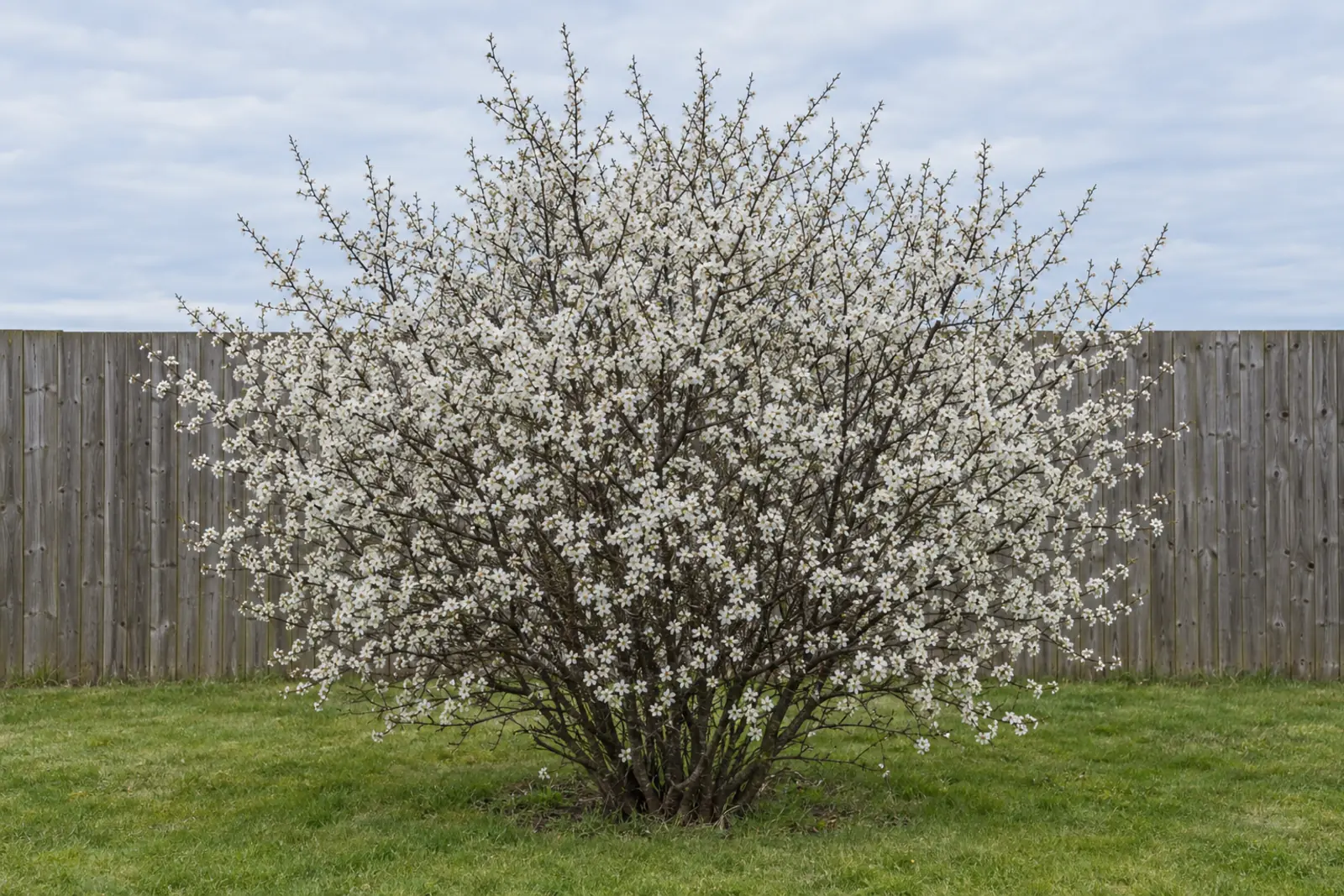
Blackthorn (Prunus spinosa) is a native thorny shrub, 1.5 to 3 metres tall. From late March the bare shrub is covered in small white flowers, before the leaves appear. In autumn blue-black fruits hang from the branches. Blackthorn wants a sunny spot and readily sends up suckers.
Blackthorn at a glance
| Feature | Blackthorn |
|---|---|
| Height | 1.5 to 3 m |
| Spread | 2.5 to 4 m |
| Full grown after | 5 to 10 years |
| Sun | Full sun to partial shade |
| Soil | Fairly dry to moist, preferably rich in lime |
| Water | Little: copes with fairly dry soil |
| Maintenance | Low: only keep the suckers in check |
| Flowers | March to May, white |
| For bees | Yes: nectar and pollen, February to May |
| Hay fever | Not or weakly allergenic |
| Leaves | Drop in autumn |
| Hardy | Yes |
| Native | Yes |
| Poisonous | The stones are harmful if eaten |
| Pricks or stings | Yes: thorns |
| Price, young | About €1.26 to €2.15 each, 40-90 cm, bare-root |
| Price, grown | About €48.50 to €54.80 each, 150-200 cm, in a pot |
- Leaf
- April to November
- Flower
- March to May
- Fruit
- September to December
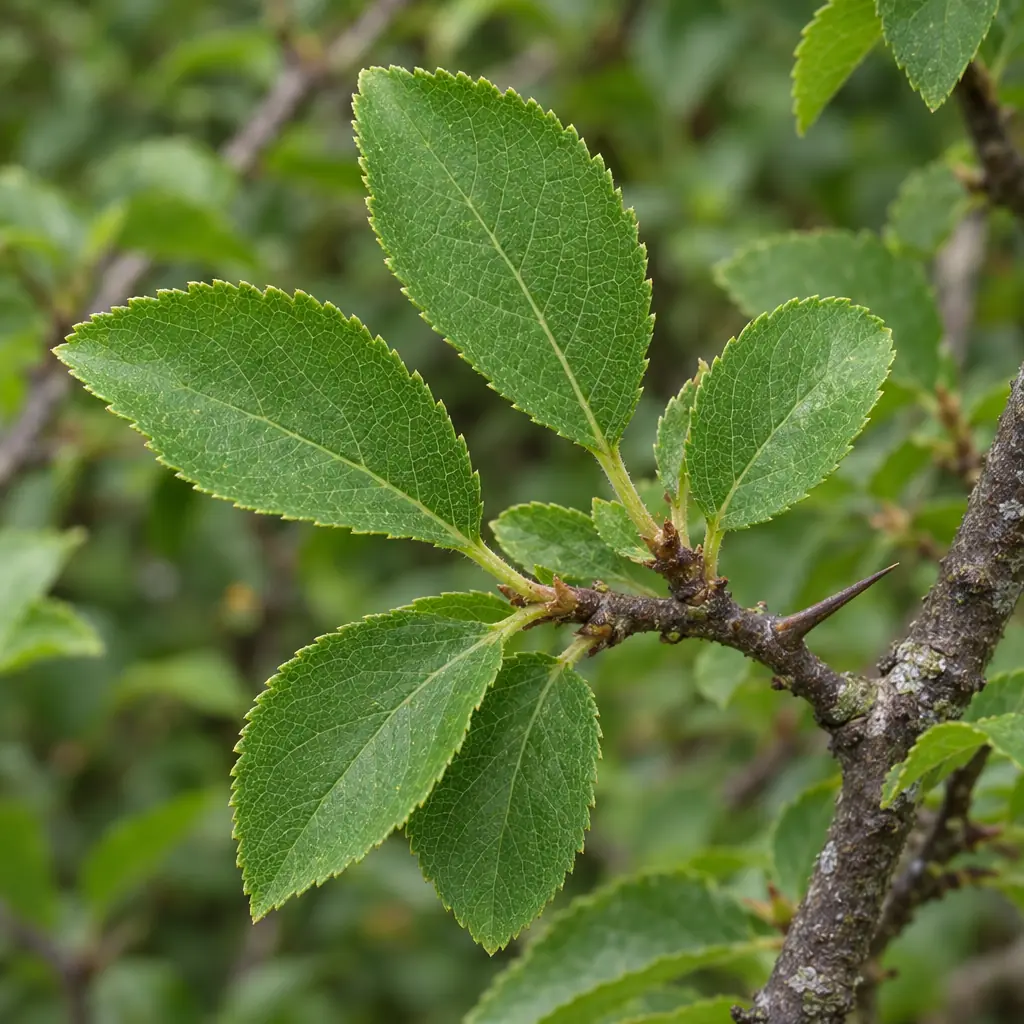
Leaf 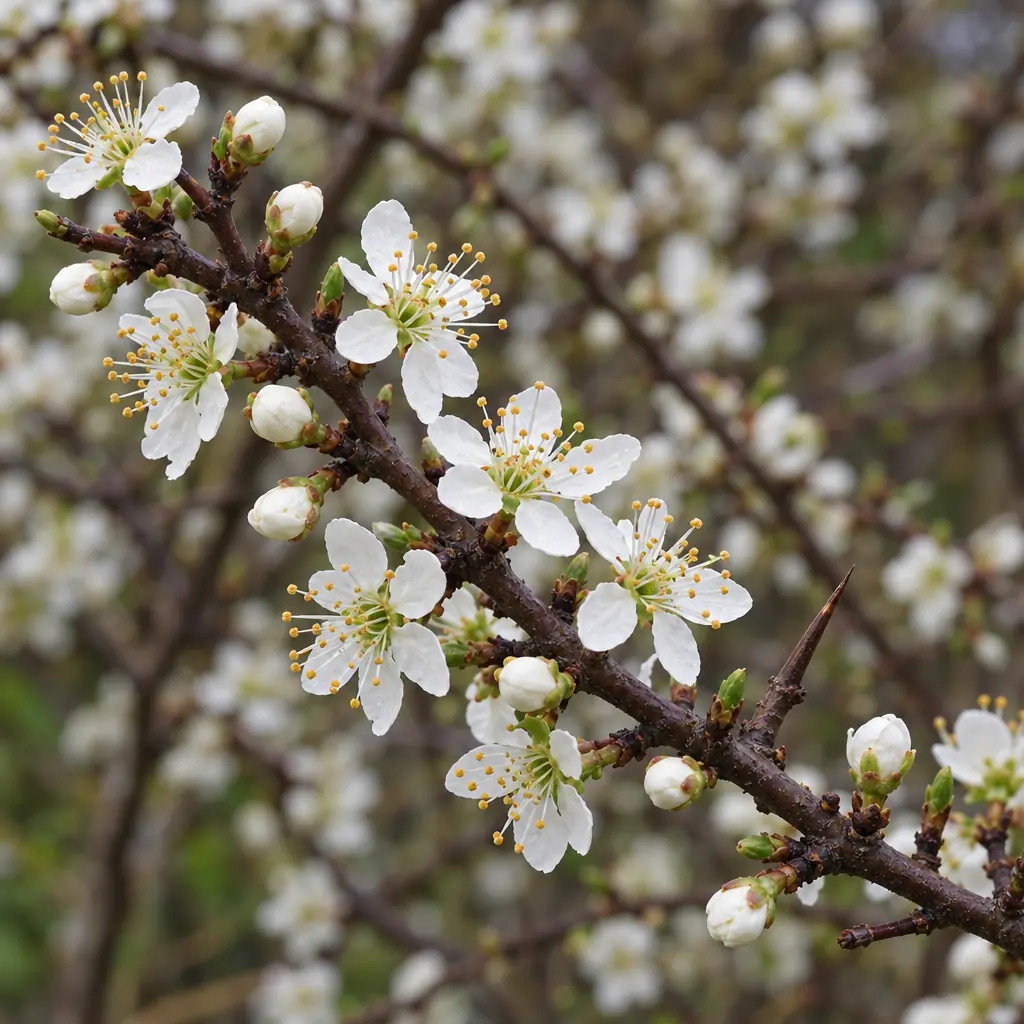
Flower 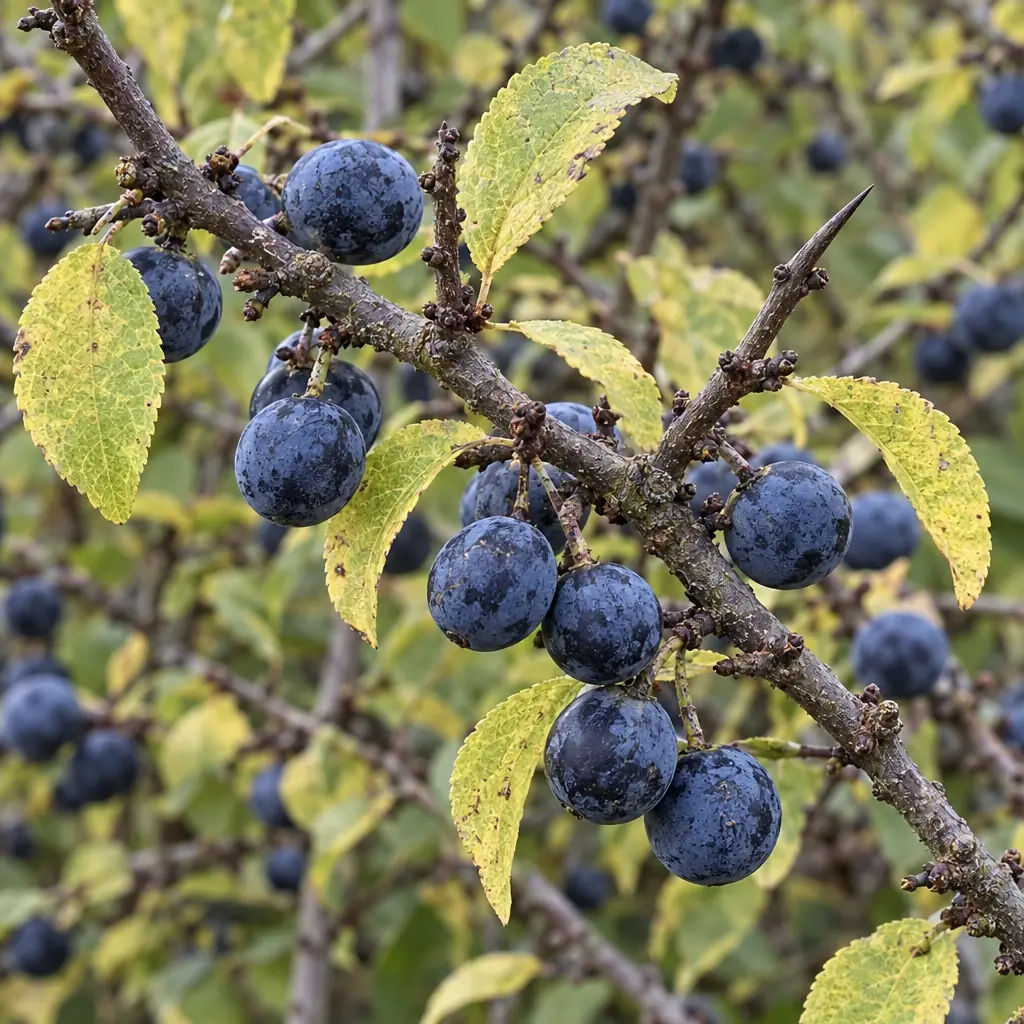
Fruit
How do I recognise blackthorn?
Start with the branches. Older branches end in a sharp thorn. The young twigs are dull, blackish and slightly hairy.
The flowers come first, on bare branches. They are white and 1 to 1.5 centimetres across. Each flower grows on its own, but they sit close together. The leaves unfold only after that.
The leaves are small: 2 to 4 centimetres, matt green and finely toothed. Each leaf is widest above its middle.
The fruit is a round stone fruit of 1 to 1.5 centimetres. Its colour is blue-black, with a grey-blue coating that looks like a touch of frost.
Note the common hawthorn (Crataegus monogyna), also a native thorny shrub with white flowers. Hawthorn flowers later, in May and June, among its leaves. Its flowers grow in flat clusters, the leaves are deeply lobed and the berries are dark red.
Where does blackthorn grow best?
Blackthorn prefers full sun: more than six hours of direct sun a day around midsummer. Partial shade also works, with the sun on it for three to six hours. The soil can be fairly dry to moist, preferably with some lime. Loam, clay and sand all suit it.
Blackthorn does less well in these spots:
- A border next to the lawn. Suckers from the roots grow out into the grass. If you leave them, they turn into a dense thicket of thorns.
- A narrow path beside the house. The shrub grows wider than the path, and every old branch carries a thorn.
- A waterlogged corner. In the wild the shrub grows on fairly dry to moderately moist soil, not where water lies on the surface.
In winter the shrub is bare, a dense mass of dark branches. In April the same shrub is white with flowers.
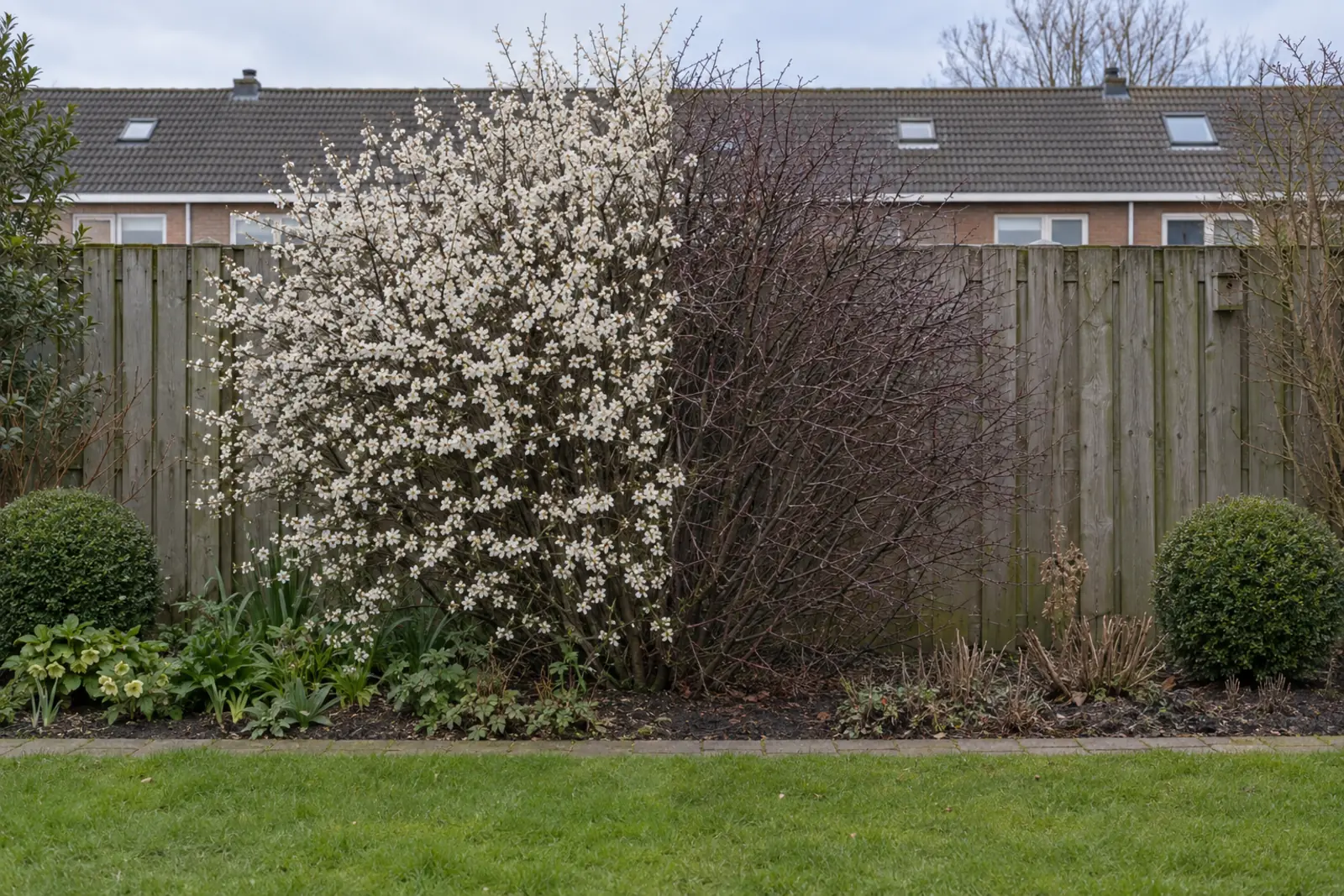 The same border in April and in January. This is a generated image, not a photo.
In the app you can see on your own plot whether there is room beside your path for a shrub this wide. The plot is drawn to scale, with the buildings around it.
Planting and caring for blackthorn
Plant blackthorn between October and April, while the shrub is dormant. Bare-root plants, sold without soil around the roots, are the cheapest. Nurseries sell them from November to the end of March. A plant in a pot can go into the ground at any time of year.
Plant a free-standing shrub about 2.5 metres from other shrubs. On planting day that looks like an empty patch. After a few seasons, branches and suckers fill the gap. For a hedge, plant 5 to 7 shrubs per metre. If that hedge runs along the property line, first read the rules on boundary fences and hedges. In the first summer, water when it stays dry for a long time.
| When | What to do |
|---|---|
| All year | Remove suckers that come up outside the border, with a spade |
| August | Cut out dead, diseased or crossing branches |
This shrub needs no more pruning than that. Many birds breed between March and the end of July. If a branch must come off in those months, look carefully for a nest first.
Blackthorn problems and what to do
Young shoots come up all over the lawn. Those are suckers: new little shrubs growing from the roots. Cut them off with a spade, or mow the grass beside the shrub regularly.
The leaves turn silvery and branches die back. That may be silver leaf, a fungus in the wood. Saw the diseased branch back into healthy wood, 10 to 15 centimetres beyond the dark stain. From then on, prune only in summer, when there are fewer spores about.
The flowers turn brown and shrivel. That is blossom wilt, also a fungus. Cut off the brown twigs in August, with the regular pruning. That leaves less fungus for the next spring.
The leaves curl and feel sticky. Those are aphids. Usually nothing needs doing. A few aphids belong in a healthy garden.
Which birds and insects use blackthorn?
Blackthorn is the food plant of the brown hairstreak (Thecla betulae), a butterfly. Its caterpillar lives on blackthorn and a few cultivated plum species. In winter the white eggs sit in the forks of the twigs, where old and young wood meet. The butterfly flies from late July to late September. In the Netherlands it occurs in a few places, such as around Zwolle and along the edge of the Veluwe.
Which birds eat the sloes is not well described for this shrub.
Is blackthorn poisonous or edible?
The stones of blackthorn are harmful if eaten. People do eat the flesh. Freshly picked, it is hard and very sour. After a spell of frost the fruits become more edible.
The photos on this page were made with AI, based on real photos and descriptions of this plant.
Frequently asked questions
How big does blackthorn grow?
Blackthorn grows 1.5 to 3 metres tall. If you leave the suckers that come up from the roots, the shrub spreads into a dense thicket.
When does blackthorn flower?
From late March into May, with small white flowers. The flowers open before the leaves, so the branches are still bare.
When should you prune blackthorn?
Little pruning is needed. In August, cut out only dead, diseased or crossing branches. Remove suckers in the lawn with a spade as soon as you see them.
Is blackthorn poisonous?
The stones are harmful if eaten. Freshly picked, the flesh is hard and very sour, and it becomes more edible after frost.
Is blackthorn native to the Netherlands?
Yes, blackthorn has long been at home in the Netherlands. In the wild the shrub grows along dykes, road verges and woodland edges, and in the dunes.
Sources (23)
- Duistermaat, Sparrius & Denters, Standaardlijst van de Nederlandse flora 2020 (Gorteria 43)
- NDFF Verspreidingsatlas — Prunus spinosa
- NDFF Verspreidingsatlas — Crataegus monogyna
- Flora van Nederland — Sleedoorn
- Wilde planten in Nederland en België — Sleedoorn
- RHS — Prunus spinosa (blackthorn)
- RHS — Shade gardening (definities zon en halfschaduw)
- RHS — Pruning groups
- RHS — Silver leaf
- RHS — Blossom wilt
- RHS — Aphids
- Imkerpedia — Drachtplanten
- LUMC — Bomenkompas voor allergeniciteit
- De Vlinderstichting — Sleedoornpage
- Vogelbescherming — Een nieuw leefgebiedje voor de grauwe klauwier
- Vogelbescherming — Snoeien in het broedseizoen, mag dat?
- FLORON via Nature Today — Nachtvorst maakt wrange zuurpruim eetbaar
- Directplant — Sleedoorn (prijs per maat, plantafstand)
- Puur van 't Veld — Sleedoorn 60-90 cm, blote wortel (prijs)
- Heijnen Planten — Sleedoorn struik (prijs)
- Wikimedia Commons — Leaf: photo by AnRo0002 (CC0)
- Wikimedia Commons — Flower: photo by Donald Hobern (CC BY 2.0)
- Wikimedia Commons — Fruit: photo by Günter Lindemann (CC0)