5 min read
Creeping Jenny: a native ground cover for damp soil
Lysimachia nummularia
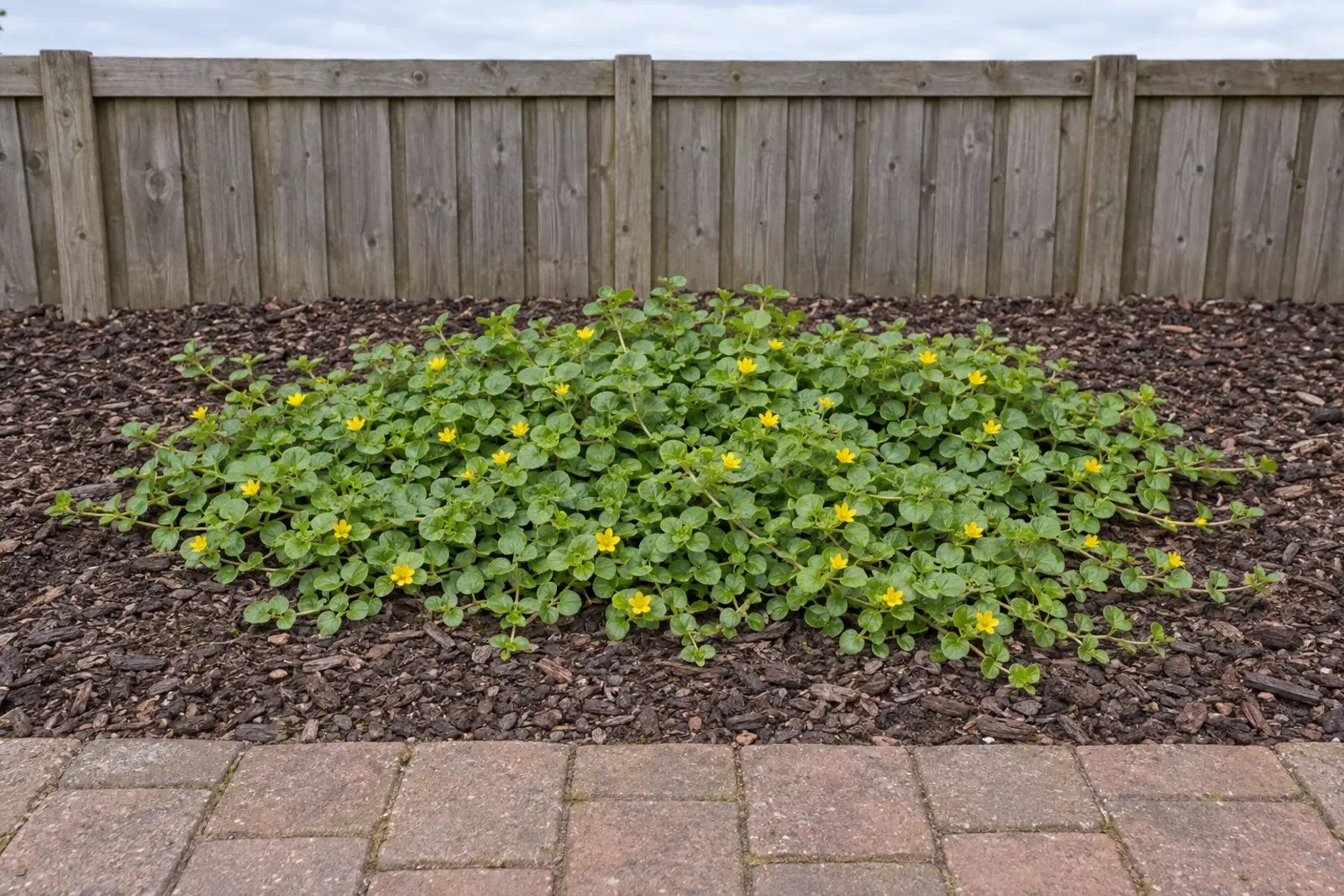
Creeping Jenny (Lysimachia nummularia) is a native ground cover with round leaves like little coins. Its stems creep over the soil and root as they go. Together they form a low mat, at most 15 centimetres tall. Single yellow flowers appear in the mat from June to August. The plant likes moist to wet soil.
Creeping Jenny at a glance
| Feature | Creeping Jenny |
|---|---|
| Height | 5 to 15 cm |
| Spread | 0.1 to 0.5 m per plant, then keeps creeping outwards |
| Full grown after | 2 to 5 years |
| Sun | Full sun to partial shade |
| Soil | Moist to wet, not acid |
| Water | Plenty: the soil has to stay moist |
| Maintenance | Low: only cut back the runners |
| Flowers | June to August, yellow |
| For bees | Little: pollen and oil, June to August |
| Hay fever | Not or weakly allergenic |
| Leaves | Stay green |
| Hardy | Yes |
| Native | Yes |
| Poisonous | No |
| Pricks or stings | No |
| Price, young | About €2.65 to €3.50 each, 5-10 cm, in a small pot |
| Price, grown | About €9.02 to €9.75 each, in a pond basket |
- Leaf
- all year
- Flower
- June to August
- Fruit
- no noticeable fruit
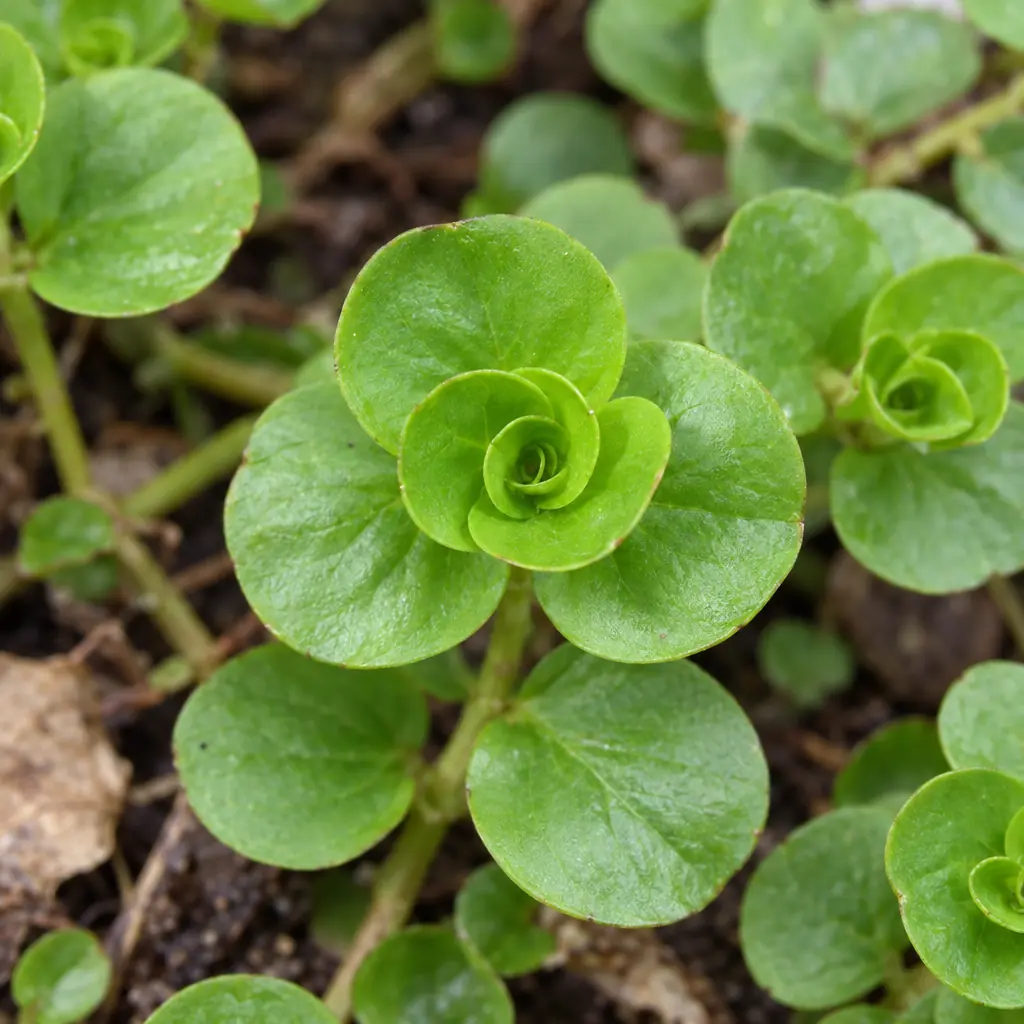
Leaf 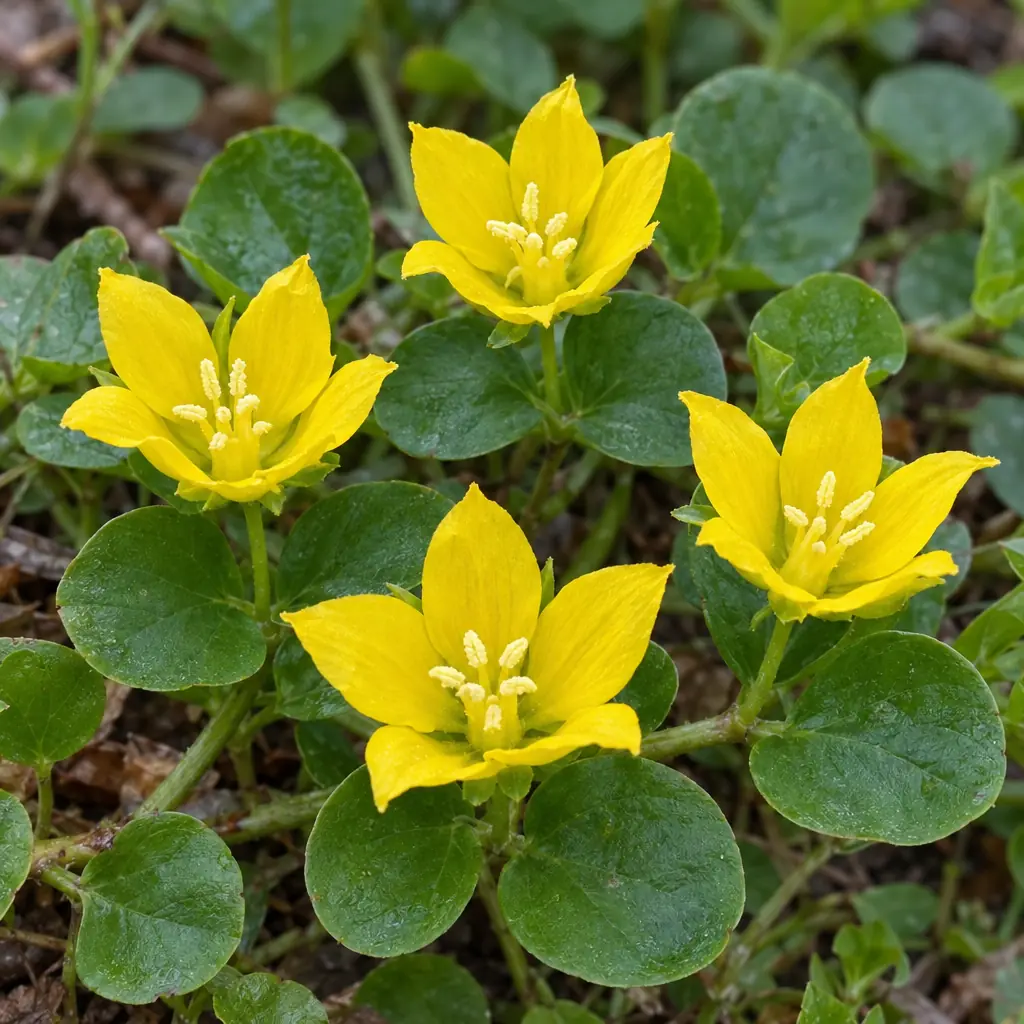
Flower
How do I recognise creeping Jenny?
Start with the leaves. They grow in opposite pairs along the stem. Each leaf is almost round, with a blunt tip and a short stalk. Against the light, a leaf shows tiny red dots. Those gland dots are a reliable feature to go by. The stems lie flat on the ground and are slightly angular.
The yellow flowers sit singly where a leaf joins the stem. Each flower has a short, sturdy stalk and measures 1.2 to 3 centimetres across. Most flowers have five pointed petals. A flower is about as large as a leaf.
At first glance, yellow pimpernel (Lysimachia nemorum) looks similar. The leaves of yellow pimpernel are oval, taper to a point and have no red dots. Its flowers sit on a long, thin stalk. Nurseries also sell a cultivated form of creeping Jenny, 'Aurea'. That cultivar has golden yellow leaves, where the wild plant has green ones.
Where does creeping Jenny grow best?
Creeping Jenny grows in full sun or in partial shade. In partial shade, the sun shines directly on the spot for three to six hours a day around midsummer. The soil should be moist to wet, and preferably not acid. Light sandy soil and heavy clay both work, as long as they hold on to moisture. In the wild, the species grows on road verges, in lawns, parks and woods, and along the water's edge.
Creeping Jenny is better kept out of these spots:
- A dry border, or a front garden on sand. The plant needs moist soil, and dry sand holds too little water.
- Along the lawn or at the front of a border. There the stems quickly creep over the edge and take over the grass or the border.
- A bed with acid soil, such as a heather garden. Creeping Jenny avoids acid soil.
The leaves stay green through winter, so the ground stays covered then as well.
Along a pond edge or under a hedge, the strip of ground is often narrow. Place creeping Jenny on the drawing of your own garden in the app. The app draws the plant at a grown plant's width, not at pot size. Then you can see whether the strip is wide enough.
Planting and caring for creeping Jenny
Nurseries offer creeping Jenny as a small plant in a little pot. Plant it in any month, provided the ground is not frozen. Leave about 30 centimetres between plants, which fits 8 to 11 on each square metre. Just after planting, the bed looks bare. The creeping stems then fill the gaps on their own. In the first summer, water whenever the weather stays dry for a few weeks.
No pruning is needed, only two small jobs:
| When | What to do |
|---|---|
| If a runner reaches too far | Cut it back |
| If the mat gets too dense | Lift a piece and plant it somewhere else |
Where the mat grows under a hedge or between shrubs, cut there with care. Many birds breed from March to the end of July.
Creeping Jenny problems and what to do
The mat is growing into the lawn or the border. Creeping Jenny spreads fast through its creeping stems. Cut back the runners where they reach too far.
The leaves hang limp in a dry summer. By then the soil has become too dry. Water the plant until the soil is damp again.
Small brown or orange spots show on the leaves. That may be rust, or a leaf spot disease. Both are fungi. Creeping Jenny rarely gets a serious disease, so there is usually nothing to do.
Is creeping Jenny good for wildlife?
At the water's edge, creeping Jenny gives cover. In one bird-friendly garden with a pond in Amsterdam, brown and green frogs hide among the creeping Jenny, water soldier and hornwort. For dragonflies, creeping Jenny is on the list of marginal plants that make a pond richer.
Which insects and birds visit creeping Jenny in the Netherlands has not been well described.
Is creeping Jenny poisonous?
Creeping Jenny counts as a plant of little or no toxicity. That still does not make it edible. The stems and leaves are smooth or barely hairy, so nothing on creeping Jenny pricks.
The photos on this page were made with AI, based on real photos and descriptions of this plant.
Frequently asked questions
How tall does creeping Jenny grow?
The mat stays low, at 5 to 15 centimetres. The creeping stems can grow much longer, but they lie flat on the ground.
Does creeping Jenny spread quickly?
Yes, creeping Jenny spreads fast. The stems take root wherever they touch the soil. Keep the plant away from a lawn edge or the front of a border, and cut back runners that reach too far.
Does creeping Jenny grow in shade?
In partial shade, yes. That is a spot where the sun shines directly for three to six hours a day around midsummer. Full sun works as well, as long as the soil stays moist.
Is creeping Jenny poisonous?
No, creeping Jenny counts as a plant of little or no toxicity. That does not make it edible.
Is creeping Jenny native to the Netherlands?
Yes. Creeping Jenny is an original native of the Netherlands and a common species. In the wild you find it on road verges, in lawns and parks, and along the water's edge.
Sources (26)
- Duistermaat, Sparrius & Denters, Standaardlijst van de Nederlandse flora 2020 (Gorteria 43)
- NDFF Verspreidingsatlas — Lysimachia nummularia
- Flora van Nederland — Penningkruid
- Flora van Nederland — Boswederik
- Wilde planten in Nederland en België — Penningkruid
- RHS — Lysimachia nummularia (creeping Jenny)
- RHS — Lysimachia nummularia 'Aurea'
- RHS — Shade gardening (definities zon en schaduw)
- PFAF — Lysimachia nummularia
- Missouri Botanical Garden — Lysimachia nummularia
- NC State Extension — Lysimachia nummularia
- Pollennieuws / Flora van Nederland — Aandachtspunten hooikoorts vriendelijke tuin
- Insectenplanten.nl (wildebijen.nl) — Lysimachia nummularia
- Bijenhouden — Solitaire bijen: de gewone slobkousbij
- De Vlinderstichting — Planten voor libellen
- Vogelbescherming — Els is trots op haar vogeltuin
- Vogelbescherming — Snoeien in het broedseizoen, mag dat?
- Antigifcentrum — Weinig of niet giftige planten
- Heijnen Planten — Lysimachia nummularia (prijs en planttijd)
- Yarinde — Penningkruid (prijs en plantafstand)
- Tuinplantenbezorgd — Lysimachia nummularia (prijs)
- Directplant — Penningkruid (prijs)
- Vijverplantenland — Lysimachia nummularia (prijs)
- Biovijver — Penningkruid (uitlopers terugknippen)
- Wikimedia Commons — Leaf: photo by Andy Slater (CC BY 4.0)
- Wikimedia Commons — Flower: photo by Denis Otkydach (CC BY 4.0)