5 min read
Ground ivy: where to plant it, care and price
Glechoma hederacea
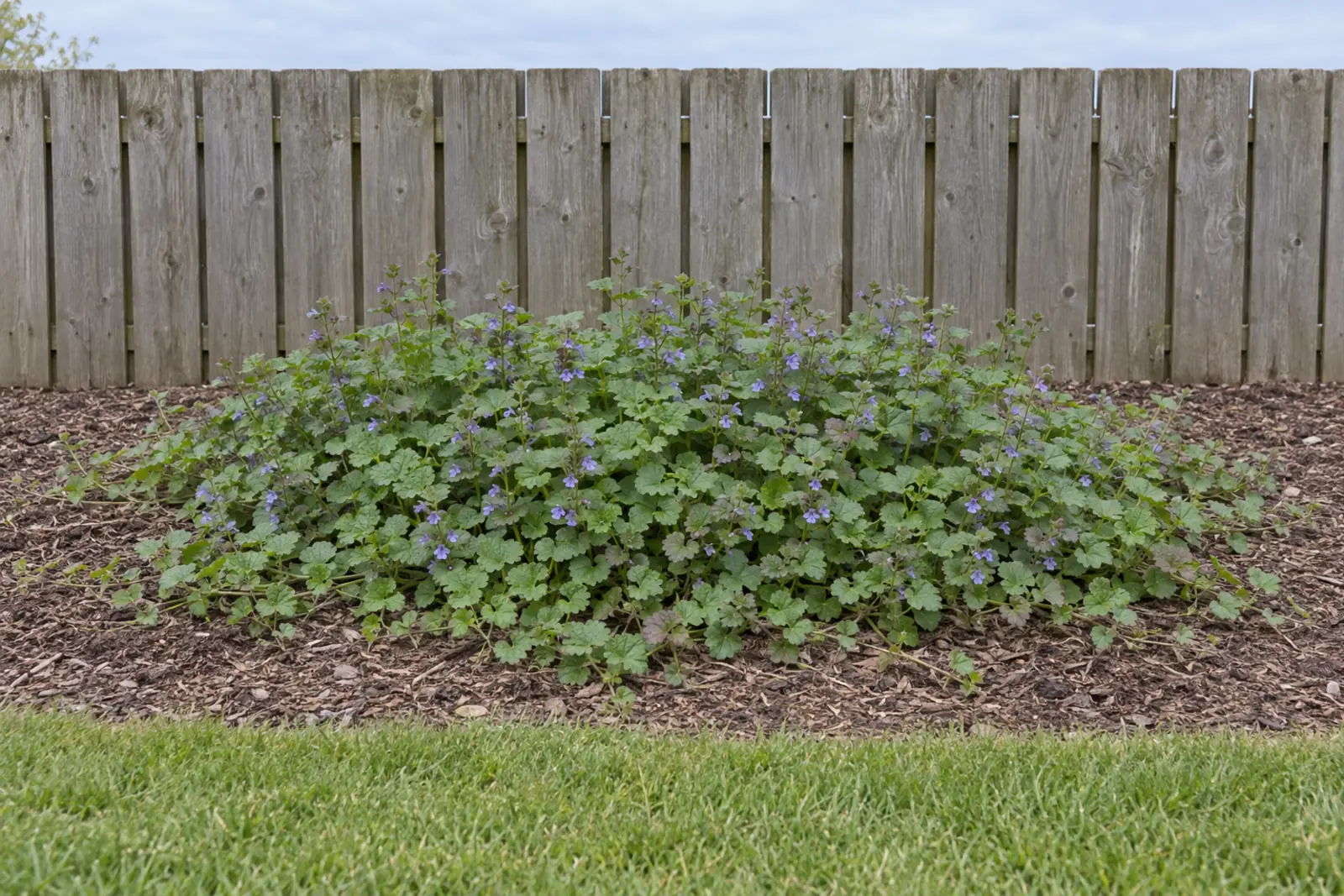
Ground ivy (Glechoma hederacea) is a native ground cover from the mint family. Its stems creep over the soil and root as they go. That builds a low mat of round leaves with scalloped edges. From April to June, small blue-violet flowers appear in it. The plant wants sun or partial shade and soil with some humus.
Ground ivy at a glance
| Feature | Ground ivy |
|---|---|
| Height | 15 to 60 cm |
| Spread | 10 to 50 cm per plant, creeps further |
| Full grown after | 2 to 5 years |
| Sun | Full sun to partial shade |
| Soil | Moist to moderately dry, with humus |
| Water | Average |
| Maintenance | Low: cut back runners when needed |
| Flowers | April to June, blue-violet |
| For bees | Yes: nectar, April and May |
| Hay fever | Not or weakly allergenic |
| Leaves | Stay green |
| Hardy | Yes |
| Native | Yes |
| Poisonous | No, as far as is known; poisonous to horses |
| Pricks or stings | No |
| Price, young | About €2.58 to €4.99 each, 5-10 cm, in a small pot |
| Price, grown | Not for sale |
- Leaf
- all year
- Flower
- April to June
- Fruit
- no noticeable fruit
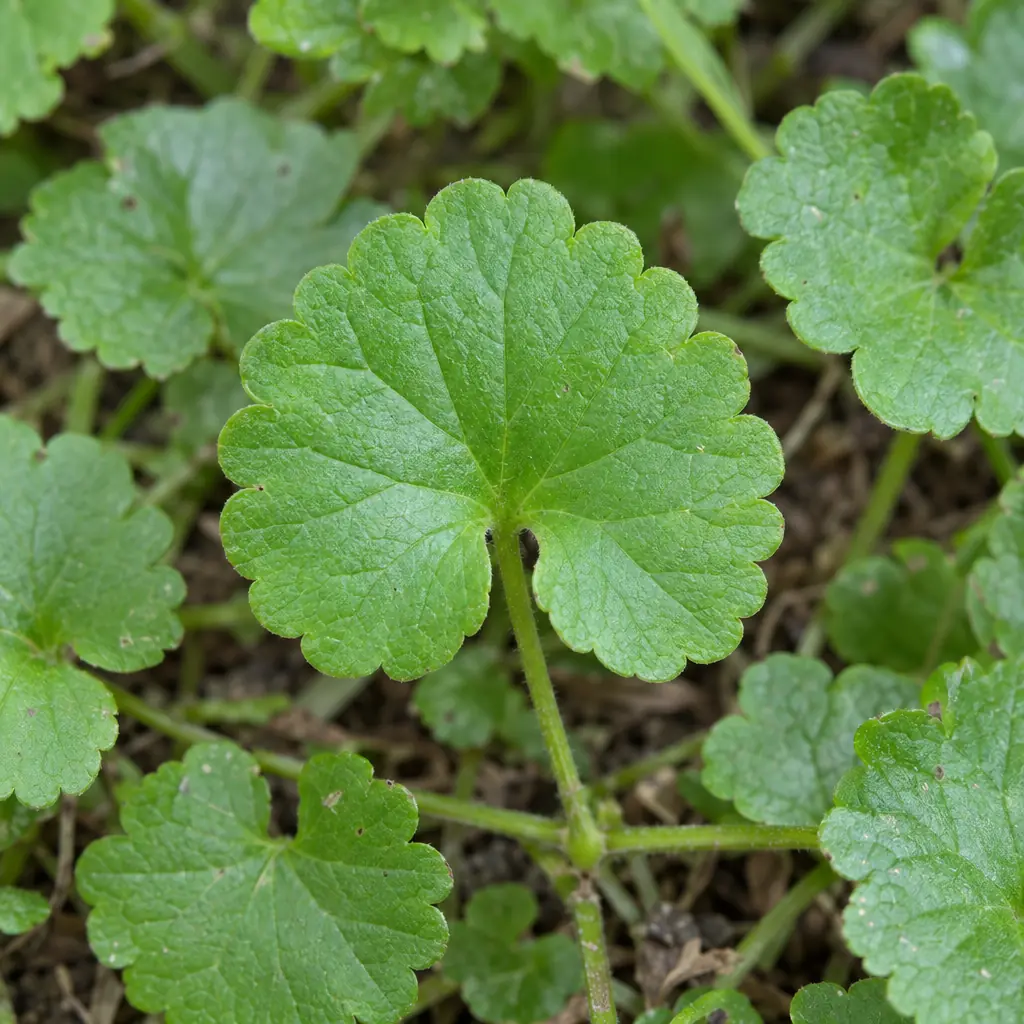
Leaf 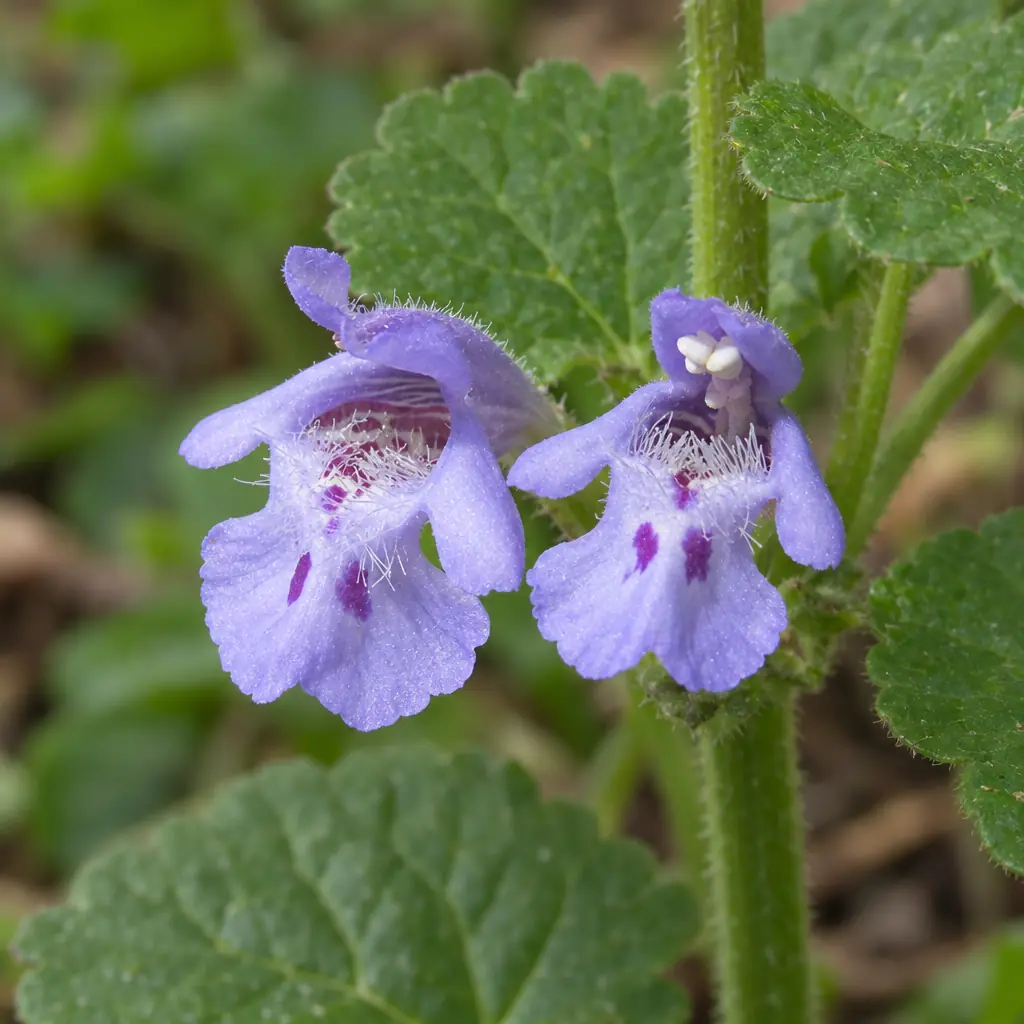
Flower
How do I recognise ground ivy?
Start with the leaves. Each one is kidney-shaped or nearly round, with a heart-shaped base. The edge is scalloped, and every leaf sits on a stalk. Leaves grow in opposite pairs, often with a faint purple tinge. The whole plant has a strong, herby smell.
The stem is square and creeps over the ground. At every node it puts down new roots. Short, hairy flowering stems rise from the mat.
Each flower is two-lipped and 1 to 2 centimetres in size. The flowers sit in small groups of one to six, where ordinary leaves join the stem. The upper lip is notched at the tip, and the lower lip has three lobes. A single flower gives at most four small nutlets. Once they are ripe, the calyx bends down and the nutlets drop out.
Note a look-alike, bugle (Ajuga reptans). That plant also makes runners and blue two-lipped flowers. Its leaves, however, are spoon-shaped, with a smooth or wavy edge. Bugle carries its flowers in whorls stacked one above the other, with bracts that are sometimes tinged blue. Nurseries also sell variegated ground ivy. That is a cultivar with a white edge along the leaf.
Where does ground ivy grow best?
Ground ivy grows in full sun and in partial shade. Partial shade means three to six hours of direct sunlight a day around midsummer. The plant copes with soil from moist to moderately dry, and from moderately poor to rich in nutrients, as long as it holds some humus. In the wild, look for it in deciduous woods, along hedges and woodland edges, on road verges and in shady lawns.
In two places, ground ivy mainly makes work for you:
- Right beside a lawn that has to stay neat. The runners root at every node and so creep in among the grass.
- Poor sand that dries out completely. Ground ivy wants soil with humus, which holds on to some moisture.
In winter the leaves stay green, often with a purple sheen.
On a plan of your own plot, you draw the spot where a low mat like this has room. The app draws the plant at a grown plant's width, not at pot size.
Planting and caring for ground ivy
Nurseries sell ground ivy as a young plant in a small pot. Planting works all year round, as long as the ground is not frozen or waterlogged. Space the plants about 30 centimetres apart, roughly 11 per square metre. At first you see a lot of bare soil between them. Runners close those gaps by themselves. Keep the soil moist in the first year, especially after a summer planting.
| When | What to do |
|---|---|
| All year, when needed | Cut off or pull out runners that go too far |
| Spring or autumn | Dig up a mat that has grown too big and divide it into pieces |
From March through July, many bird species are nesting. Where the mat grows under a hedge, look for a nest there before you cut.
What goes wrong with ground ivy?
The mat creeps into the lawn. That is the nature of the plant: every stem roots where it touches the soil. Pull the runners loose and cut a clean edge between bed and grass with a spade. Some gardeners weed ground ivy out, while others keep it as a ground cover.
There are holes in the leaves. Slugs and snails are often the cause. The damage is cosmetic, and the mat keeps growing. Diseases are rare on ground ivy.
In summer the leaves hang limp. The soil has become too dry. Water thoroughly, until the soil under the mat is wet as well.
Few flowers appear. The flowers sit on the upright stems. Mowing the strip in April or May removes them, so leave the mat alone in those months.
Which insects and birds use ground ivy?
The narrow-bordered bee hawk-moth (Hemaris tityus) visits ground ivy flowers. That moth flies in May and June. In the dunes, the grizzled skipper (Pyrgus malvae) drinks nectar from ground ivy. The caterpillar of the pale shoulder (Acontia lucida) feeds on ground ivy, but that moth is very rare in the Netherlands.
The potter flower bee (Anthophora retusa) collects pollen from ground ivy. This wild bee has also become very rare.
No fixed link between ground ivy and any particular bird species has been described.
Is ground ivy poisonous?
Ground ivy is not known to be poisonous to people. That does not make the plant edible. For horses, though, ground ivy is strongly poisonous. Even a small amount can make a horse ill. That rarely happens when a horse has enough other food.
The photos on this page were made with AI, based on real photos and descriptions of this plant.
Frequently asked questions
How tall does ground ivy grow?
The leaves stay low to the ground. With the flowering stems included, ground ivy grows 15 to 60 centimetres tall.
Does ground ivy spread?
Yes, the plant spreads. The stems creep over the ground and root at every node. Cut or pull back the runners where the mat goes too far.
Is ground ivy poisonous?
Ground ivy is not known to be poisonous to people. That does not make the plant edible. For horses, though, ground ivy is strongly poisonous: even a small amount can make a horse ill.
How much sun does ground ivy need?
Ground ivy grows in full sun and in partial shade. Partial shade means three to six hours of direct sunlight a day around midsummer.
Is ground ivy native to the Netherlands?
Yes. Ground ivy is an original native of the Netherlands and a common species here, in woods, on road verges and along hedges.
Sources (26)
- Duistermaat, Sparrius & Denters, Standaardlijst van de Nederlandse flora 2020 (Gorteria 43)
- NDFF Verspreidingsatlas — Glechoma hederacea
- Flora van Nederland — Hondsdraf
- Flora van Nederland — Kruipend zenegroen
- RHS — Glechoma hederacea (ground ivy)
- RHS — Glechoma hederacea 'Variegata'
- BSBI Fermanagh Flora — Glechoma hederacea
- Heijnen Planten — Glechoma hederacea 'Variegata'
- RHS — Shade gardening (definities zon en schaduw)
- RHS — Planting perennials
- Imkerpedia — Drachtplanten
- Pollennieuws / Flora van Nederland — Aandachtspunten hooikoorts vriendelijke tuin
- PFAF — Glechoma hederacea
- De Vlinderstichting — Hommelvlinder
- De Vlinderstichting — Aardbeivlinder
- De Vlinderstichting — Bleekschouderuil
- EIS Kenniscentrum Insecten en Landschap Erfgoed Utrecht — Zwarte sachembij minder kieskeurig dan gedacht
- Vogelbescherming — 'Onkruid' te lijf, zonder gif
- Vogelbescherming — Snoeien in het broedseizoen, mag dat?
- Regionaal Landschap Lage Kempen — Risicoplanten voor paarden
- Heijnen Planten — Hondsdraf (planttijd)
- Planta — Glechoma hederacea (prijs)
- Vijvermeester — Hondsdraf (prijs)
- KwaliteitsPlanten — Glechoma hederacea (plantafstand)
- Wikimedia Commons — Leaf: photo by Ksd5 (CC0)
- Wikimedia Commons — Flower: photo by AnRo0002 (CC0)