5 min read
Lesser periwinkle: where it grows, planting and care
Vinca minor
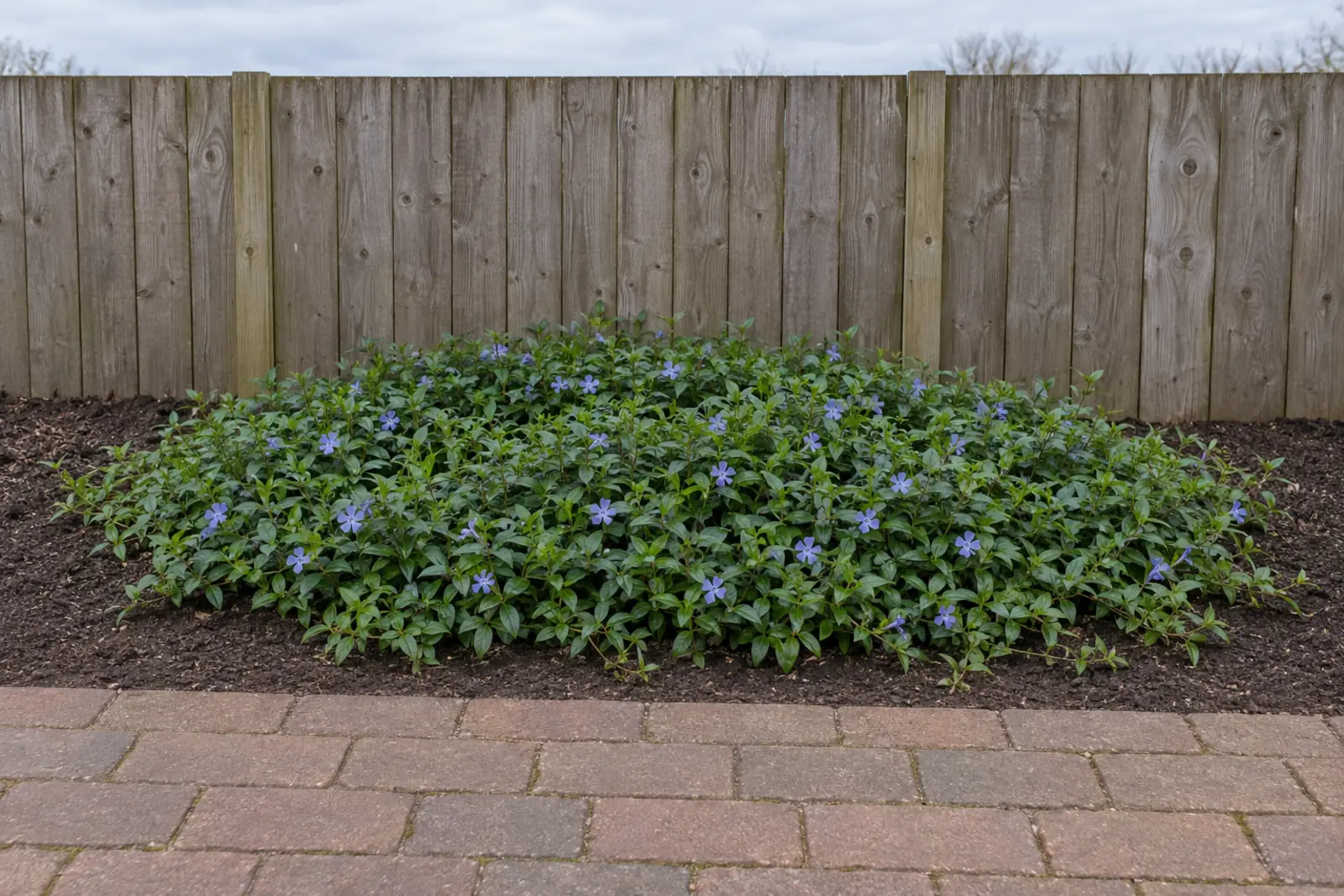
Lesser periwinkle (Vinca minor) is a low ground cover that stays green all year. The plant grows 15 to 30 centimetres tall and creeps over the soil on long stems. From April to June it flowers light blue. Sun or shade, both suit it.
Lesser periwinkle at a glance
| Feature | Lesser periwinkle |
|---|---|
| Height | 15 to 30 cm |
| Spread | Creeps outward, runners up to 50 cm |
| Full grown after | 2 to 5 years |
| Sun | Sun to full shade |
| Soil | Humus-rich, ideally loam |
| Water | Moist, but not wet |
| Maintenance | Low |
| Flowers | April to June, light blue |
| For bees | Little: some nectar for bumblebees, April and May |
| Hay fever | Not or weakly allergenic |
| Leaves | Stay green |
| Hardy | Yes |
| Native | Yes |
| Poisonous | Mildly: do not eat the leaves |
| Pricks or stings | No |
| Price, young | About €1.21 to €1.85 each |
| Price, grown | About €3.93 to €4.50 each, in a large pot |
- Leaf
- all year
- Flower
- April to June
- Fruit
- no noticeable fruit
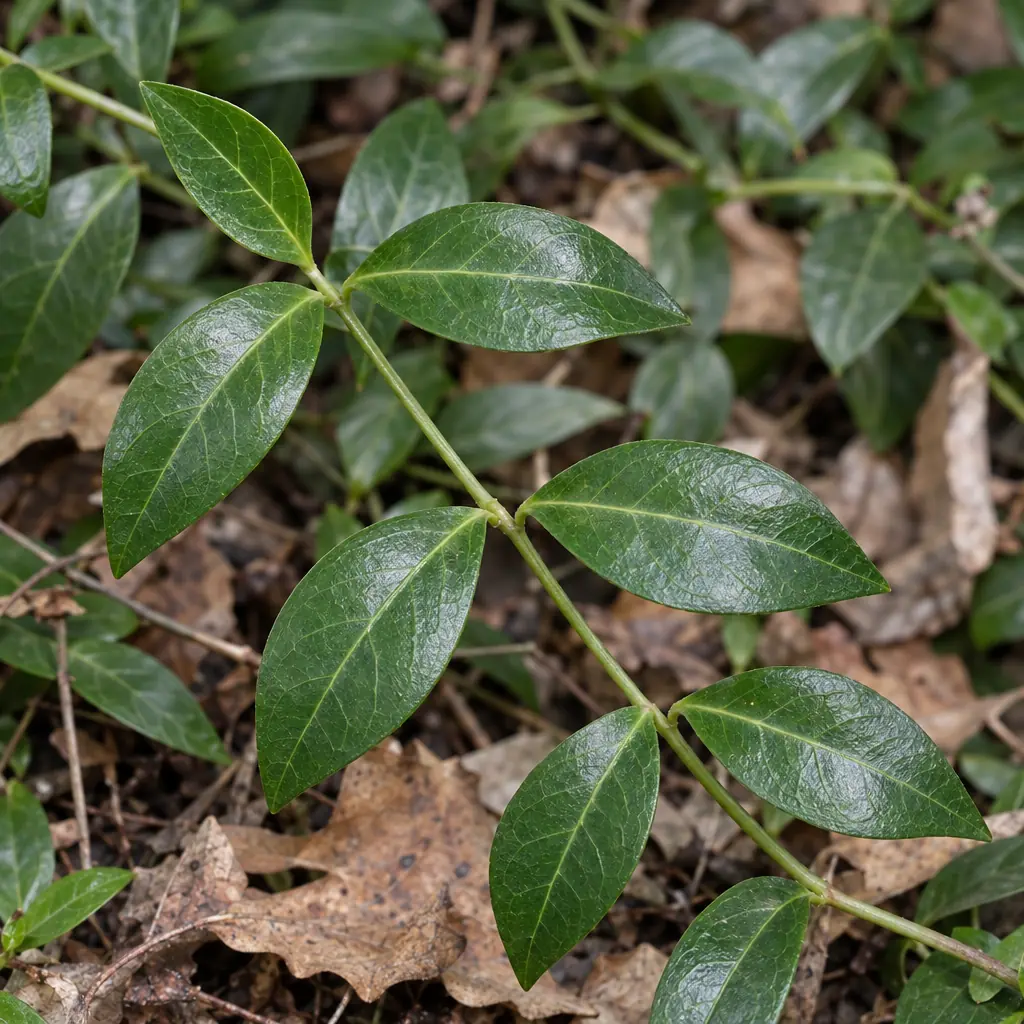
Leaf 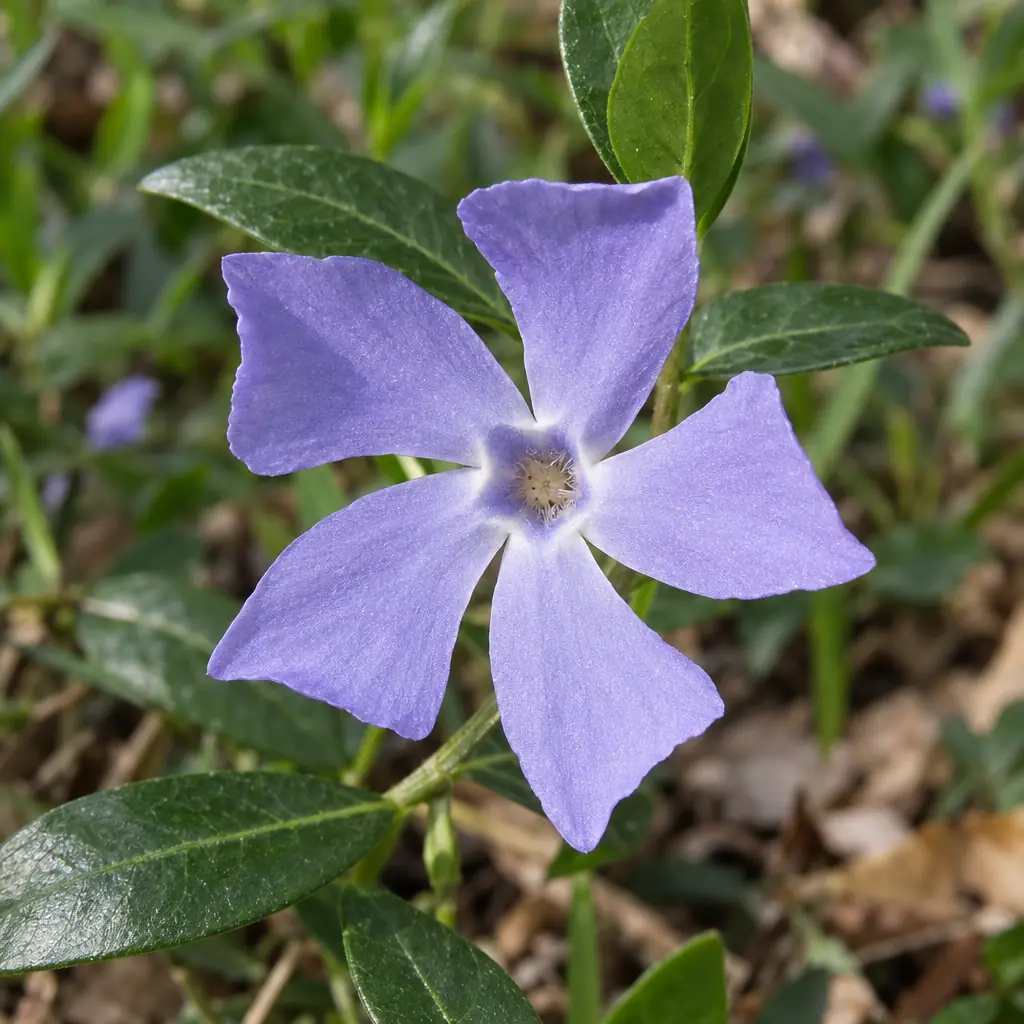
Flower
How do I recognise lesser periwinkle?
Start with the leaves. They are small, leathery and glossy dark green. Each leaf is 3 to 4 centimetres long, oval and slightly pointed. The leaves grow in opposite pairs and have a smooth edge.
The stems creep over the ground. Wherever they touch the soil, they put down new roots. Short upright shoots grow from those roots and carry the flowers.
Each flower sits alone on a short stalk, at the point where a leaf joins the stem. The flower is light blue and 2.5 to 3 centimetres across. Five flat petals spread out around a narrow tube.
Watch out for greater periwinkle at the garden centre, sold as grote maagdenpalm. Its leaf edge is hairy and its flowers are 5 to 6 centimetres across. The lesser species is the only one that grows wild here. A plant with variegated leaves is a cultivar.
Where does periwinkle grow best?
Lesser periwinkle grows in full sun and in full shade. It flowers most freely with six hours of sun or more a day in summer, as long as the soil holds on to moisture. In the wild you find it in deciduous woods, on wooded banks and along sunken lanes. The plant once came here from Central Europe as an ornamental and has grown here for centuries.
In these three places, choose something else or count on extra work:
- Dry sand in full sun. The plant cannot cope with soil that dries out completely.
- Soil that stays wet. There a fungus takes hold of the stems.
- Right beside the lawn or a low border. The stems root wherever they touch the ground. That is how the plant creeps into the grass and the border.
In winter it stays green, even under shrubs that are bare by then.
Whether a green carpet like this fits your garden shows on a drawing of your own plot. The app draws each plant there at a grown plant's width, not at pot size.
Planting and care
Periwinkle is sold in pots; at a Dutch nursery, look for kleine maagdenpalm. A potted plant can go in whenever the soil is not frozen or waterlogged. If you plant in summer, keep the soil well watered.
Set 9 plants per square metre. On planting day you mostly see bare soil between the pots. That fills in by itself, though it takes a few years. Until then, weed by hand now and then. How to work out numbers like this for a whole border is in how to make a planting plan.
In its first summer the young mat needs water in dry weeks. After that it usually manages without a watering can.
| When | What to do |
|---|---|
| Late February or early March | Cut long stems back hard |
| All year | Pull up runners that creep into the lawn or the border |
Many birds nest from March through July. If you cut in March, first check for a nest among the stems.
Common problems and what to do
The stems turn black and wilt. That is stem dieback, a fungal disease. The shoot tips turn dark brown and die back to the ground. The fungus likes wet soil and water on the leaves. Cut out diseased stems and water the soil rather than the plant.
In summer the leaves hang limp. Then the soil is too dry. Put a watering can or sprinkler on it until the soil is wet through, and spread a thin layer of leaves or compost between the stems.
It hardly flowers. Then the spot is too dark. In full shade the plant stays a fine green carpet, but few flowers appear. Nothing needs doing: as a ground cover it still does its job.
Which insects and birds use it?
The flowers open early in the year. Their nectar sits at the bottom of a narrow tube. Insects with a long tongue, such as bumblebees, come to it. A bumblebee pushes its tongue between the stamens to reach the nectar. Exactly which bees and butterflies visit the flowers is not well described.
Without fruit, birds find little to eat here. Which birds do make use of it is not well described.
Is lesser periwinkle poisonous?
Lesser periwinkle is mildly poisonous. The leaves contain toxic substances, mainly vincamine. Only in larger amounts are they harmful. The plant is not as poisonous as its relative, the oleander.
The photos on this page were made with AI, based on real photos and descriptions of this plant.
Frequently asked questions
How tall does lesser periwinkle grow?
Between 15 and 30 centimetres. The stems creep over the ground and root where they touch it. That is how the plant forms a dense green carpet.
Does lesser periwinkle grow in shade?
Yes, even in full shade. There it stays green but flowers little. The soil must not dry out.
Is lesser periwinkle poisonous?
Yes, mildly. The leaves contain toxic substances, mainly vincamine. These are only harmful in larger amounts.
Is lesser periwinkle native to the Netherlands?
Yes. You find it wild in deciduous woods and on wooded banks, and it belongs to the Dutch flora.
How many periwinkle plants do I need per square metre?
About 9 plants. Each plant reaches full size after 2 to 5 years, and by then the carpet has closed.
Sources (20)
- Duistermaat, Sparrius & Denters, Standaardlijst van de Nederlandse flora 2020 (Gorteria 43)
- NDFF Verspreidingsatlas — Vinca minor
- Flora van Nederland — Kleine maagdenpalm
- Wikipedia — Kleine maagdenpalm
- Wikipedia — Maagdenpalm
- RHS — Vinca minor (lesser periwinkle)
- RHS — Vinca minor 'Aureovariegata' (bonte kweekvorm)
- RHS — Shade gardening (definities zon en schaduw)
- RHS — Perennials: planting (vaste planten uit een pot)
- NC State Extension — Vinca minor
- Pacific Northwest Plant Disease Management Handbook — Vinca canker and dieback
- Stadsplanten — Maagdenpalm
- Vogelbescherming — Snoeien in het broedseizoen, mag dat?
- Directplant — Kleine maagdenpalm (prijs en planten per m²)
- Tas Boomkwekerij — Vinca minor in 2 liter pot (prijs)
- Garmundo — Kleine maagdenpalm P9 (prijs)
- Yarinde — Kleine maagdenpalm (prijs per stuk)
- Pollennieuws / Flora van Nederland — Aandachtspunten hooikoorts vriendelijke tuin
- Wikimedia Commons — Leaf: photo by George Chernilevsky (Public domain)
- Wikimedia Commons — Flower: photo by AnRo0002 (CC0)