6 min read
Silver birch: where it grows, planting and what it feeds
Betula pendula
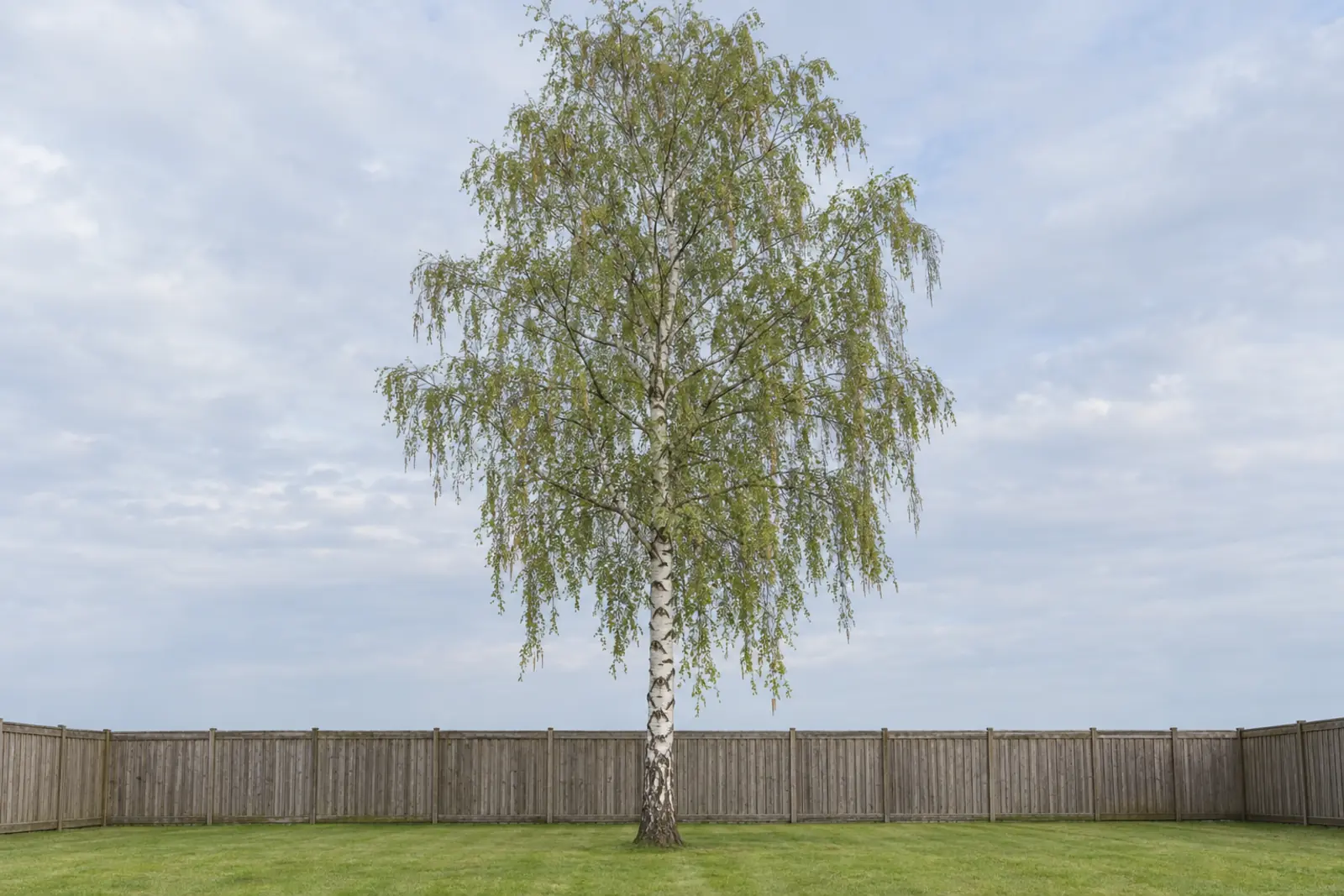
Silver birch (Betula pendula) is a tree native to the Netherlands that grows 15 to 20 metres tall. The trunk is white and the thin twigs hang down. In April and May yellow catkins hang from them. The tree wants sun or partial shade and copes with poor sandy soil. In a small garden it gets big.
Silver birch at a glance
| Feature | Silver birch |
|---|---|
| Height | 15 to 20 m, sometimes 30 m |
| Spread | 8 to 12 m |
| Full grown after | 15 to 20 years |
| Sun | Sun to partial shade |
| Soil | Dry to moderately moist, poor to moderately rich |
| Water | Average: water it in long dry spells |
| Maintenance | Low: no pruning needed |
| Flowers | April and May, yellow catkins |
| For bees | Little: some pollen, April and May |
| Hay fever | Very strongly allergenic, April and May |
| Leaves | Drop in autumn, turning yellow first |
| Hardy | Yes |
| Native | Yes |
| Poisonous | No |
| Pricks or stings | No |
| Price, young | About €1.70 to €2.50 each, 60-100 cm, bare-root |
| Price, grown | About €90 to €112 each, 200-300 cm, in a pot |
- Leaf
- April to October
- Flower
- April to May
- Fruit
- August to September
Leaf 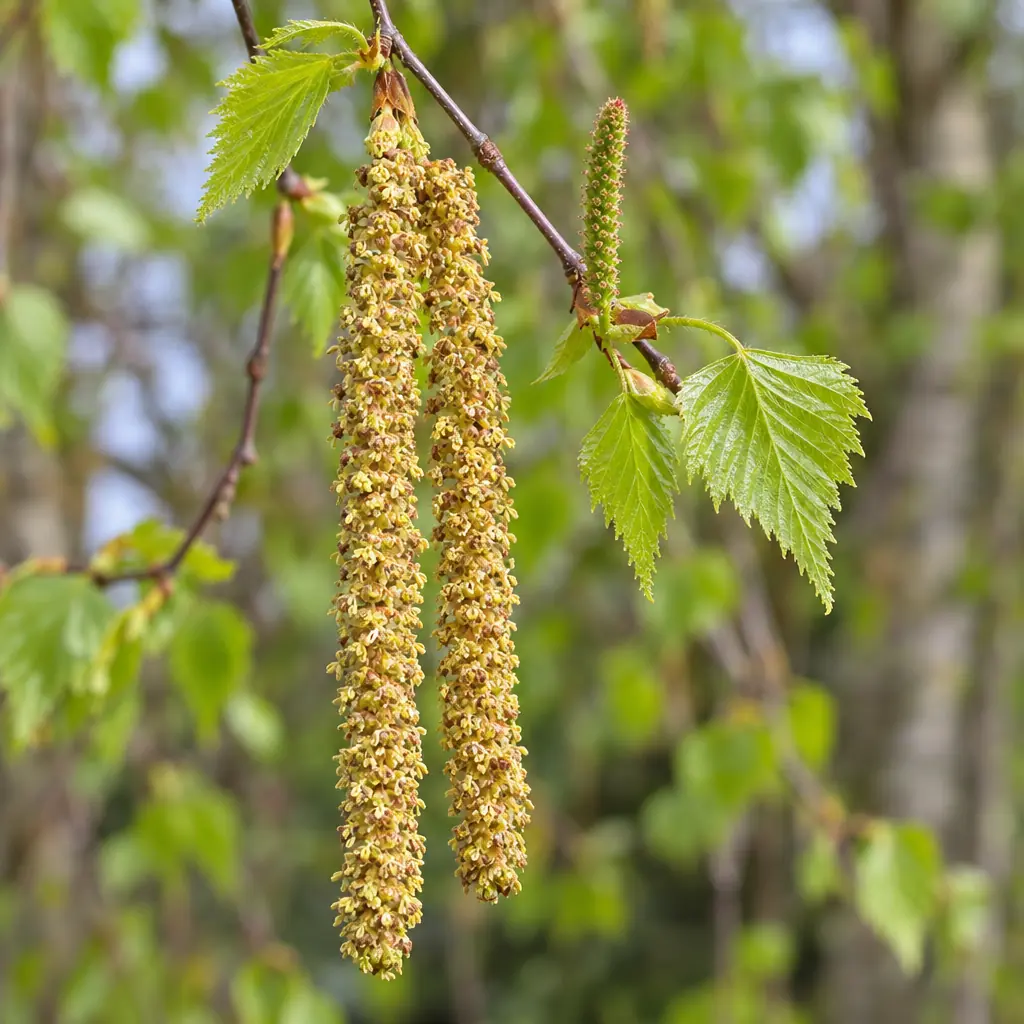
Flower 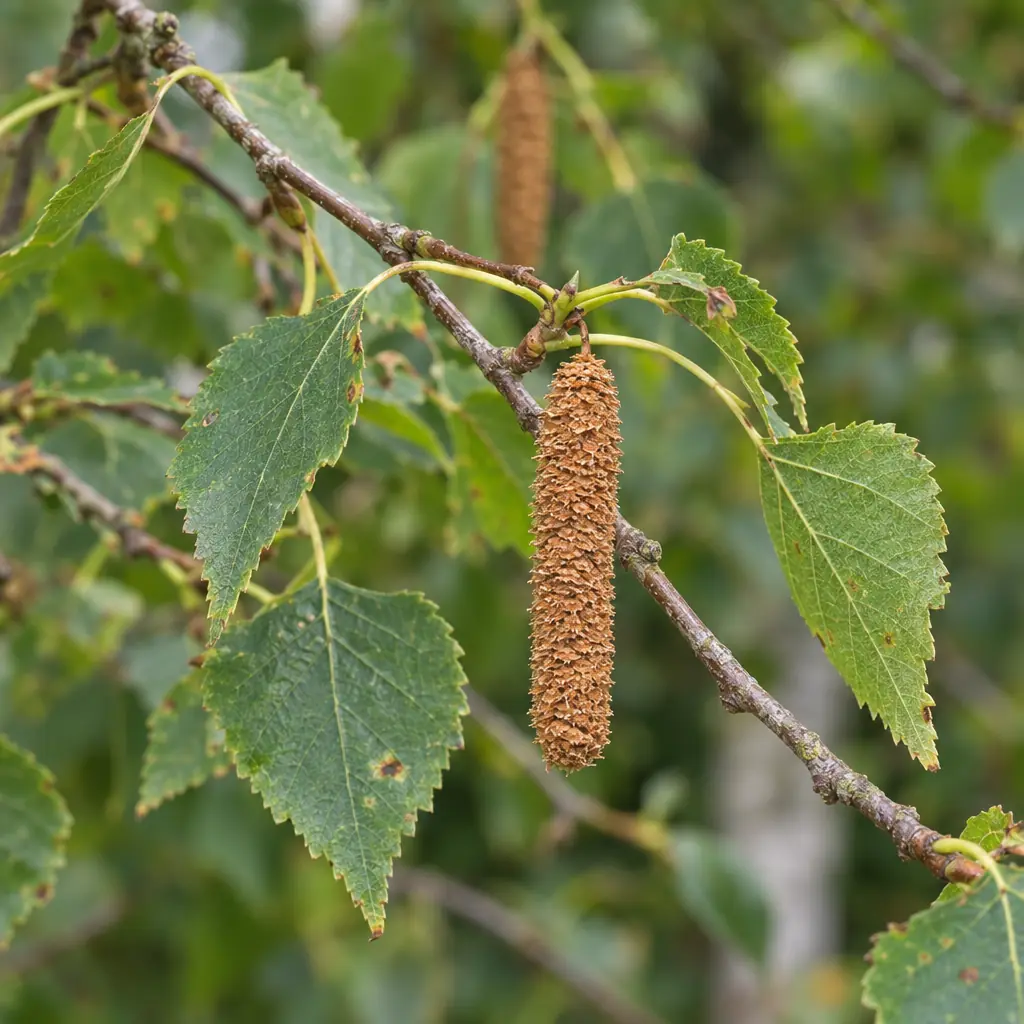
Fruit
How do I identify a silver birch?
Look at the trunk first. On a young tree the bark is red-brown. Later it turns silver-white and peels off. Near the ground, the trunk of an old birch grows dark and rough, as if the bark is splitting open.
Then check the twigs. Young twigs are thin and hang over, and they soon lose their hairs. Tiny resin glands make them feel slightly warty.
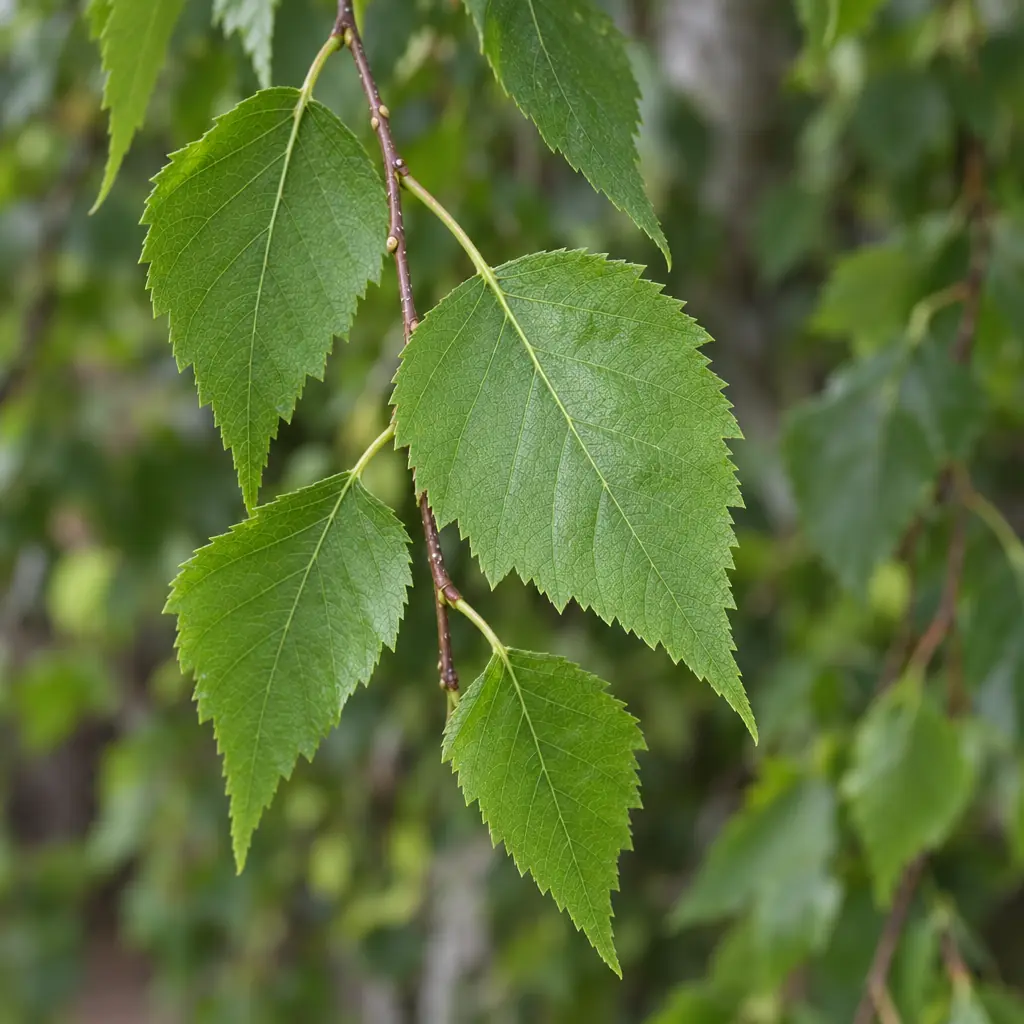
A leaf is 3 to 7 centimetres long, diamond-shaped and pointed. Its edge is double-toothed: large teeth with small ones in between. The male catkins hang down and grow 3 to 6 centimetres long. The female catkins stand upright. Each seed has a wing two to three times as wide as the tiny nut.
Watch out for downy birch. Its young twigs grow upwards at an angle, do not hang over and are hairy. The two species also cross with each other, so not every birch is purely one or the other.
Where does silver birch grow best?
Give silver birch sun or partial shade: at least 3 hours of direct sun a day in summer. More sun is fine too. In the wild the tree grows in woodland, on heathland and in the dunes. Acid sandy soil suits it well.
Two places in a Dutch garden cause trouble:
- A narrow back garden. The crown grows 8 to 12 metres wide. In a garden 6 metres wide, the tree hangs far over the neighbours' side.
- Close to the house when someone has hay fever. Birch pollen is a very strong allergen. More than 1 million people in the Netherlands are allergic to it.
In winter the birch stands bare. That is exactly when the white trunk stands out most.
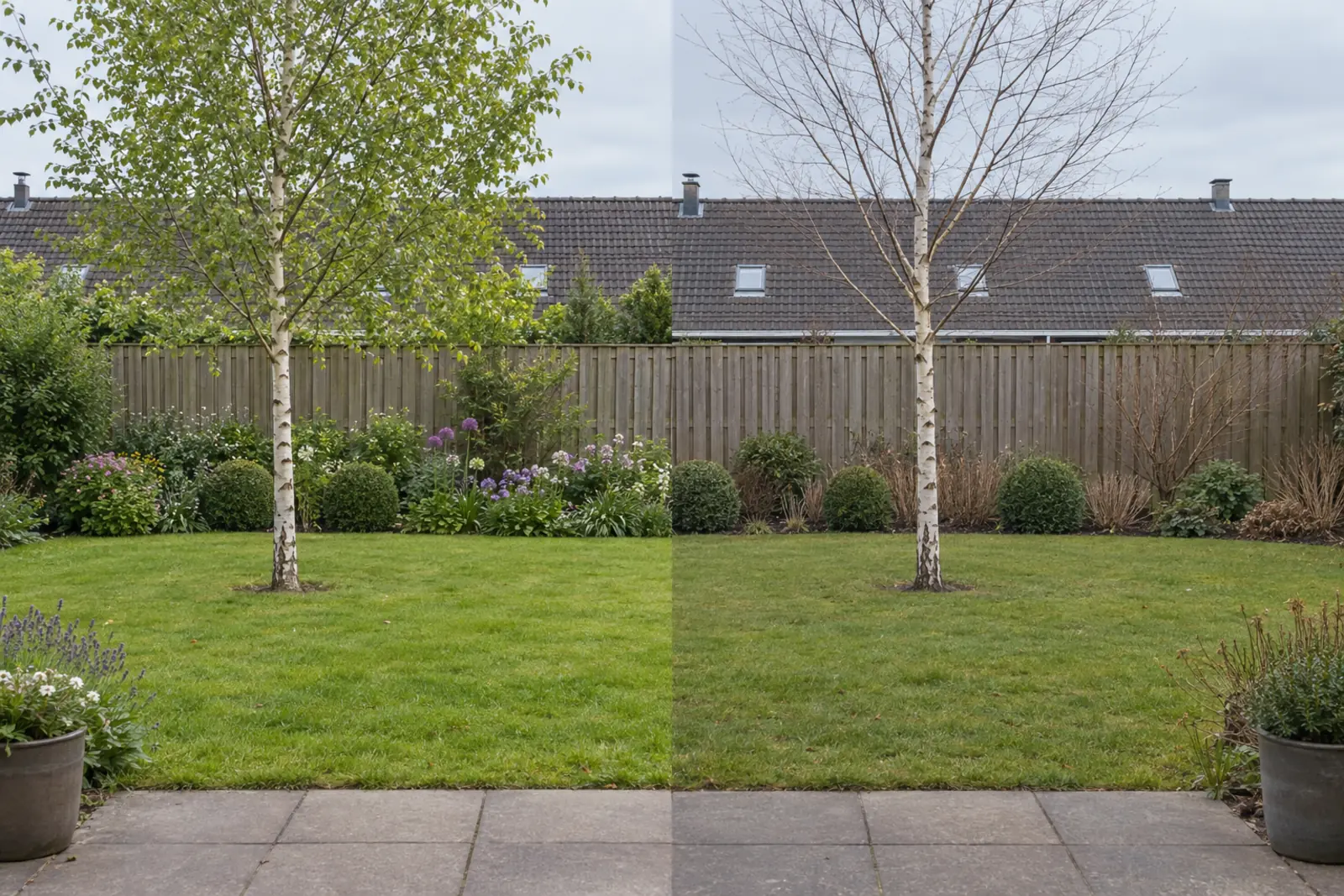 The same garden in May and in January. This is a generated image, not a photo.
A drawing of your own plot, to scale, shows how wide your garden really is. Your house and the buildings around it are on it too. That way you choose the spot for the birch before anyone starts digging.
How to plant and look after a silver birch
Plant a bare-root birch, sold without soil around its roots, between November and early March. The tree is dormant then. A young bare-root tree is the cheapest way to buy one, and Dutch nurseries sell it as ruwe berk. A tree in a pot can go into the ground all year round, but autumn or winter is still the best time for it too.
Set the trunk at least 4 to 6 metres from the house, the fence and other trees. That is half the width of the crown. On planting day the gap looks far too wide for such a thin stem. In a lawn, keep a circle around the trunk free of grass.
Water regularly in the first year. Until three years after planting, also water in long dry spells. A birch needs no pruning, and cutting it back hard is a bad idea.
| When | What to do |
|---|---|
| August to December | Prune only if you must, for example a dead branch |
| February to April | Do not prune: the cuts bleed a lot of sap |
Many birds nest from March through July, and some into August. So check the tree for a nest first.
Silver birch problems and what to do
The leaves have orange spots underneath. That is birch rust, a fungus. In a bad year the leaves drop a little early. A mature tree is hardly bothered by it. Clearing up the fallen leaves in autumn slows the fungus down a little.
Everything under the tree is sticky. Aphids give off a sticky honeydew. Black sooty mould sometimes grows on it. No control is needed, because natural enemies keep the aphids in check. A damp cloth takes the sticky film off tables and chairs.
A thick fungus is growing on the trunk. That may be birch polypore. This fungus grows only on birch and rots the wood. For birches it is the main cause of death. Have a tree with this fungus near the house or a path checked.
The leaves hang limp in summer. The soil is too dry. Birches root shallowly and cope badly with drought. Give the tree a good soaking.
No catkins appear. The tree is still too young. A birch usually starts flowering only at 10 to 15 years old.
Which birds and insects use silver birch?
In autumn and winter the siskin visits, often in small flocks. This little bird hangs acrobatically from the thin twigs. With its pointed beak it picks the seeds out of the birch catkins. The common redpoll also eats mostly birch and alder seed. That winter visitor does not turn up every year, but sometimes large flocks arrive.
The caterpillars of dozens of butterfly and moth species live on birch. The orange underwing is one of them. This small moth flies by day, from late February to late April. The northern winter moth flies later in the year, from October to mid-December.
Is silver birch poisonous?
Silver birch is not known to be poisonous. That does not make it edible. In spring, though, people tap sap from the trunk. They drill shallow holes in the trunk and catch the sap through a small tube. Because the sap contains sugar, it is also fermented into an alcoholic drink.
The photos on this page were made with AI, based on real photos and descriptions of this plant.
Frequently asked questions
How big does a silver birch get?
Usually 15 to 20 metres tall, sometimes 30 metres. The crown grows 8 to 12 metres wide. That is too big for a narrow back garden.
How much sun does a silver birch need?
Sun to partial shade. Count on at least 3 hours of direct sun a day in summer. More sun is fine too.
When should I prune a birch tree?
A birch needs no pruning. If a cut is unavoidable, make it between August and December and check for a nest first. From February through April the cuts bleed a lot of sap.
Is silver birch poisonous?
No, silver birch is not known to be poisonous. That does not make it edible. Its pollen does give many people hay fever.
What is the difference between silver birch and downy birch?
On silver birch the young twigs hang down and are hairless, with small resin warts. Downy birch has hairy twigs that grow upwards at an angle. The two species also cross with each other.
Sources (30)
- Duistermaat, Sparrius & Denters, Standaardlijst van de Nederlandse flora 2020 (Gorteria 43)
- NDFF Verspreidingsatlas — Betula pendula
- NDFF Verspreidingsatlas — Betula pubescens (zachte berk)
- NDFF Verspreidingsatlas — Berkenzwam
- Flora van Nederland — Ruwe berk
- Wikipedia — Ruwe berk
- RHS — Betula pendula (silver birch)
- RHS — How to grow birch
- RHS — Bleeding from pruning cuts
- RHS — Birch trees for winter interest
- RHS — Shade gardening (definities zon en halfschaduw)
- RHS — Tree rusts
- RHS — Aphids
- USDA Woody Plant Seed Manual — Betula
- De Vlinderstichting — Berk (waardplant)
- De Vlinderstichting — Oranje berkenspanner
- De Vlinderstichting — Berkenwintervlinder
- Vogelbescherming — Sijs
- Vogelbescherming — Grote barmsijs
- Vogelbescherming — Snoeien in het broedseizoen, mag dat?
- Imkerpedia — Drachtplanten (nectar- en pollenwaarde voor de honingbij)
- LUMC — Bomenkompas voor allergeniciteit (2023)
- Antigifcentrum — Lijst van weinig of niet giftige planten
- Van den Berk Boomkwekerijen — Betula pendula (hoogte en kroonbreedte)
- Directplant — Berk, bosplantsoen (prijs kale wortel en in pot)
- Garmundo — Ruwe berk (prijs kale wortel)
- Yarinde — Ruwe berk (prijs in pot)
- Wikimedia Commons — Leaf: photo by Donald Hobern from Copenhagen, Denmark (CC BY 2.0)
- Wikimedia Commons — Flower: photo by AnRo0002 (CC0)
- Wikimedia Commons — Fruit: photo by Donald Hobern from Copenhagen, Denmark (CC BY 2.0)