5 min read
Sweet woodruff: planting, care and price
Galium odoratum
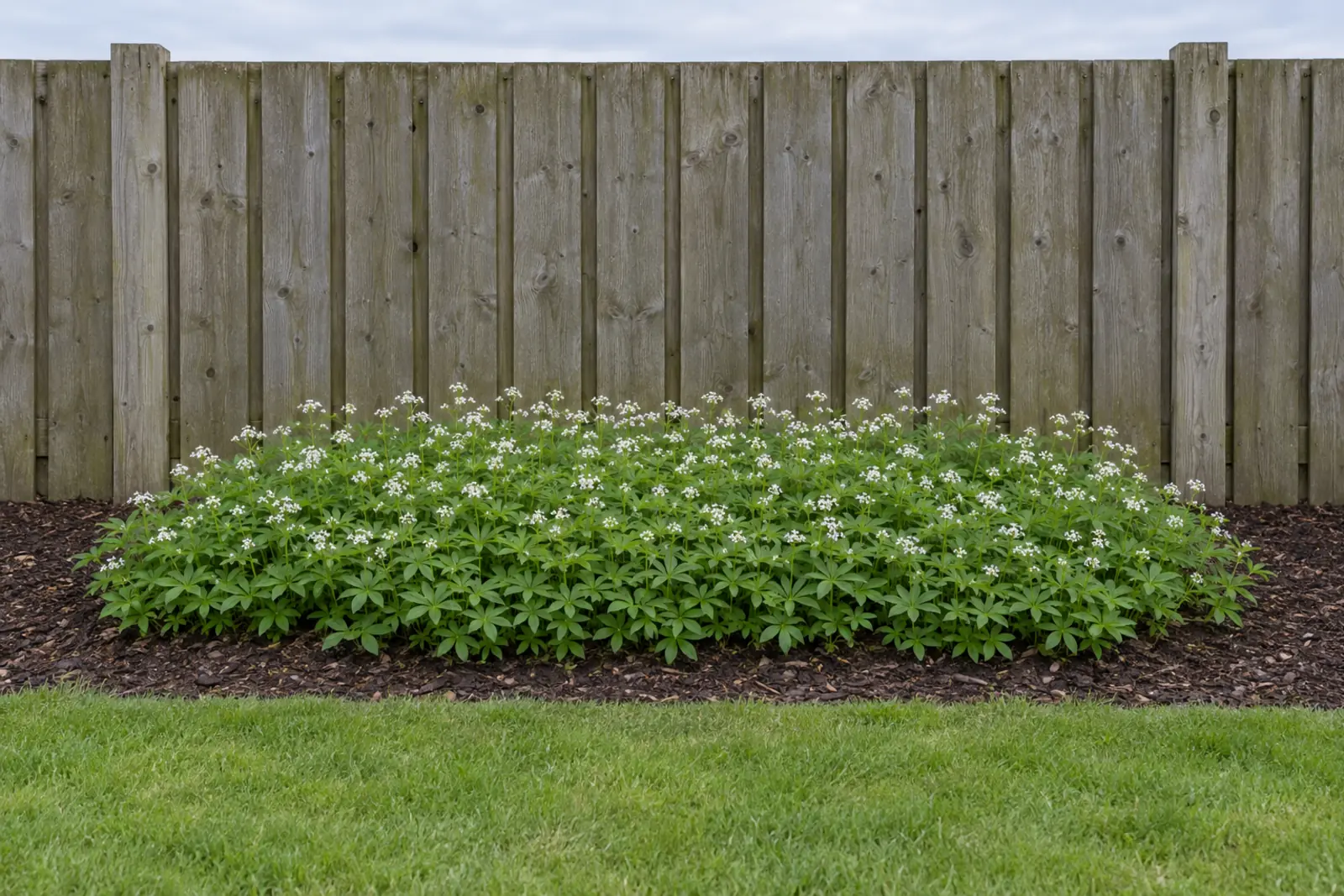
Sweet woodruff (Galium odoratum) is a native ground cover for shade. It forms a flat mat of upright stems, 15 to 30 cm tall, with whorls of bright green leaves around each stem. Tiny white star flowers appear in late spring. It thrives under trees and shrubs, in moist, crumbly soil.
Sweet woodruff at a glance
| Feature | Sweet woodruff |
|---|---|
| Height | 15 to 30 cm |
| Spread | 1 to 1.5 m per plant |
| Full grown after | 5 to 10 years |
| Sun | Partial shade to shade |
| Soil | Moist and crumbly, not waterlogged |
| Water | Average: the soil should stay moist |
| Maintenance | Low: no pruning, sometimes trim the edge back |
| Flowers | May and June, white |
| For bees | Little: some nectar and pollen, May and June |
| Hay fever | Not or weakly allergenic |
| Leaves | Stay green in most winters |
| Hardy | Yes |
| Native | Yes |
| Poisonous | Harmful in large amounts |
| Pricks or stings | No |
| Price, young | €2.33 to €3.89 each, 5-10 cm, potted; lowest price from 12 plants |
| Price, grown | €5.09 to €7.95 each, 10-20 cm, potted; lowest price from 12 plants |
- Leaf
- all year
- Flower
- May to June
- Fruit
- July to August
Leaf 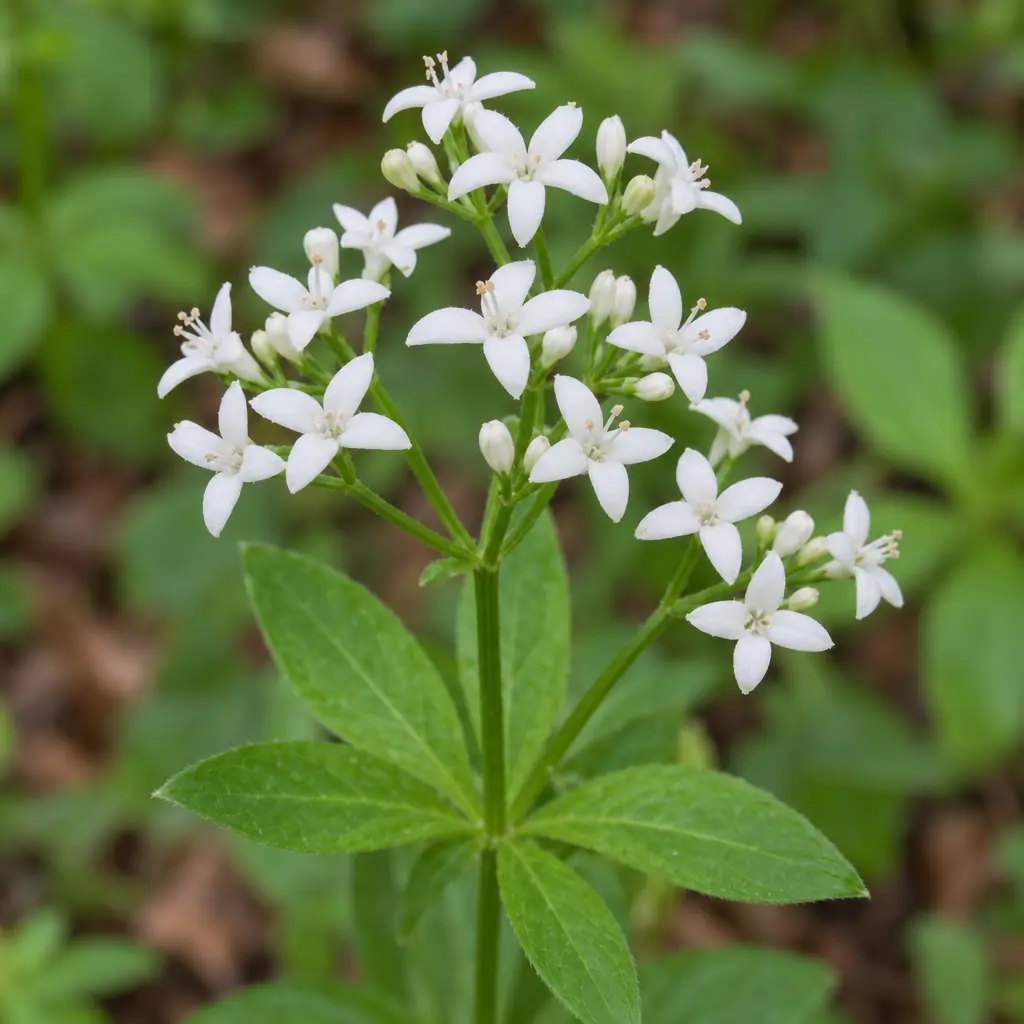
Flower 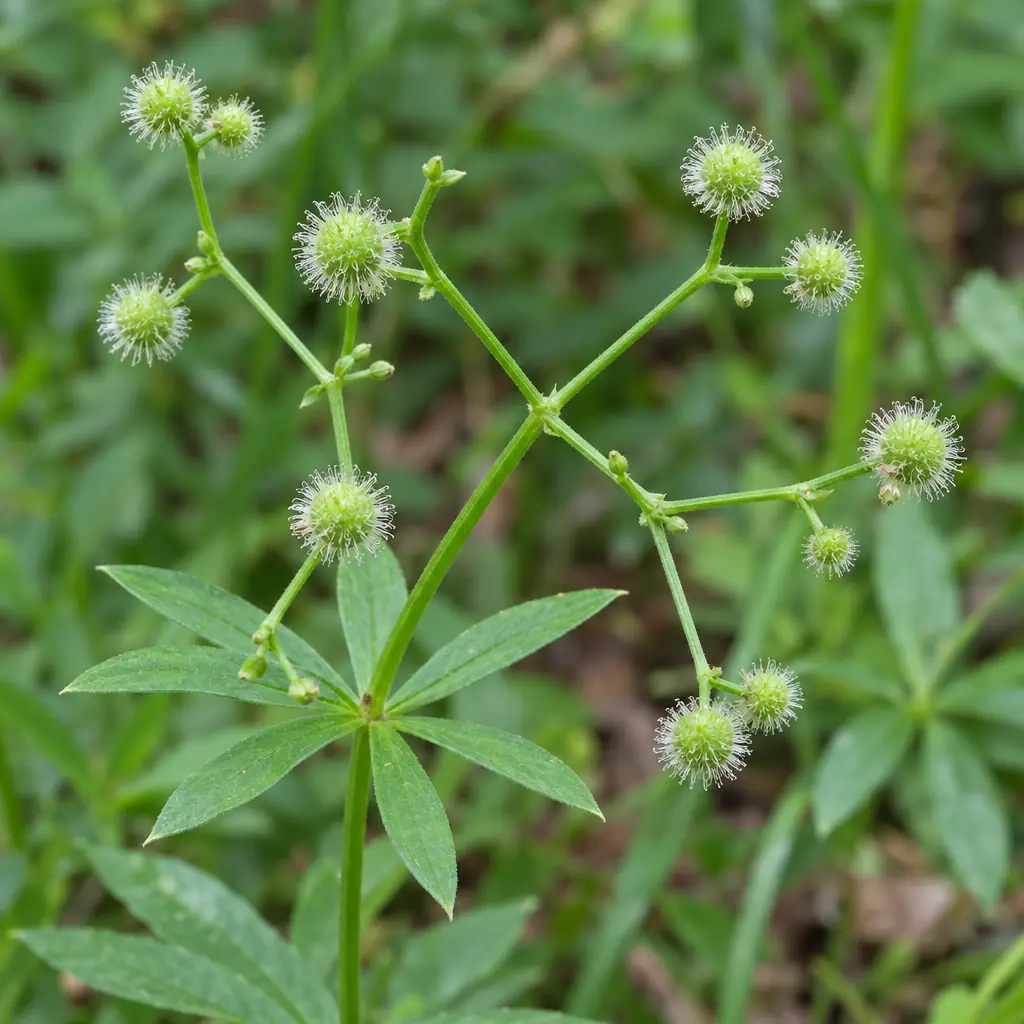
Fruit
How do you recognise sweet woodruff?
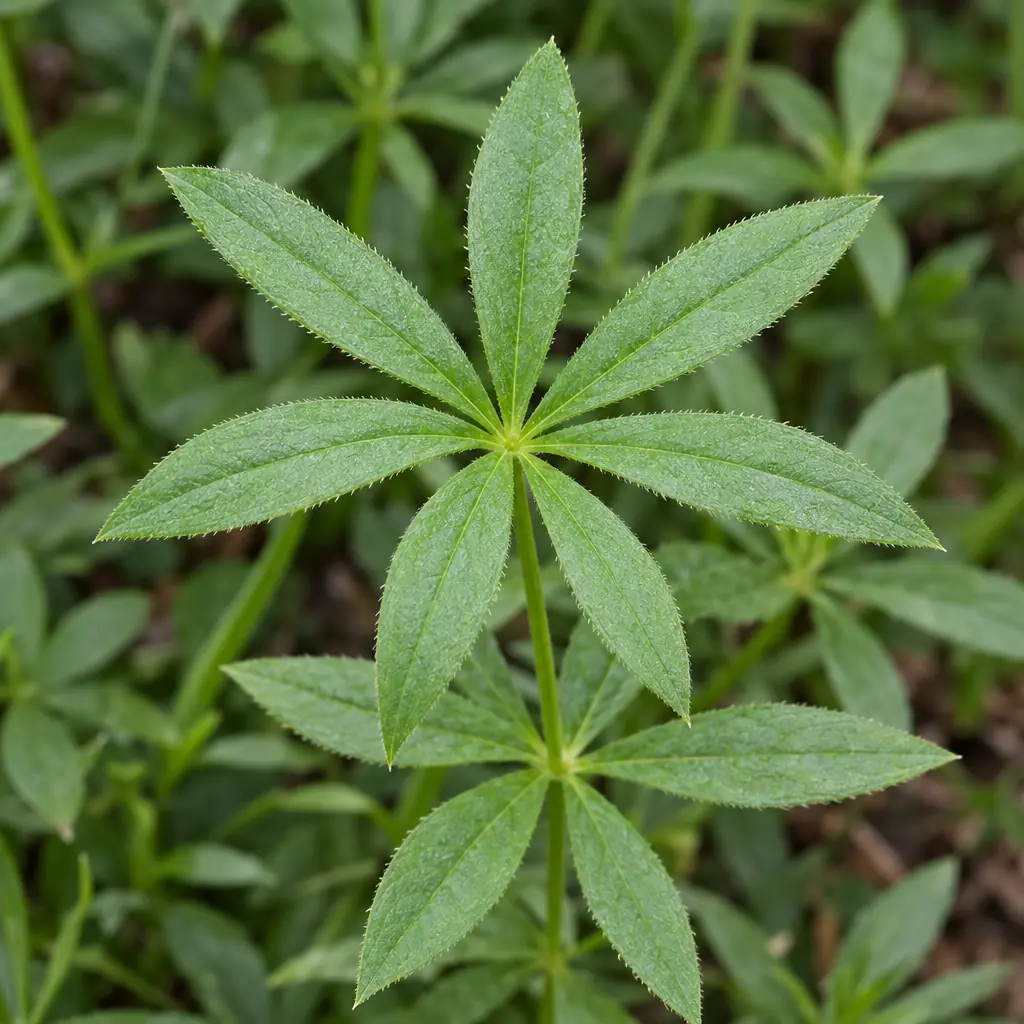
Look first at the leaves. They sit in whorls around the stem, like a green star. Low on the stem, a whorl has six leaves; higher up, eight. For a bedstraw, the leaves are strikingly broad. Along the edge and on the midrib underneath, they feel slightly rough from short hairs. The stem is square, smooth and hairless.
The flowers are white and 4 to 7 millimetres across. Each one is a small funnel with four lobes. Near the top of the stem, they sit together in a loose cluster. Round fruits follow, 2 to 3 millimetres, covered in small hooks. Like tiny burrs, they cling to fur, and that is how the seeds travel.
The species it resembles most is cleavers, also a bedstraw. Cleavers has narrow leaves and weak stems that lean on other plants. Sweet woodruff stands upright, and its whorls are much broader.
Where does sweet woodruff grow best?
Sweet woodruff grows well in partial shade and in shade. Partial shade means three to six hours of direct sun a day around midsummer. Under trees, in full shade, the plant also does well. The top layer of soil is best kept moist and crumbly, with fallen leaves on it. In the wild, the species grows mainly in lime-rich broadleaf woods in the south of Limburg.
Two spots in an ordinary garden suit it poorly:
- A sunny front garden with no shade. Strong sun scorches the leaves there, and they turn brown.
- A border of low perennials. The rhizomes creep on quickly and push between their neighbours. Plants taller than 60 centimetres are not bothered by it.
In winter the leaves usually stay green and visible.
When you draw the border on a plan of your own plot, you see which of your shrubs leave room for a mat one and a half metres wide. The app pulls your plot boundary from the Kadaster, the Dutch cadastre, and sets the buildings around it to scale.
Planting and caring for sweet woodruff
Nurseries sell sweet woodruff as a young plant in a pot. A potted plant can go into the ground at any time of year, as long as the soil is not frozen or waterlogged. Space the plants about 30 centimetres apart, roughly nine per square metre. On the first day, the bed looks bare. The rhizomes close the gaps by themselves, because one plant grows well over a metre wide. Water in dry weeks during the first year.
No pruning is needed. There are two small jobs:
| When | What to do |
|---|---|
| When the mat creeps too far | Cut the edge with a spade, or mow it with the mower set high |
| Autumn or early spring | Dig up a piece with its rhizome and plant it elsewhere |
Where the mat grows under a hedge, keep nesting birds in mind. Many bird species nest from March through July.
What can go wrong with sweet woodruff?
The mat grows through everything. On moist, fertile soil, the plant grows far more vigorously than on poor soil. A mat once established is hard to get rid of. So choose the spot with care beforehand, among shrubs taller than the mat.
In midsummer the plant disappears. On a dry, sunny spot, sweet woodruff already goes dormant by then. Water in dry weeks, or move the plant to a spot in the shade.
There are no more flowers. After June, the plant is a green mat with no flowers. That is normal.
Pests and diseases are uncommon on this plant.
Which insects and birds use sweet woodruff?
What the plant offers is a little nectar and a dense, low mat. Which insects actually visit it is not described by name for this species.
The mat is good for three garden birds: the dunnock, the robin and the wren.
Is sweet woodruff poisonous or edible?
The leaves contain coumarin. Taking in a lot of it over a long time can damage the liver. In sensitive people, liver enzyme levels rise, sometimes leading to jaundice. Too large an amount causes dizziness.
The leaves are used to flavour syrup and May wine. That use comes with limits on the amount, precisely because of the coumarin. The plant has no thorns, prickles or stinging hairs.
The photos on this page were made with AI, based on real photos and descriptions of this plant.
Frequently asked questions
How tall does sweet woodruff grow?
The stems grow 15 to 30 centimetres tall. Through its rhizomes, one plant spreads into a mat 1 to 1.5 metres wide.
Does sweet woodruff spread out of control?
On moist, fertile soil, it can. The rhizomes creep on quickly, and a mat once established is hard to get rid of. Plants taller than 60 centimetres are not bothered by it.
Is sweet woodruff poisonous?
The leaves contain coumarin. A lot of coumarin, taken in over a long time, harms the liver. Too large an amount causes dizziness.
Does sweet woodruff grow in shade?
Yes. It grows well in partial shade, with three to six hours of direct sun a day around midsummer, and in full shade under trees. In strong sun, the leaves scorch.
Does sweet woodruff stay green in winter?
Usually. In most winters, the green leaves stay visible. New stems grow in spring.
Sources (20)
- Duistermaat, Sparrius & Denters, Standaardlijst van de Nederlandse flora 2020 (Gorteria 43)
- NDFF Verspreidingsatlas — Galium odoratum
- Flora van Nederland — Lievevrouwebedstro
- RHS — Galium odoratum (sweet woodruff)
- RHS — Shade gardening (definities zon en schaduw)
- RHS — Planting perennials
- Missouri Botanical Garden — Galium odoratum
- University of Wisconsin–Madison Extension — Sweet woodruff
- PFAF — Galium odoratum
- AGES — Cumarin
- Imkerpedia — Drachtplanten
- Pollennieuws / Flora van Nederland — Aandachtspunten hooikoorts vriendelijke tuin
- Vogelbescherming — Meer vogels in je tuin
- Vogelbescherming — Snoeien in het broedseizoen, mag dat?
- Directplant — Lievevrouwebedstro (prijs en aantal per m²)
- PlantBezorgd — Galium odoratum (prijs)
- Heijnen Planten — Galium odoratum (prijs)
- Wikimedia Commons — Leaf: photo by AnRo0002 (CC0)
- Wikimedia Commons — Flower: photo by AnRo0002 (CC0)
- Wikimedia Commons — Fruit: photo by AnRo0002 (CC0)