5 min read
Flowering rush as a pond plant: position and care
Butomus umbellatus
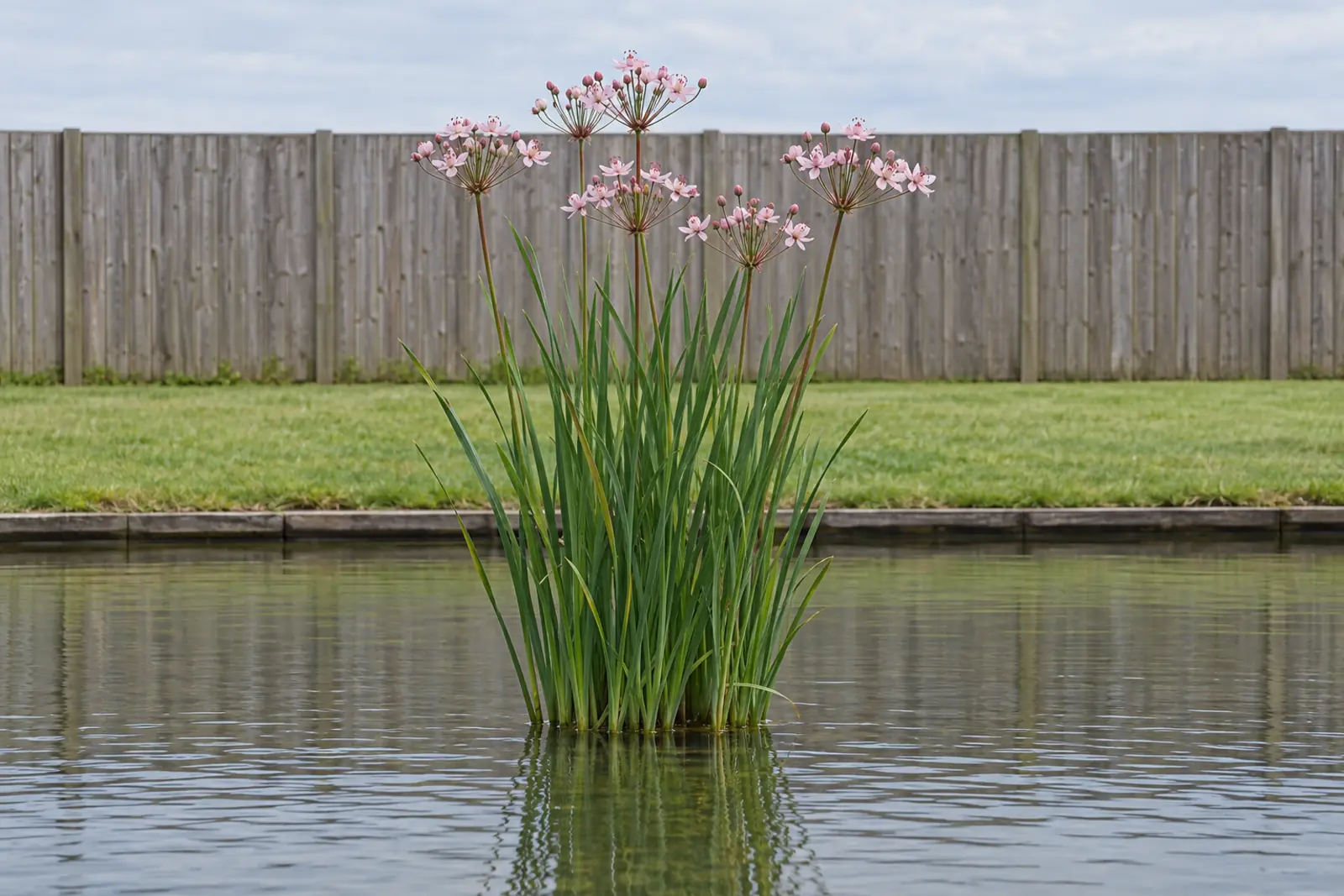
Flowering rush (Butomus umbellatus) is a native marginal plant for the shallow edge of a pond. From a clump of narrow, upright leaves rise bare stems, each topped with an umbel of light pink flowers. The plant grows 30 centimetres to one and a half metres tall. Flowering rush blooms from June to September and needs full sun.
Flowering rush at a glance
| Feature | Flowering rush |
|---|---|
| Height | 0.3 to 1.5 m |
| Spread | 0.1 to 0.5 m |
| Full grown after | 2 to 5 years |
| Sun | Full sun |
| Soil | Nutrient-rich mud in shallow water |
| Water | Plenty: the base stands under water |
| Maintenance | Low: remove old leaves once a year |
| Flowers | June to September, light pink |
| For bees | Yes: the flowers give nectar and pollen, June to September |
| Hay fever | Not or weakly allergenic |
| Leaves | Drop in autumn |
| Hardy | Yes |
| Native | Yes |
| Poisonous | No: no hazards are known |
| Pricks or stings | No |
| Price, young | About €4.95 to €4.99 per plant, in a small pot |
| Price, grown | About €8.50 to €23.75 per pond basket, the dearest with 4 plants |
- Leaf
- April to October
- Flower
- June to September
- Fruit
- August to September
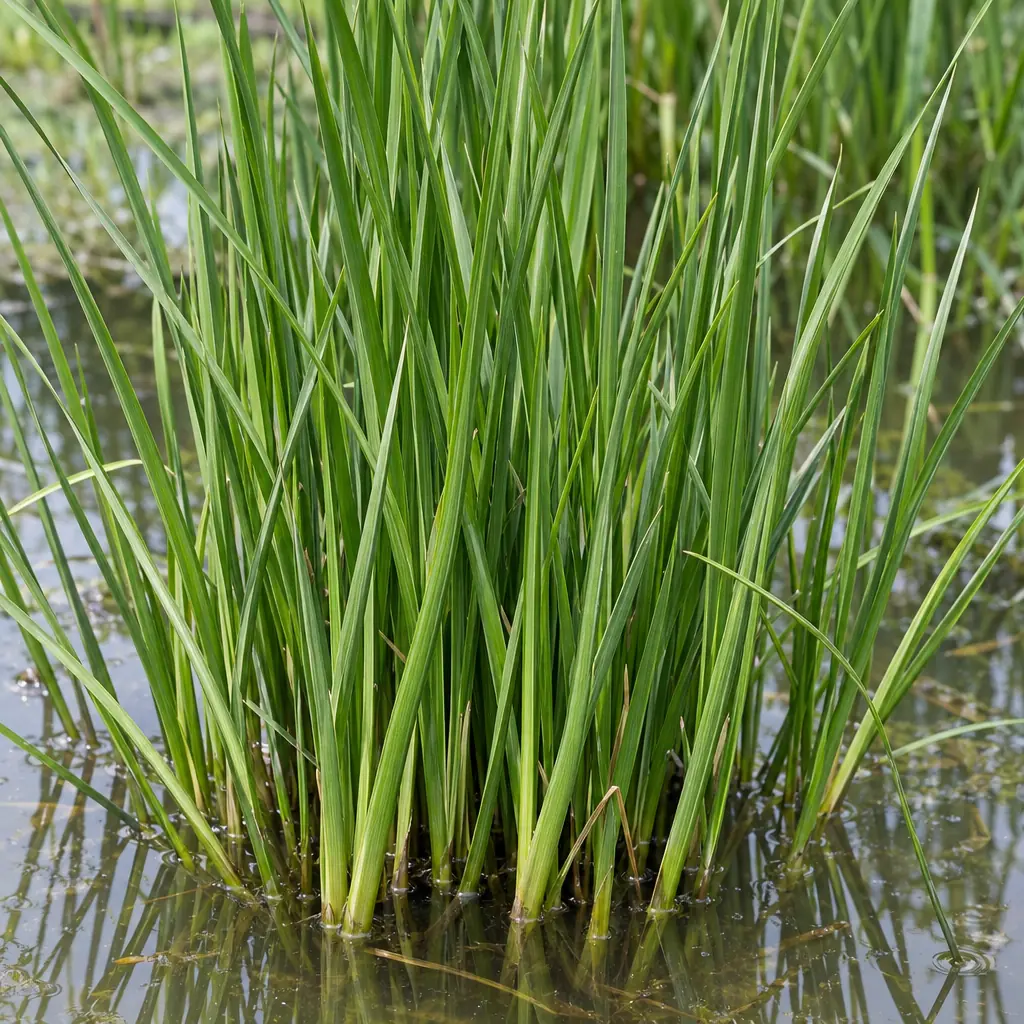
Leaf 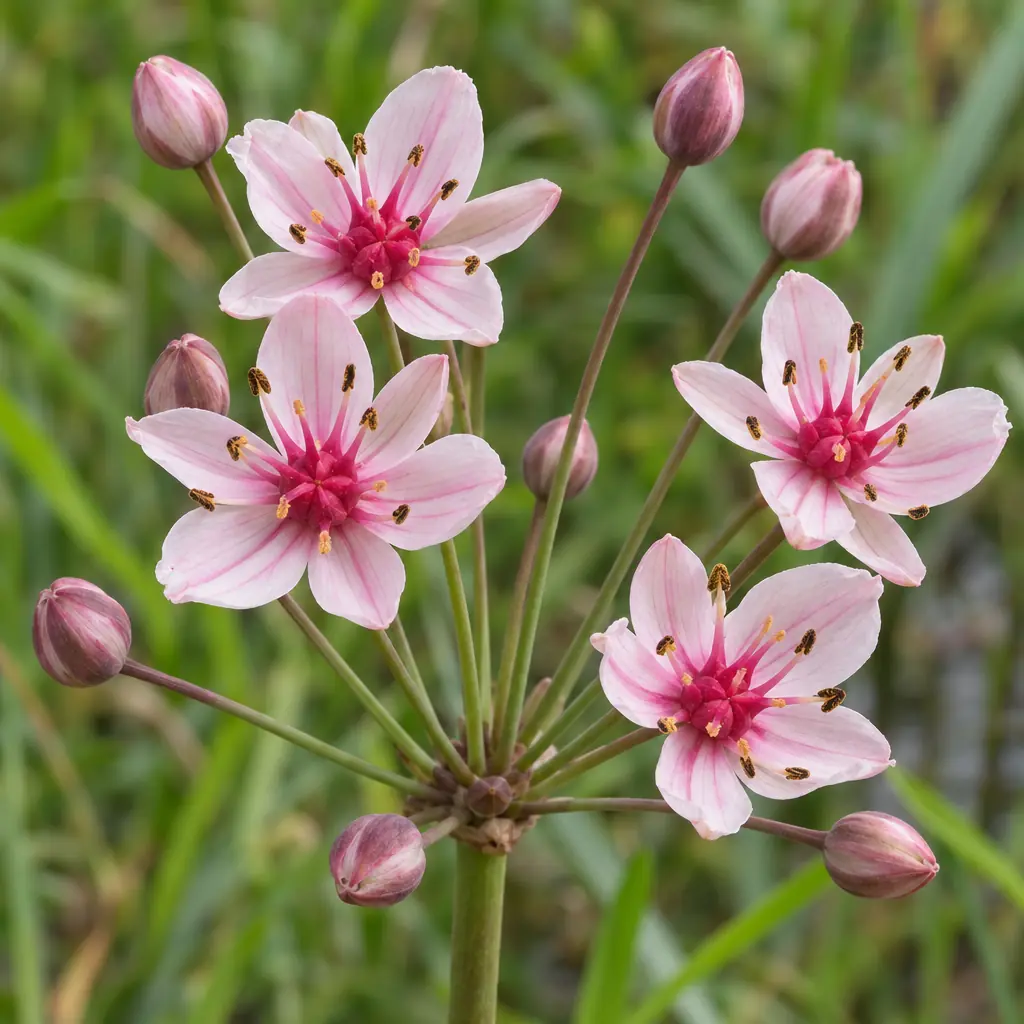
Flower 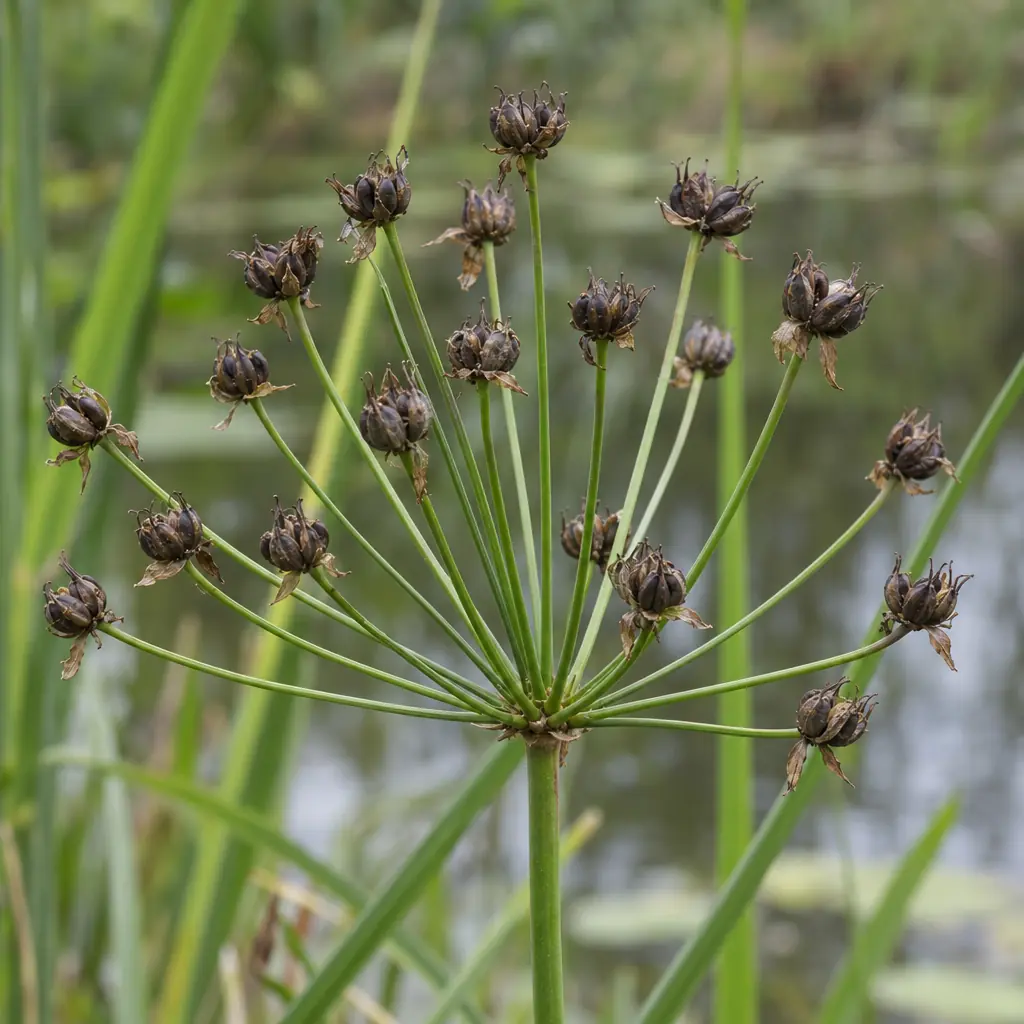
Fruit
How do you recognise flowering rush?
Start with the leaves. All of them grow straight from the ground and stand upright. Each leaf is long and narrow, a little twisted and three-sided at the base.
The flower stems are round, sturdy and bare, often tinged red. At the top sits a loose umbel, spread like the ribs of an umbrella. Each flower has its own stalk from the tip of the stem. The flowers are light pink with dark veins and 1.6 to 2.6 centimetres across. In the centre are nine red stamens. Up close, the flowers smell of bitter almond. After flowering, small reddish-purple fruits form in groups of six.
Without flowers, flowering rush looks like a bulrush or a true rush. In that case, look at the base of the leaf: it is three-sided. Cultivars exist too. 'Rosenrot' flowers mid to deep pink, 'Schneeweisschen' white.
Where does flowering rush grow best?
Choose a sunny pond edge, a spot that gets more than six hours of direct sunlight around midsummer. The base of the plant does best in still water.
Two places in a garden do not suit flowering rush:
- A dry border. Flowering rush is a marsh plant and needs wet soil or shallow water.
- A pond without a shallow edge. Flowering rush does not belong in the deep zone of a pond.
In autumn the leaves die back. Until spring, a clump of straw-brown leaves remains, partly bent over onto the water.
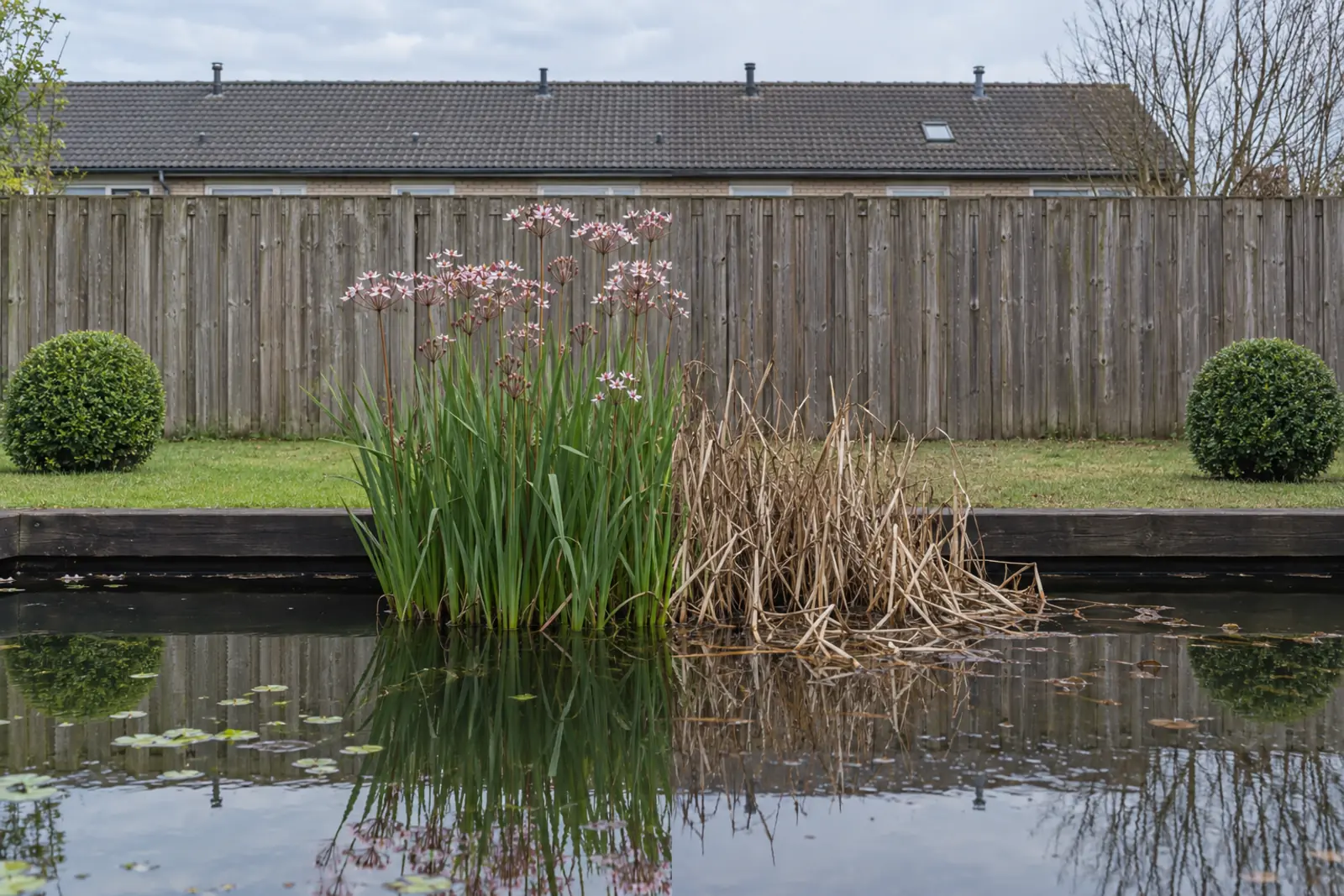 One pond edge with flowering rush, in July and in January. This is a generated image, not a photograph.
In the app you can first try out where those narrow clumps go in your own garden. The app draws the plant at a grown plant's width, not at pot size.
Planting and caring for flowering rush
Plant flowering rush in spring, when new growth comes up again from the roots. Nurseries sell it in a small pot or in a pond basket. Set the plant so that there is usually 10 to 30 centimetres of water above its base.
One nursery gives a planting density of 12 plants per square metre. On planting day that looks like a bare edge with a few green blades. Watering is not needed as long as the base stays under water.
| When | What to do |
|---|---|
| After flowering | Cut off the spent flower stems |
| Autumn or spring | Remove the dead leaves |
| Spring | Divide a clump that grows too dense |
Many bird species breed from March through July. Before you remove stems in those months, check whether there is a nest in the clump.
If a piece is left over after dividing, never put it out in a ditch, a lake or any other natural water.
What goes wrong with flowering rush?
No flowers appear. Check the water depth. In deep water flowering rush does not come up above the surface, and the plant does not flower. Move the plant to shallower water.
Small reddish-brown or dull green aphids sit on the leaves and buds. That is probably the water lily aphid. Damage usually only happens in summer, when a dense colony forms. Wipe the aphids off the leaves and buds.
The leaves turn yellow and brown. In autumn that is normal, because the plant loses its leaves every year.
Which insects and birds use flowering rush?
The flowers give nectar and pollen. Many hoverflies visit them, and hoverflies in turn are food for dragonflies. That makes flowering rush a good fit for a pond meant for dragonflies.
A dense edge of flowering rush, yellow iris or water mint also helps against the grey heron. Such an edge makes it harder for the heron to reach the fish in your pond.
Is flowering rush poisonous or edible?
No hazards are known for flowering rush. That tells you nothing about eating it, though. The rhizome is eaten, but only cooked, peeled and with the rootlets removed. More than half of that rhizome is starch.
The photos on this page were made with AI, based on real photos and descriptions of this plant.
Frequently asked questions
How tall does flowering rush grow?
Flowering rush grows 30 centimetres to one and a half metres tall. The flower umbels rise above the narrow leaves.
How deep should flowering rush be planted in a pond?
Usually with 10 to 30 centimetres of water above the base of the plant. In deep water flowering rush does not come above the surface and does not flower.
Does flowering rush spread?
In a garden pond flowering rush usually grows at a calm to moderate pace. If the clump gets too dense, divide it in spring.
Is flowering rush poisonous?
Flowering rush is not known to be poisonous. That does not mean you can just eat the plant.
Is flowering rush native to the Netherlands?
Yes. Flowering rush is native to the Netherlands. In the west and centre of the country the species is common.
Sources (25)
- Duistermaat, Sparrius & Denters, Standaardlijst van de Nederlandse flora 2020 (Gorteria 43)
- NDFF Verspreidingsatlas — Butomus umbellatus
- Flora van Nederland — Zwanenbloem
- RHS — Butomus umbellatus
- RHS — Butomus umbellatus 'Rosenrot'
- RHS — Butomus umbellatus 'Schneeweisschen'
- RHS — Shade gardening (definities zon en schaduw)
- RHS — Waterlily invertebrates
- PFAF — Butomus umbellatus
- Wisconsin DNR — Flowering rush
- King County — Flowering rush identification
- Wilde planten in Nederland en België — Zwanenbloem
- Pollennieuws / Flora van Nederland — Aandachtspunten hooikoorts vriendelijke tuin
- Imkerpedia — Drachtplanten
- De Vlinderstichting — Hoe lok je libellen naar je tuin? (Vlinders 3, 2015)
- Vogelbescherming — 5 veel gehoorde vogelergernissen
- Vogelbescherming — Snoeien in het broedseizoen, mag dat?
- Biovijver — Zwanenbloem (waterdiepte en onderhoud)
- Vijverkenner — Butomus umbellatus (prijs en plantdichtheid)
- Vijvermeester — Zwanenbloem (prijs)
- De Vijvertuinen van Ada Hofman — Butomus umbellatus (prijs)
- Hagedorn Waterplanten — Zwanenbloem in mand (prijs)
- Wikimedia Commons — Leaf: photo by AnRo0002 (CC0)
- Wikimedia Commons — Flower: photo by AnRo0002 (CC0)
- Wikimedia Commons — Fruit: photo by AnRo0002 (CC0)