6 min read
Yellow iris: where to plant it, care and wildlife
Iris pseudacorus
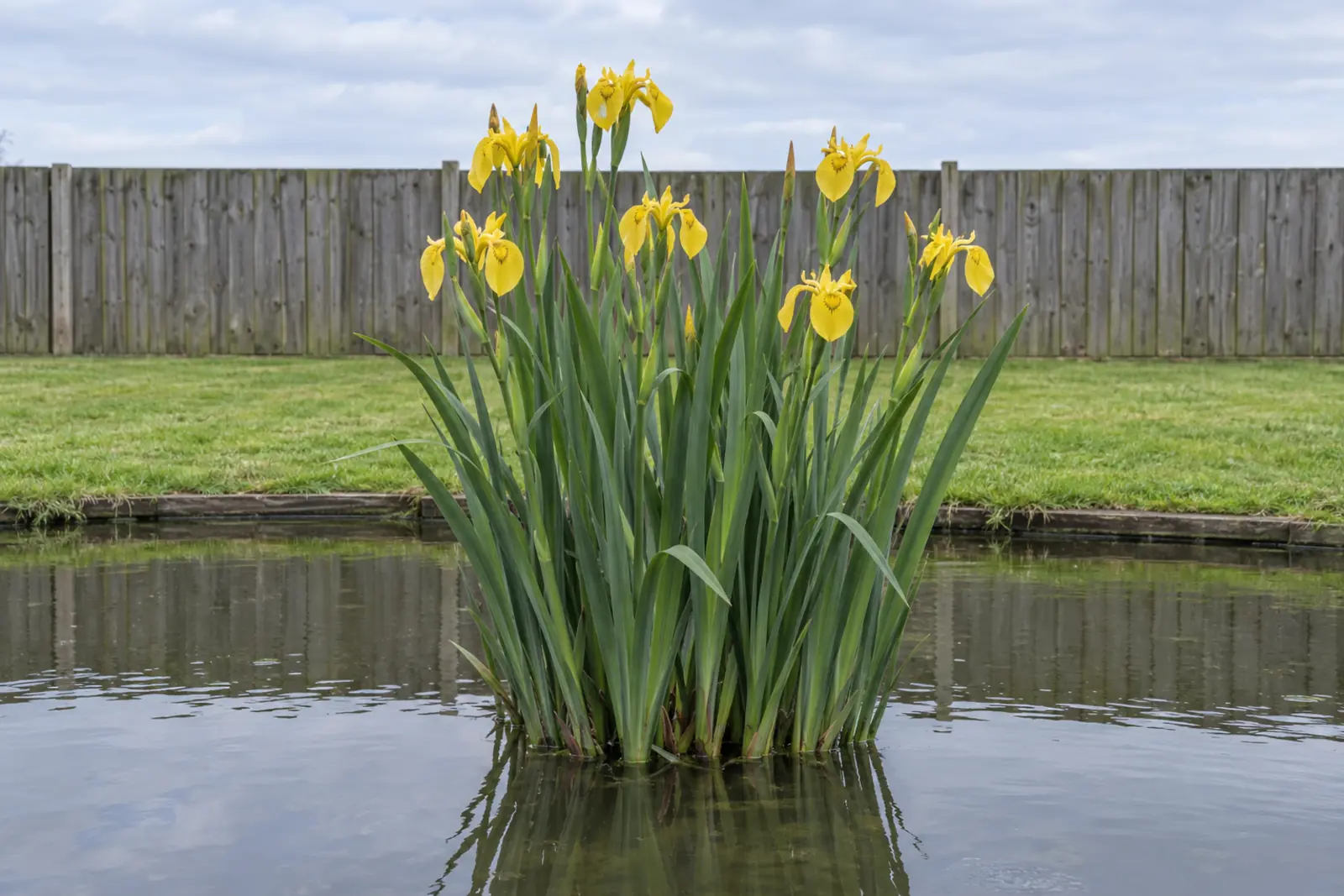
Yellow iris (Iris pseudacorus) is a native marginal plant for wet soil and shallow water. The clump grows 40 to 120 centimetres tall, with stiff, sword-shaped leaves. From May to July, large yellow flowers open above the leaves. The plant likes full sun or partial shade, and it is common along Dutch ditches.
Yellow iris at a glance
| Feature | Yellow iris |
|---|---|
| Height | 0.4 to 1.2 m |
| Spread | 1 to 1.5 m per clump |
| Full grown after | 2 to 5 years |
| Sun | Full sun to partial shade |
| Soil | Wet and rich in nutrients, or shallow water |
| Water | Plenty: its base can stand in water |
| Maintenance | Low: remove dead leaves in autumn |
| Flowers | May to July, yellow |
| For bees | Little: some nectar and pollen, May to July |
| Hay fever | Not or weakly allergenic |
| Leaves | Drop in autumn |
| Hardy | Yes |
| Native | Yes |
| Poisonous | Mildly: especially the rhizome |
| Pricks or stings | No |
| Price, young | About €3.29 to €4.99 each, in a small nursery pot |
| Price, grown | About €9.75 to €9.99 each, in a large pot or pond basket |
- Leaf
- March to November
- Flower
- May to July
- Fruit
- July to October
Leaf 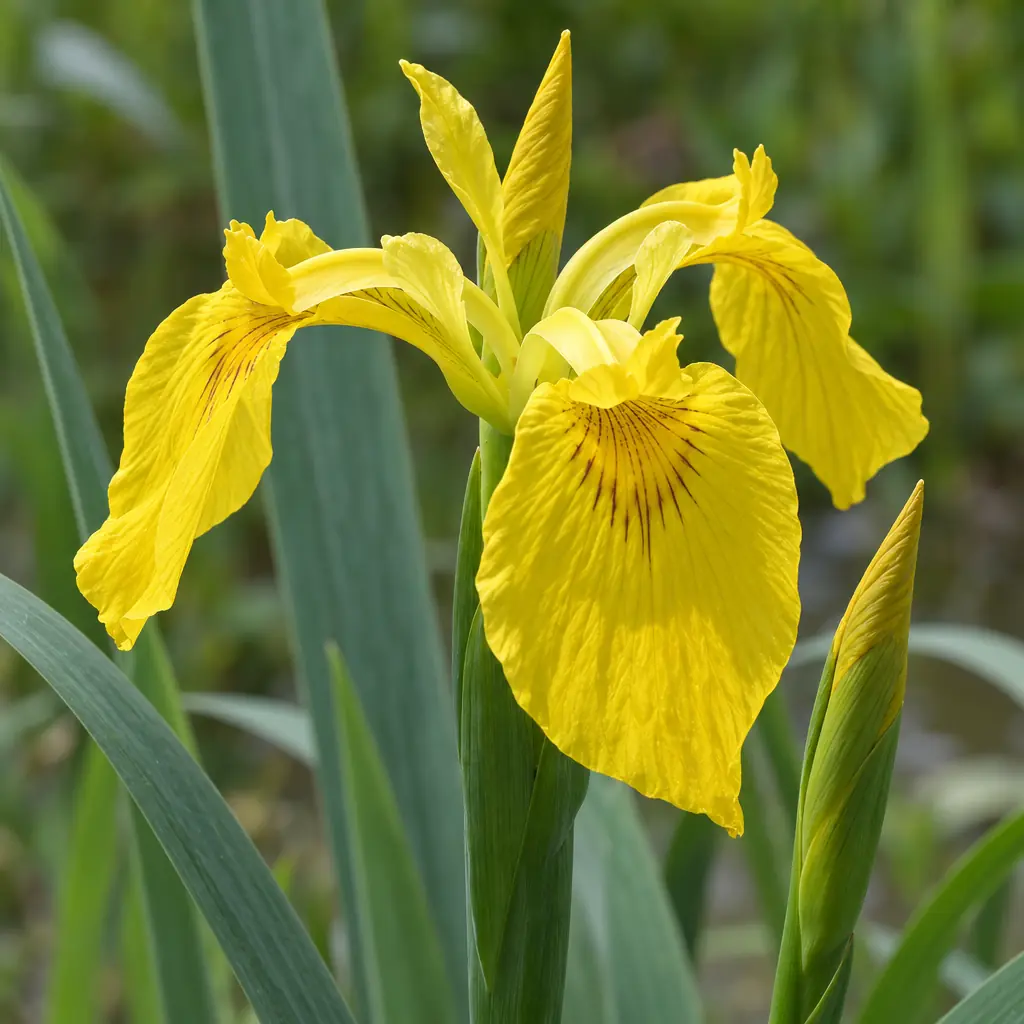
Flower 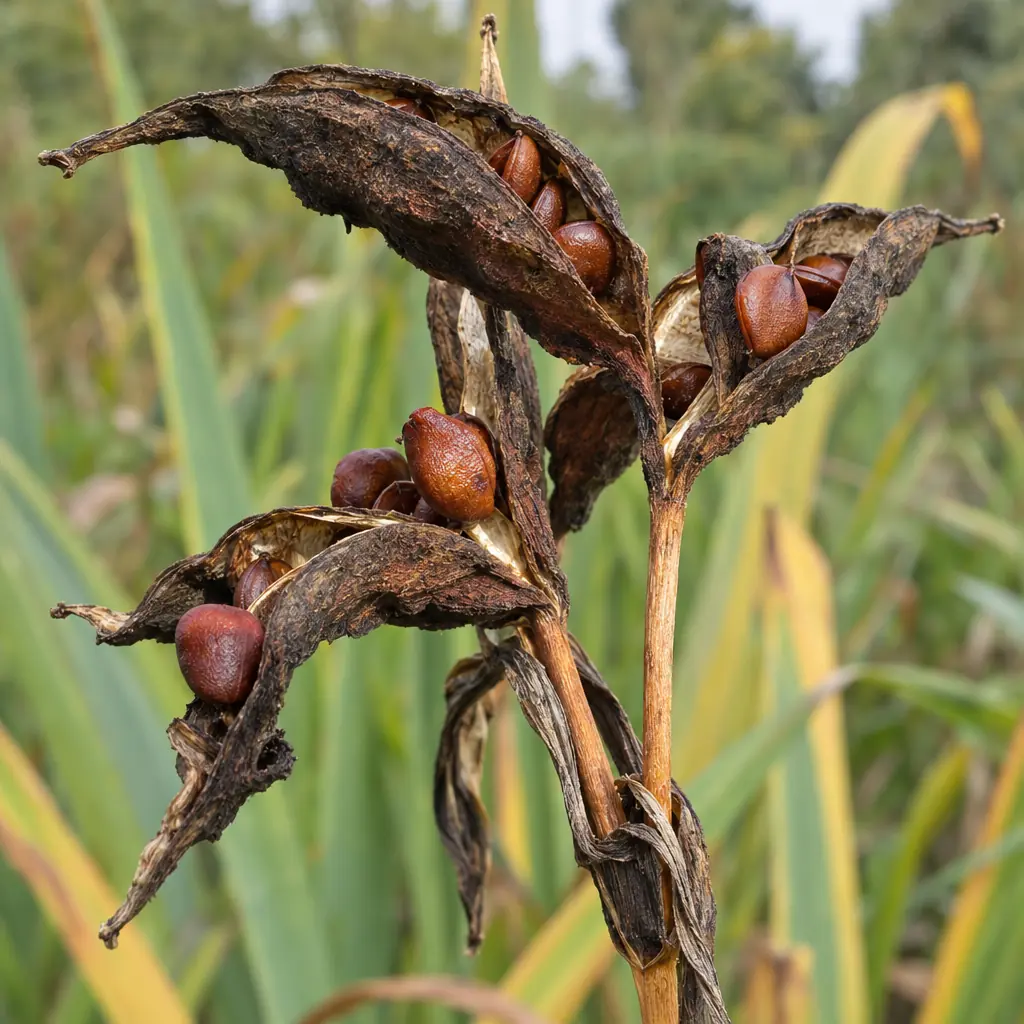
Fruit
How do you recognise yellow iris?
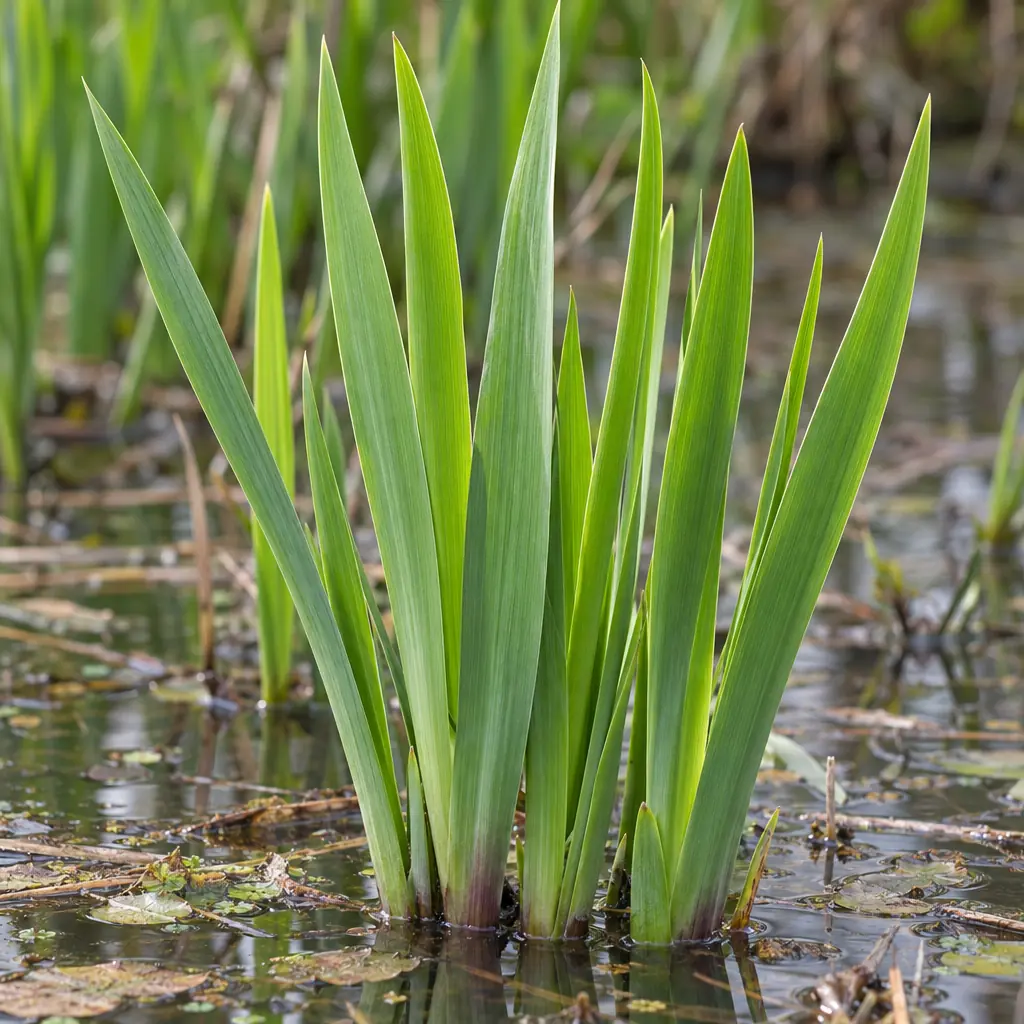
The leaves stand upright in flat fans. Each leaf is long, narrow and sword-shaped, 1 to 3 centimetres wide. Their colour is a slightly bluish green, with a thick midrib. At the base the leaves turn purplish.
The flowers are sulphur yellow and about 10 centimetres across. Two or three open together at the top of a round, branched stem. The three broad outer petals are 4 to 8 centimetres long, with brown veins at the centre. The three inner petals are narrow and much shorter.
After flowering comes a blunt, three-sided seed capsule of 4 to 5 centimetres. Inside lie three rows of smooth, flat, brown seeds.
Sweet flag (Acorus calamus) grows on the same kind of bank, with almost the same leaves. Its leaves are often wavy, though. A crushed leaf smells spicy, like Deventer koek, a Dutch spiced cake. Sweet flag flowers with a spike full of tiny flowers, each with petals of only 2 to 3 millimetres.
Yellow iris also comes as 'Variegata', a cultivar with leaves striped yellow and white.
Where does yellow iris grow best?
Yellow iris wants full sun or partial shade. Partial shade here means three to six hours of direct sun around midsummer. The soil should be wet and moderately rich to rich in nutrients. Shallow water is fine too, if it is still or flows slowly. In the wild the plant grows along ditches, streams, rivers and lakes.
Places where yellow iris will not do well:
- A dry border or a sandy front garden. Without wet feet the plant gets too little water.
- A small pond left to itself. The rhizome creeps and branches. That way one clump keeps pushing further along the bank.
- The deep part of the pond. Nurseries usually give at most 20 centimetres of water above the pot.
In autumn the leaves die back. If you leave them, all that remains of the tall clump in January is a low mound of brown, collapsed leaves.
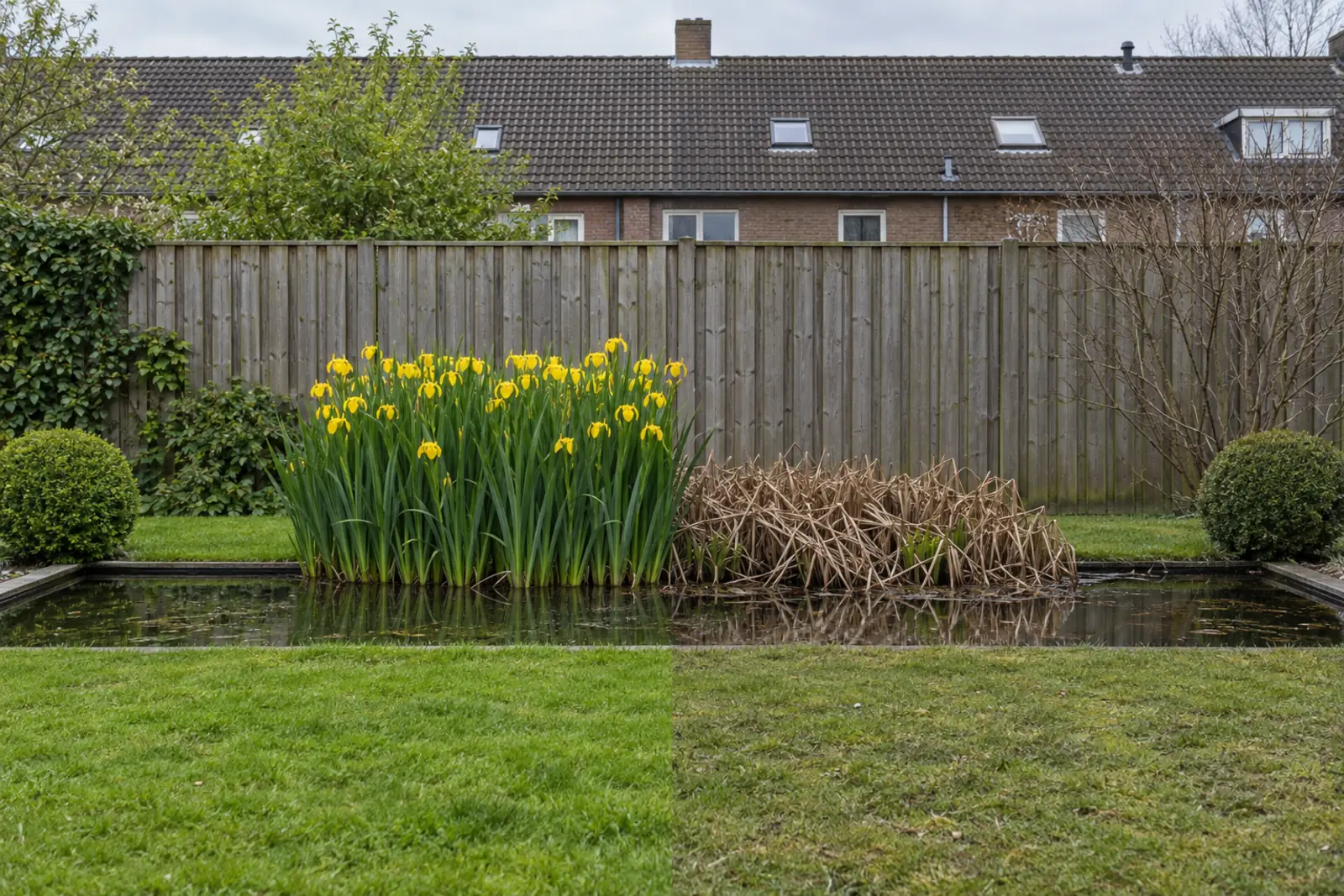 The same pond edge in May and in January. This is a generated image, not a photograph.
In the app you can see on your own plot, drawn to scale, whether there is room beside your pond for a clump this wide. The app draws the plant at a grown plant's width, not at pot size.
Planting and caring for yellow iris
Nurseries usually sell the wild species as a young plant in a small nursery pot. Dutch shops label it gele lis. That pot is no place for it to stay. Move the plant to a pond basket with pond soil, or plant it straight into the wet margin. A piece of an existing clump goes in from midsummer to early autumn, right after dividing.
Keep a metre between two plants, the low end of the spread in the table. On planting day that looks bare, because a young plant is a handful of shoots. The creeping rhizome fills the gap on its own. In or beside a pond there is no need to water. In a wet border, keep the soil wet, especially in early summer.
| When | What to do |
|---|---|
| After flowering, in July | Cut off the spent flower stems if you do not want seed |
| Autumn | Remove the dying leaves |
| Midsummer to early autumn | Dig up and divide a clump that has grown too wide |
For many birds the breeding season runs from March through July. Species that raise a second brood, such as the coot and the mallard, continue into August. So look between the stems before you cut in July.
What goes wrong with yellow iris?
The leaves turn brown and limp in summer. Check whether the spot is too dry. Yellow iris belongs on wet soil or in shallow water. On dry ground, move the clump to the edge of the pond.
No flowers appear. No single cause has been described for yellow iris.
The clump crowds out other marginal plants. The creeping rhizome does that. Between midsummer and early autumn, dig out part of the clump. Wear gloves while you work.
There are holes in the leaves. Slugs and snails sometimes eat them. Collect the slugs and snails on a damp evening.
Which insects and birds use yellow iris?
The caterpillar of the crescent (Helotropha leucostigma), a moth, lives in the stem and root of yellow iris and great fen-sedge. The moth flies from late June to early October. At night it comes to light.
The rosy rustic (Hydraecia micacea) also has a caterpillar that eats yellow iris, among other plants such as dock, nettle and potato. This very common moth flies from early July to early November.
Birds use the plant differently. A dense edge of yellow iris around the pond makes it hard for a heron to catch fish there.
Is yellow iris poisonous or edible?
Yellow iris is mildly poisonous. The leaves, and the rhizome most of all, contain an irritating resin-like substance. Eating the plant can cause serious stomach and bowel complaints.
In some people the plant irritates the skin. Yellow iris is also harmful to pets that eat it.
The photos on this page were made with AI, based on real photos and descriptions of this plant.
Frequently asked questions
How big does yellow iris get?
Yellow iris grows 40 to 120 centimetres tall. A clump spreads to 1 to 1.5 metres across and is full grown after 2 to 5 years.
How deep can yellow iris go in a pond?
Yellow iris grows on wet ground and in shallow water. Nurseries usually give at most 20 centimetres of water above the pot.
Does yellow iris spread?
Yes, it can. The rhizome creeps and branches, so the clump keeps getting wider. To keep it in check, dig out part of the clump between midsummer and early autumn.
Is yellow iris poisonous?
Yes, mildly. Eating it causes serious stomach and bowel complaints, the rhizome most of all, and the sap can irritate the skin.
Is yellow iris native to the Netherlands?
Yes. Yellow iris is the only member of the iris family that grows wild in the Netherlands. Along ditches, rivers and lakes it is a common plant.
Sources (22)
- Duistermaat, Sparrius & Denters, Standaardlijst van de Nederlandse flora 2020 (Gorteria 43)
- NDFF Verspreidingsatlas — Iris pseudacorus
- Flora van Nederland — Gele lis
- Flora van Nederland — Kalmoes
- RHS — Iris pseudacorus (yellow iris)
- RHS — Iris pseudacorus 'Variegata'
- RHS — Shade gardening (definities zon en halfschaduw)
- Imkerpedia — Drachtplanten
- Pollennieuws / Flora van Nederland — Aandachtspunten hooikoorts vriendelijke tuin
- Plants For A Future — Iris pseudacorus
- De Vlinderstichting — Gele lis-boorder
- De Vlinderstichting — Aardappelstengelboorder
- Vogelbescherming — 5 veel gehoorde vogelergernissen
- Vogelbescherming — Snoeien in het broedseizoen, mag dat?
- Vijverbenodigdheden — Gele lis (prijs en plantdiepte)
- Vijvermeester — Lis Geel (prijs)
- Vijverplantenland — Iris pseudacorus (prijs en plantdiepte)
- Vijverplanten webshop — Gele lis (plantdiepte)
- Hornbach — Gele lis in een grote pot (prijs)
- Wikimedia Commons — Leaf: photo by AnRo0002 (CC0)
- Wikimedia Commons — Flower: photo by AnRo0002 (CC0)
- Wikimedia Commons — Fruit: photo by AnRo0002 (CC0)