5 min read
Arrowhead (Sagittaria sagittifolia): planting and care
Sagittaria sagittifolia
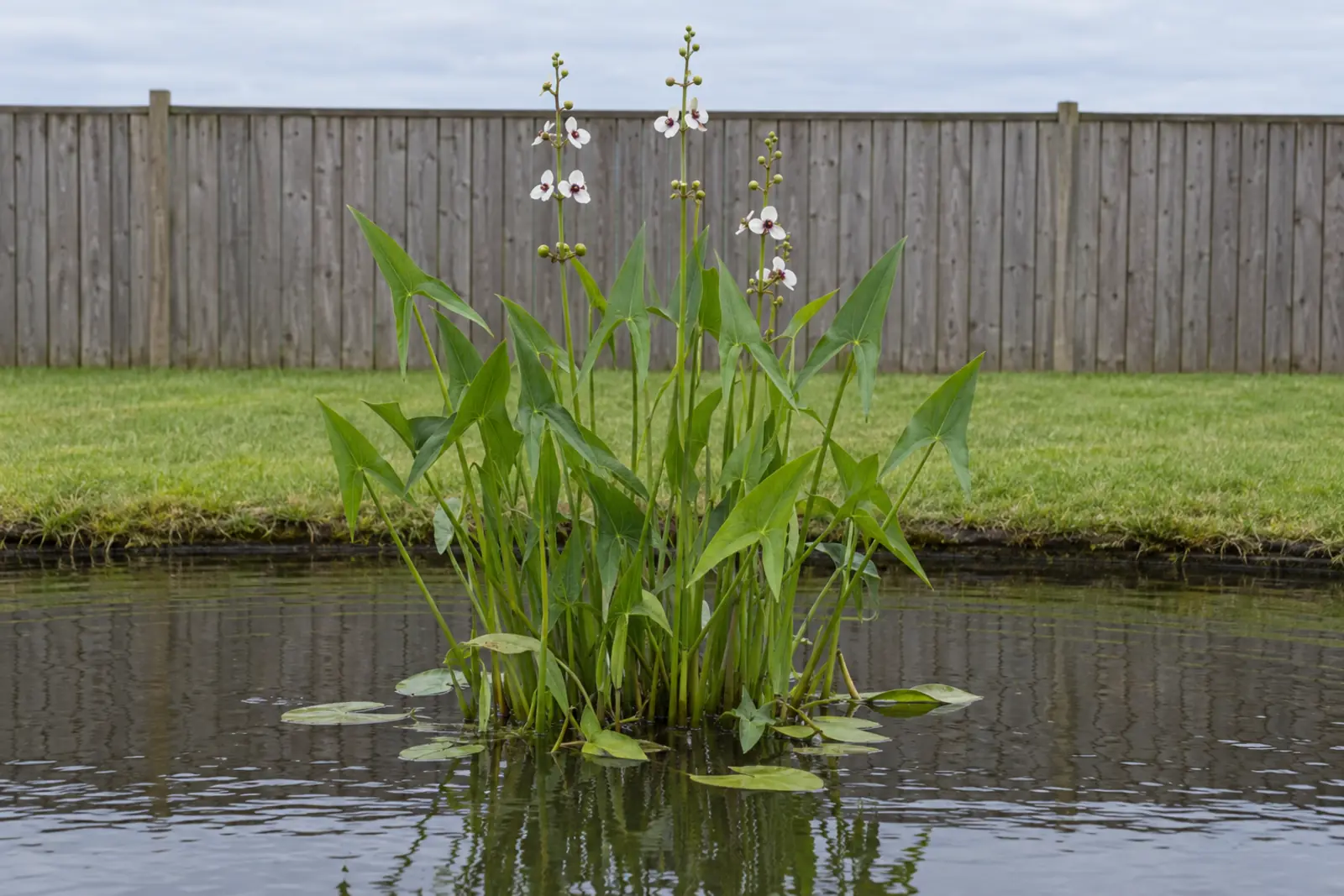
Arrowhead (Sagittaria sagittifolia) is a native marginal plant for shallow fresh water. Leaves shaped like the point of an arrow stand above the water. From June to September the plant flowers white, with purple at the base. Arrowhead grows 30 to 90 centimetres tall and wants a sunny spot.
Arrowhead at a glance
| Feature | Arrowhead |
|---|---|
| Height | 0.3 to 0.9 m |
| Spread | 0.5 to 1.5 m |
| Full grown after | 2 to 5 years |
| Sun | Full sun |
| Soil | Clay, loam or sand under shallow water |
| Water | Plenty: the base stands in water |
| Maintenance | Low: rein in the runners now and then |
| Flowers | June to September, white with purple |
| For bees | Little: not a known forage plant for honeybees |
| Hay fever | Not or weakly allergenic |
| Leaves | Drop in autumn |
| Hardy | Yes |
| Native | Yes |
| Poisonous | No, as far as is known |
| Pricks or stings | No |
| Price, young | About €4.61 to €5.45 each, in a small pot |
| Price, grown | About €8.50 to €10.50 each, in a pond basket |
- Leaf
- May to October
- Flower
- June to September
- Fruit
- August to October
Leaf 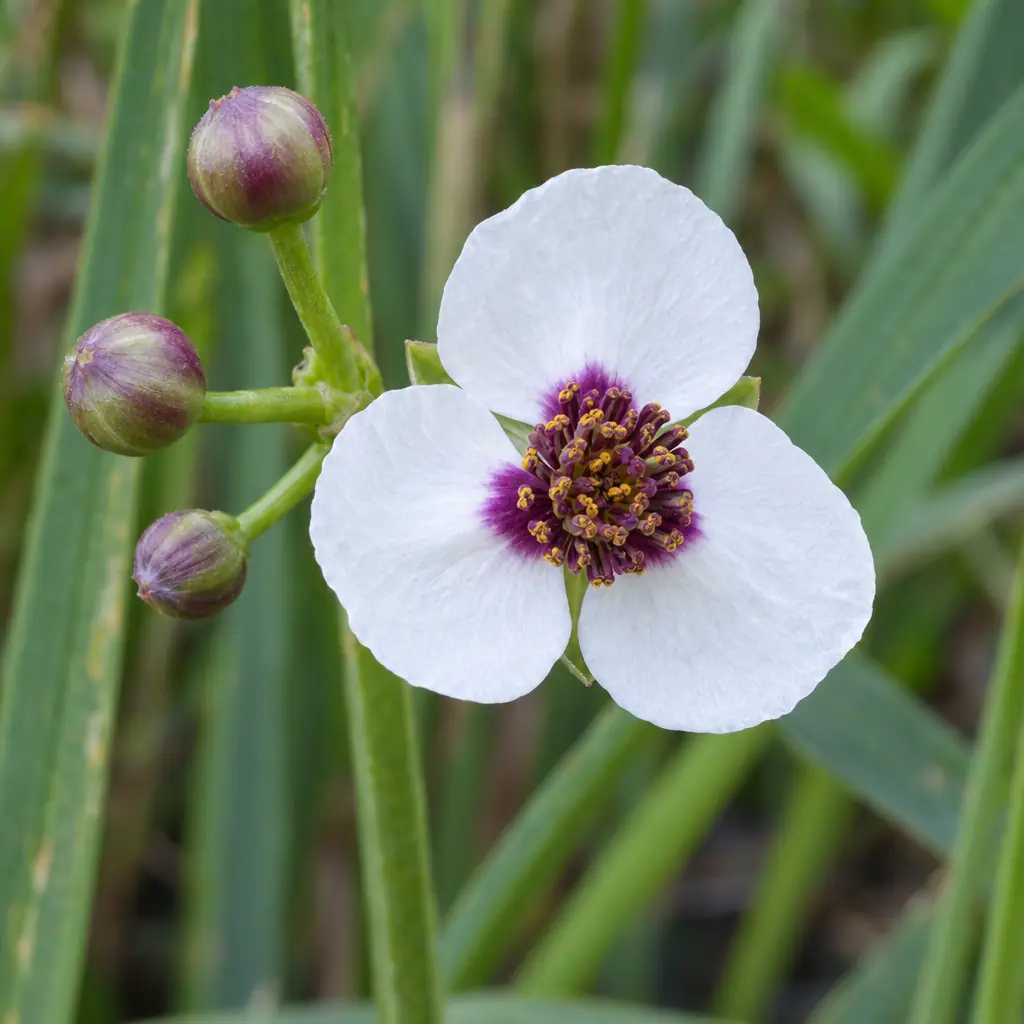
Flower 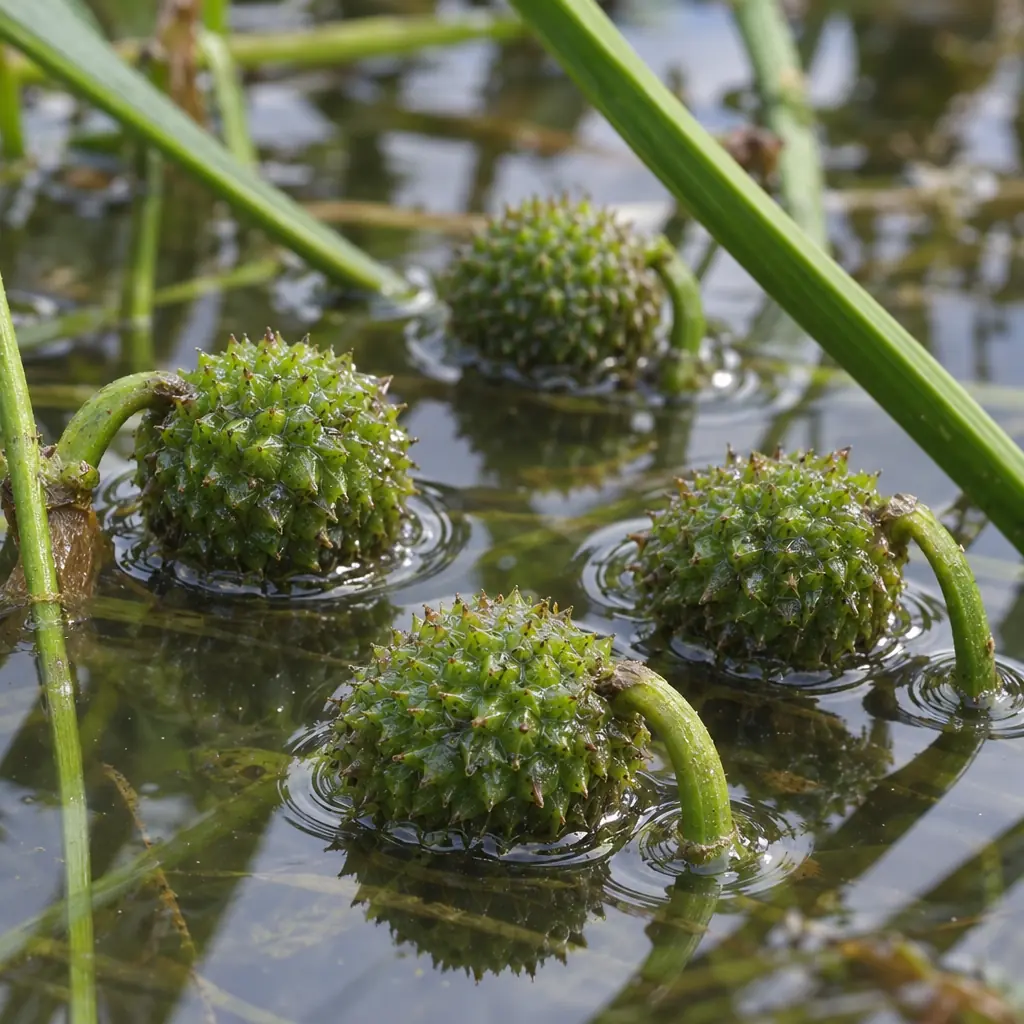
Fruit
How do I recognise arrowhead?
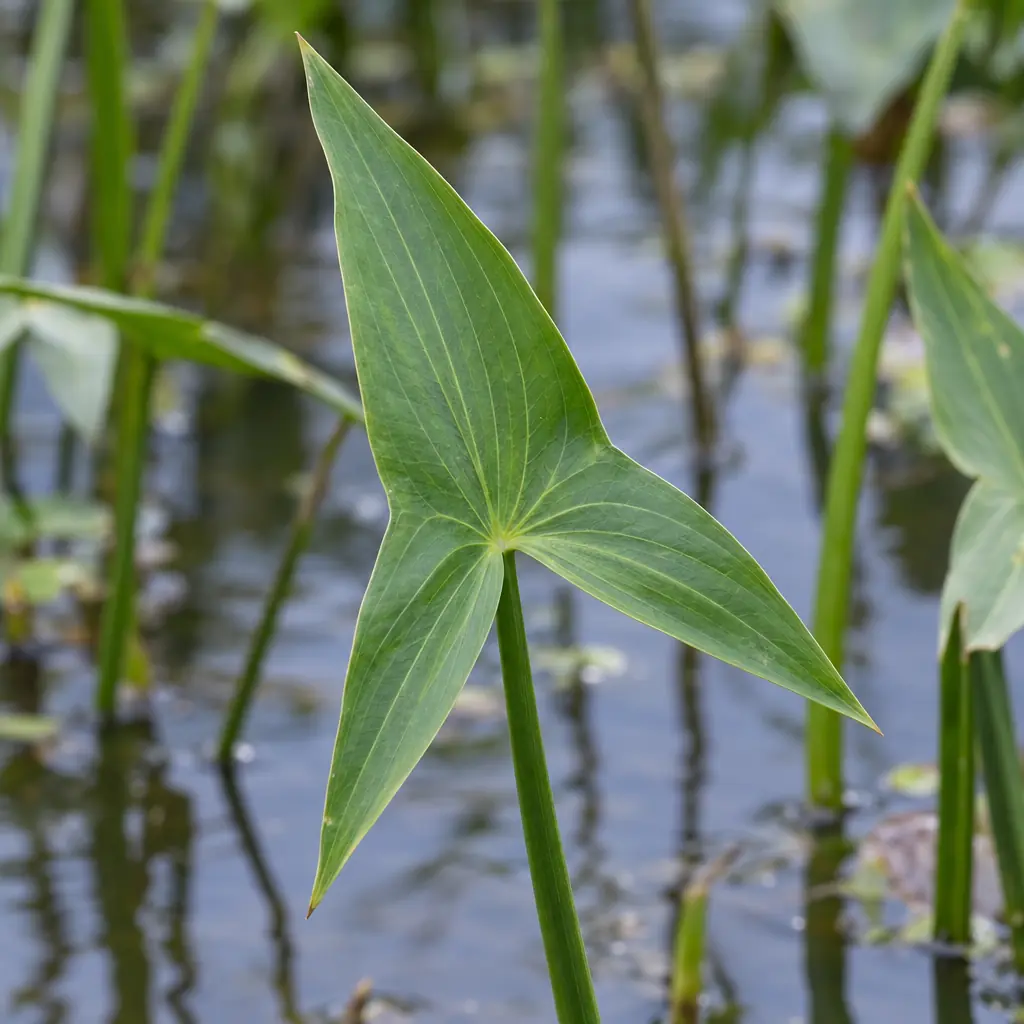
Start with the leaves above the water. Each one is deeply arrow-shaped, with two pointed lobes reaching backwards, on a long stalk. Earlier in the year the plant makes other leaves. First, long ribbon-like leaves grow under water. Floating leaves follow, oval to oblong. The stems and leaf stalks are three-sided.
The flowers sit in whorls, usually of three, on a long stem above the water. Each flower measures 2 to 2.6 centimetres and has three white petals, purple at the base. The male flowers grow at the top of the stem, with many dark purple stamens. The female flowers are a little smaller. Each one grows into a ball of flat fruitlets, half a centimetre in size.
Do not mix arrowhead up with broadleaf arrowhead (Sagittaria latifolia). That species comes from North America and grows wild here in a few places. Its leaves are much broader and its petals are pure white. Nurseries also sell 'Flore Pleno', a cultivar with double flowers.
Where does arrowhead grow best?
Arrowhead belongs in full sun: more than six hours of direct sun a day around midsummer. The plant grows with its base in shallow water, on a bottom of clay, loam or sand. Still or slow-flowing fresh water suits arrowhead best.
Not every wet corner of a garden will do:
- A border or lawn with no water. Arrowhead is a marsh plant, and its base belongs under water.
- A small pond that must stay open. Runners as much as a metre long grow from the rootstock, each with a tuber at the end. That way the plant keeps moving further into the water.
In autumn the leaves die back. The tubers on the runners stay in the pond bottom. In January all that is left at that spot is a few broken brown stalks lying on the water.
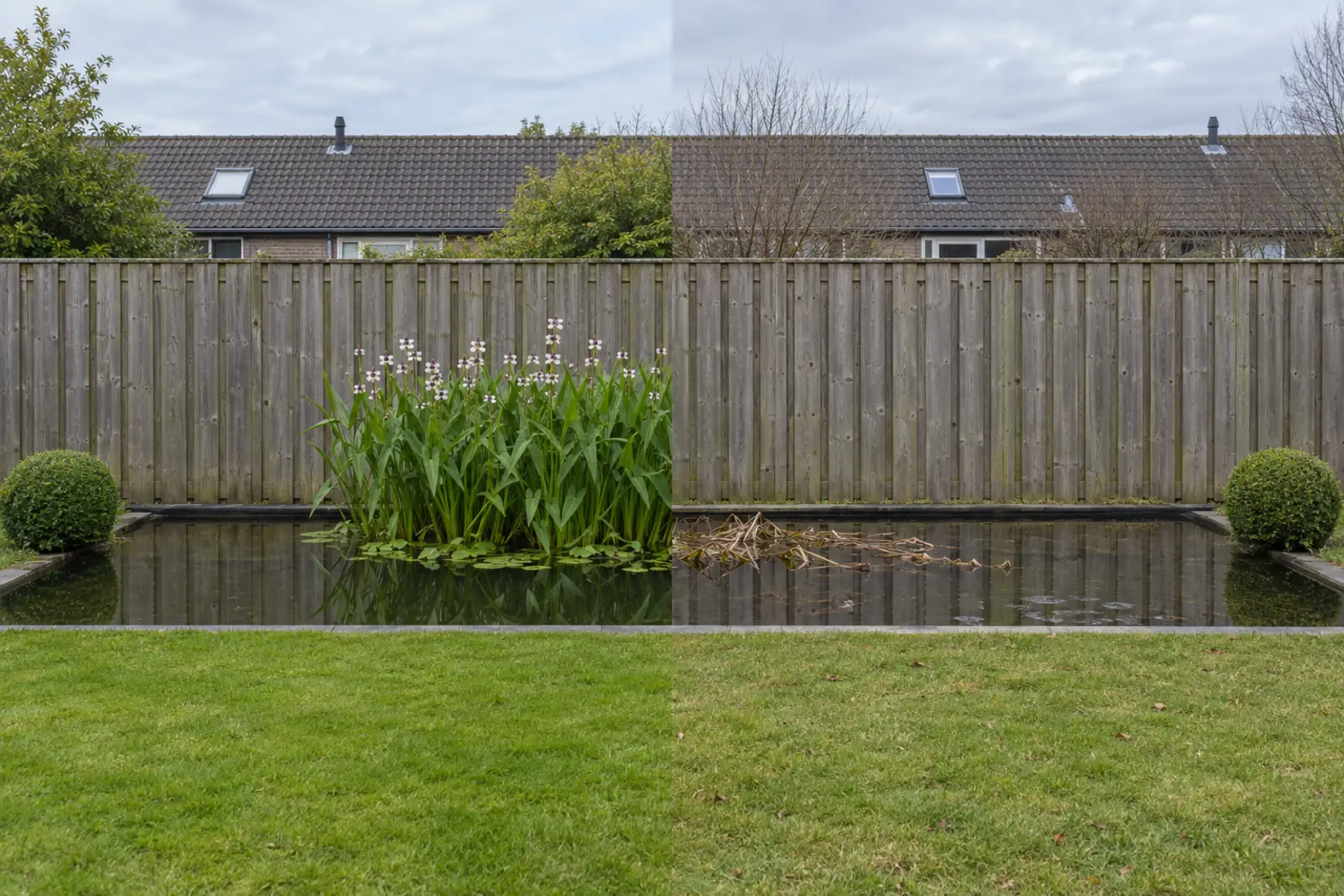 The same pond edge in July and in January. This is a generated image, not a photograph.
On a plan of your own plot, to scale and with the buildings around it, you can see where a pond edge like this could go in your garden.
Planting and caring for arrowhead
Nurseries sell arrowhead in a small pot. Until mid-April, some also deliver loose tubers. Place the plant so that there are 10 to 40 centimetres of water above its base.
If you plant more than one, keep about 50 centimetres between plants. That is the smallest spread in the table. On planting day this looks like a lot of open water. The runners fill that space later without any help.
Watering is not needed, as long as the base stays under water. Pruning is not needed either. Only pull out the runners that reach further than you want.
Arrowhead problems and what to do
Only long, narrow leaves appear, and no flowers. In spring that is normal: the first leaves are ribbon-like and stay under water. If nothing changes, look at the water. In fast-flowing water arrowhead makes only ribbon leaves and does not flower. A spot with still water helps.
The leaves turn yellow and flop over. In autumn that is to be expected. Above the water the plant dies back.
Young plants pop up all over the pond. Those are the runners, each with a tuber at the end. Pull them out, tuber and all.
Pests and diseases are rare on arrowhead.
Which birds and insects use arrowhead?
Insects pollinate the flowers. Which insects and birds use arrowhead has hardly been described for this species.
Is arrowhead poisonous or edible?
Arrowhead is not known to be poisonous. That does not mean you can eat the plant. In East Asia people do eat the tubers, after cooking. Raw tubers are not fit to eat.
The photos on this page were made with AI, based on real photos and descriptions of this plant.
Frequently asked questions
How tall does arrowhead grow?
Arrowhead grows 30 to 90 centimetres tall. The arrow-shaped leaves and the flower stems rise above the water.
How deep should arrowhead be planted in a pond?
Usually with 10 to 40 centimetres of water above the base of the plant. Still or slow-flowing water suits arrowhead best.
Does arrowhead spread?
A little. The runners grow up to a metre long and end in a tuber. Pull them out where the plant spreads further than you want.
Is arrowhead poisonous?
Arrowhead is not known to be poisonous. That does not make the plant safe to eat as it is. In East Asia people eat the tubers, but only after cooking.
Is arrowhead native to the Netherlands?
Yes. Arrowhead is originally native to the Netherlands. The species is common here in ditches, shallow lakes, canals and ponds.
Sources (24)
- Duistermaat, Sparrius & Denters, Standaardlijst van de Nederlandse flora 2020 (Gorteria 43)
- NDFF Verspreidingsatlas — Sagittaria sagittifolia
- NDFF Verspreidingsatlas — Breed pijlkruid (Sagittaria latifolia)
- Flora van Nederland — Pijlkruid
- Wilde planten in Nederland en België — Pijlkruid
- RHS — Sagittaria sagittifolia
- RHS — Sagittaria sagittifolia 'Flore Pleno'
- RHS — Shade gardening (definities zon en schaduw)
- PFAF — Sagittaria sagittifolia
- Pollennieuws / Flora van Nederland — Aandachtspunten hooikoorts vriendelijke tuin
- Imkerpedia — Drachtplanten
- Nature Today — Natuurjournaal 27 augustus 2025
- De Vlinderstichting — Moerasbosspanner
- De Vlinderstichting — Hoe lok je libellen naar je tuin? (Vlinders 3, 2015)
- Biovijver — Pijlkruid (waterdiepte)
- Vijverplanten webshop — Pijlkruid (losse knollen)
- Cruydt-Hoeck — Pijlkruid (prijs)
- Vijvermeester — Pijlkruid (prijs)
- Vijverkenner — Sagittaria sagittifolia (prijs)
- Vijverplantenland — Sagittaria sagittifolia (prijs en waterdiepte)
- De Vijvertuinen van Ada Hofman — Sagittaria sagittifolia (prijs)
- Wikimedia Commons — Leaf: photo by AnRo0002 (CC0)
- Wikimedia Commons — Flower: photo by юра запеченко (CC BY 3.0)
- Wikimedia Commons — Fruit: photo by AnRo0002 (CC0)