5 min read
Alder Buckthorn: How to Recognise, Plant and Care For It
Frangula alnus
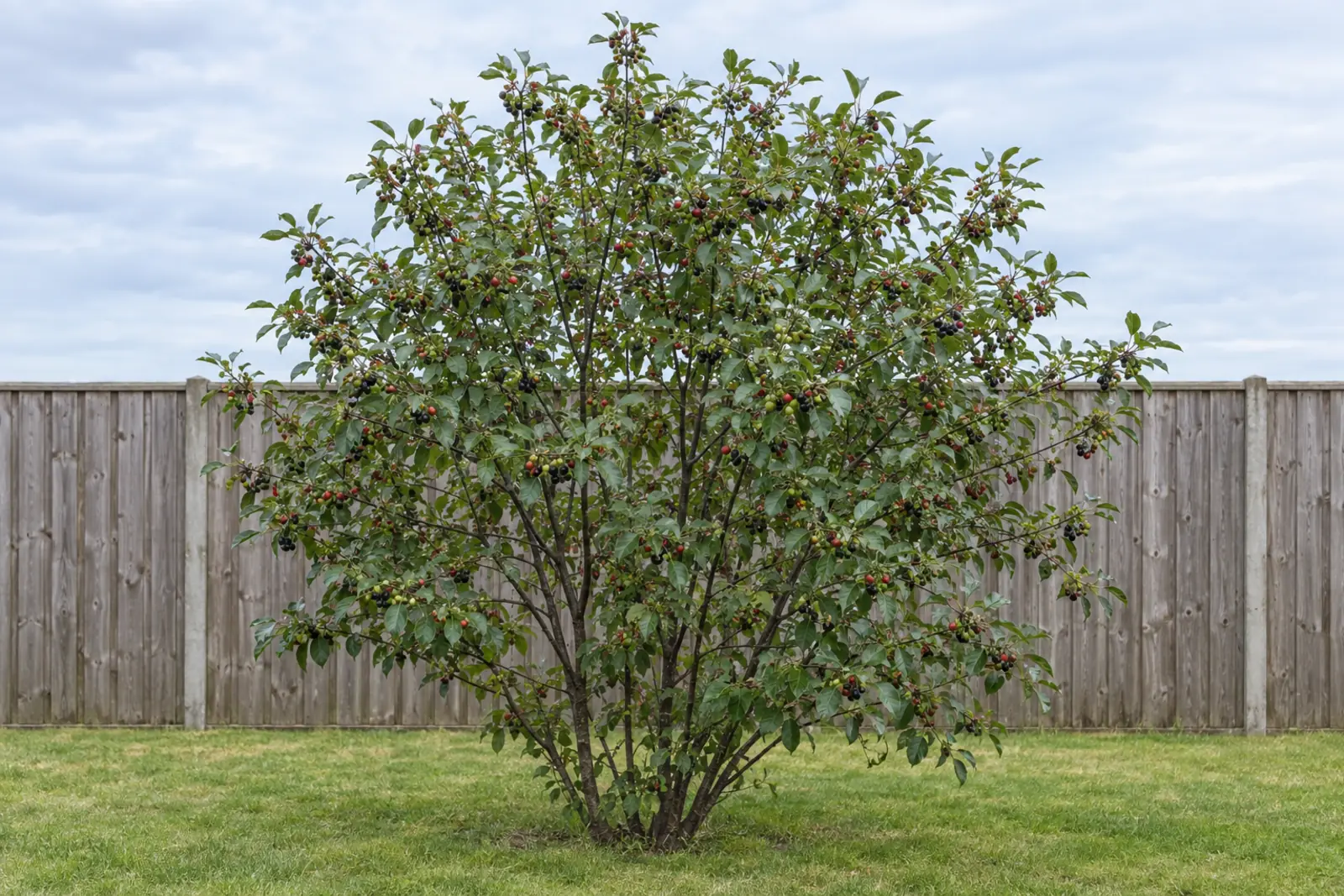
Alder buckthorn (Frangula alnus) is a native shrub with no thorns, growing 1.5 to 5 metres tall. Small greenish flowers appear from May to September. Its berries turn from green to red and finally black. The shrub wants moist, slightly acidic soil, in full sun or partial shade.
Alder buckthorn at a glance
| Feature | Alder buckthorn |
|---|---|
| Height | 1.5 to 5 m, sometimes taller |
| Spread | 2.5 to 4 m |
| Full grown after | 5 to 10 years |
| Sun | Full sun to partial shade |
| Soil | Moist to wet, preferably acidic |
| Water | Plenty: likes moist soil |
| Maintenance | Low: a freestanding shrub needs no pruning |
| Flowers | May to September, greenish white, inconspicuous |
| For bees | Yes: plenty of nectar and pollen, May to September |
| Hay fever | Not or weakly allergenic |
| Leaves | Drop in autumn |
| Hardy | Yes |
| Native | Yes |
| Poisonous | Mainly the berries: harmful if eaten |
| Pricks or stings | No |
| Price, young | About €1.26 to €2.86 each, 30-80 cm, bare-root |
| Price, grown | About €22.34 to €36.86 each, 100-150 cm, potted |
- Leaf
- April to October
- Flower
- May to September
- Fruit
- July to October
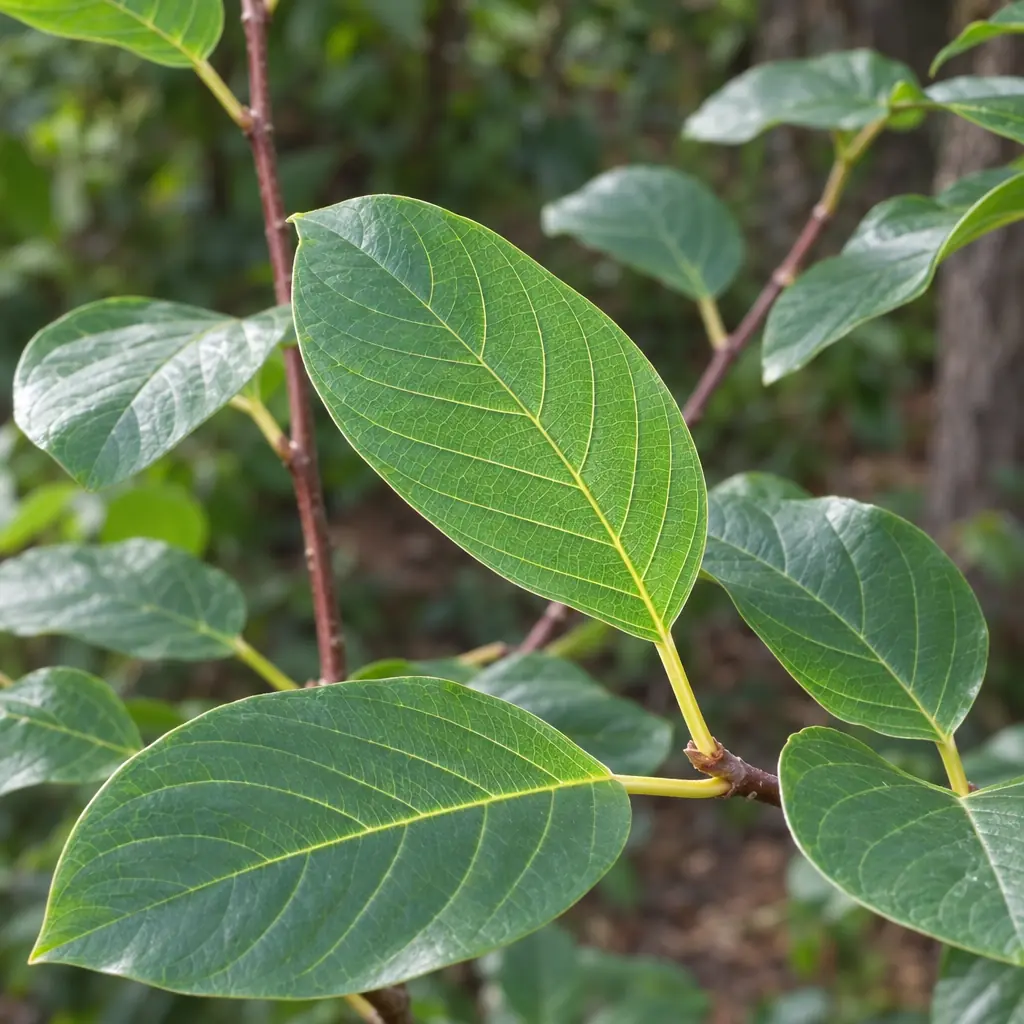
Leaf 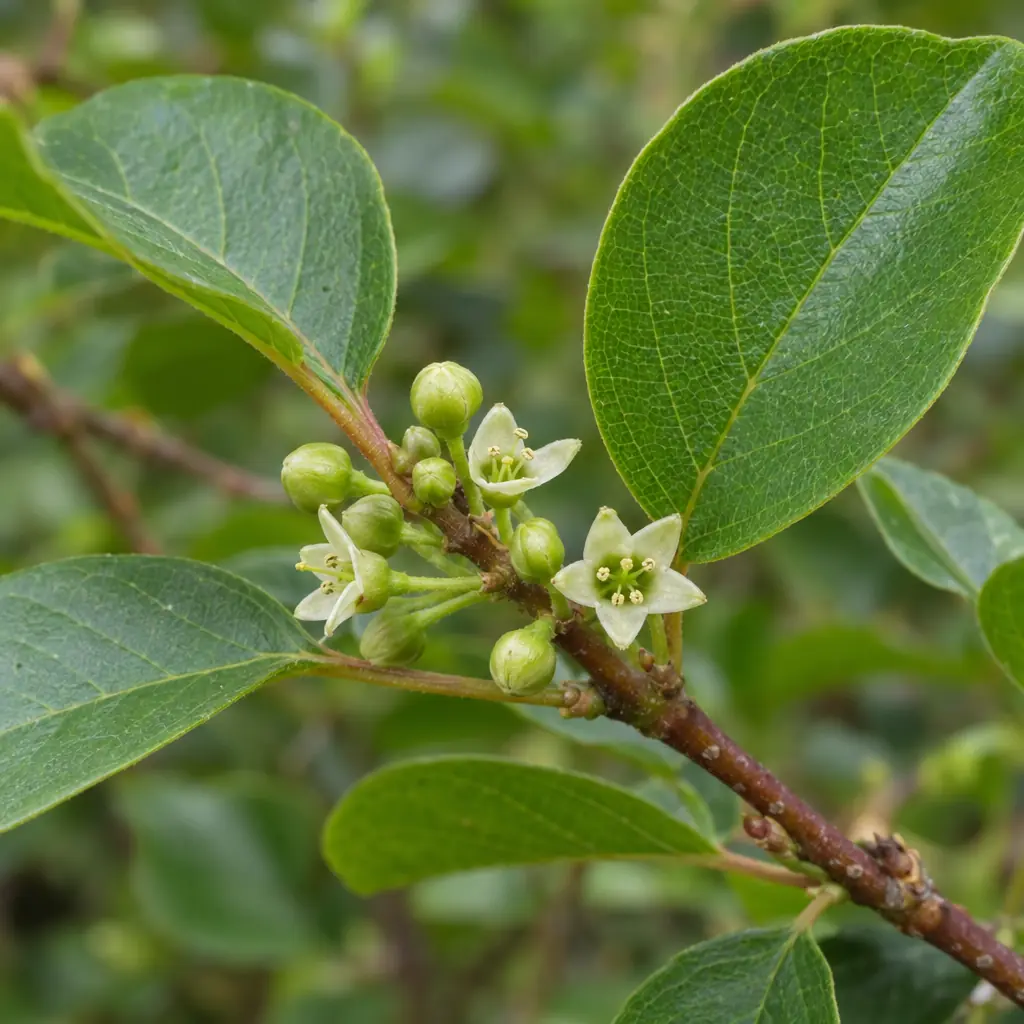
Flower 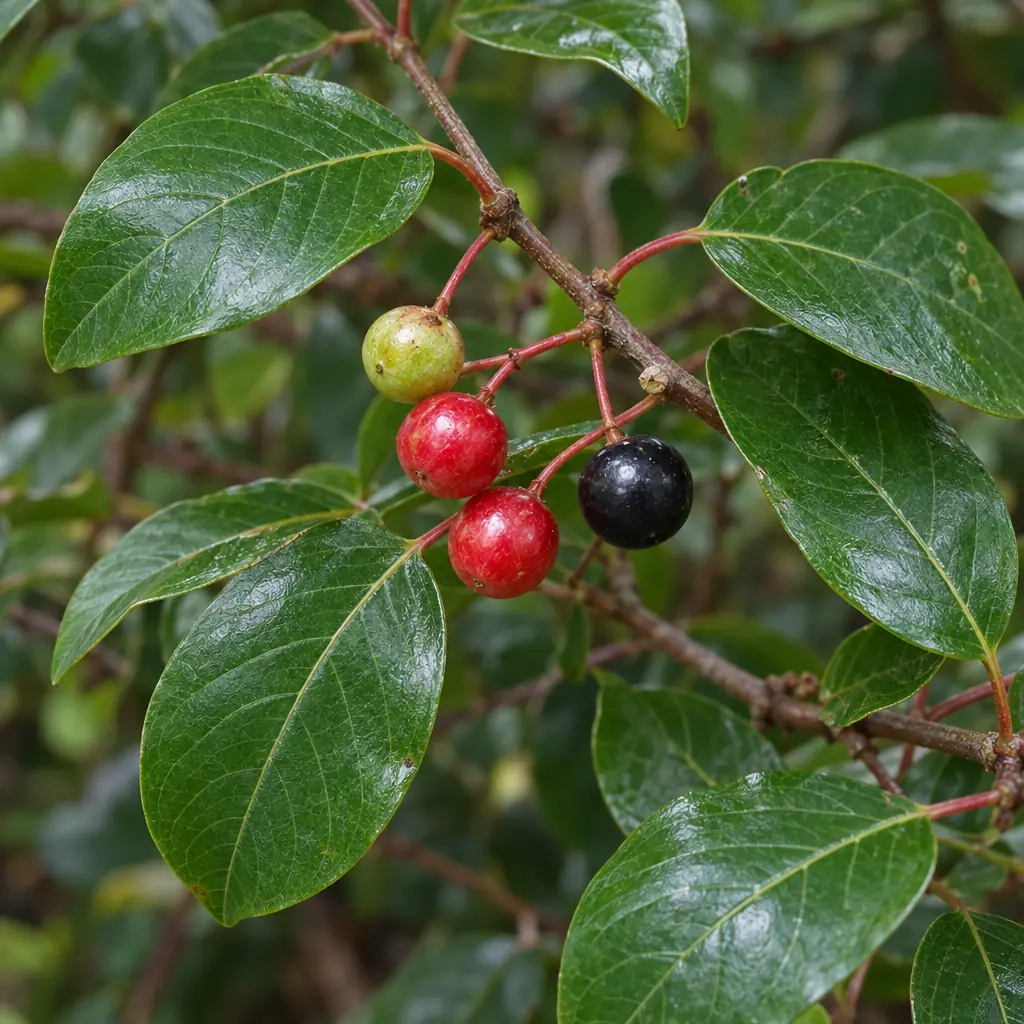
Fruit
How do you recognise alder buckthorn?
Start with the branches. Alder buckthorn has no thorns anywhere. The bark is dark brown to blackish purple, and the side branches spread out along the stem.
The leaves are oval with a pointed tip and a smooth, untoothed edge. Each leaf is 2 to 5 centimetres long and glossy green. Count the veins: 7 to 9 pairs, curving forward toward the edge.
The flowers are about 5 millimetres across. They are greenish, whitish on the inside. Between 1 and 10 sit together in the leaf axil, the spot where the leaf meets the twig.
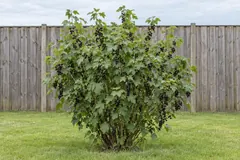
A berry is 0.6 to 1 centimetre across. It starts pale green, turns bright red, and is ripe once it turns black.
Watch out for common buckthorn (Rhamnus cathartica), the look-alike. Its branches often end in a thorn, and its leaves sit opposite each other, with a finely toothed edge. The berries go straight from green to black, skipping the red stage. A cultivar, 'Aspleniifolia', has narrow, fern-like leaves.
Where does alder buckthorn grow best?
Alder buckthorn grows in full sun and in partial shade. A spot with at least three hours of direct sun at midsummer is already enough. The soil can be moist to wet, preferably a little acidic. In the wild, the shrub grows in swamp woodland, on heathland and along woodland edges.
This is where it struggles:
- A front garden on dry sand. The shrub wants moist soil, and sand like that dries out in summer.
- A narrow strip along a path. Alder buckthorn grows wider than most paths and then hangs over them.
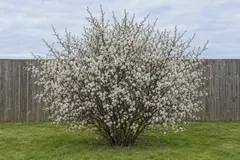
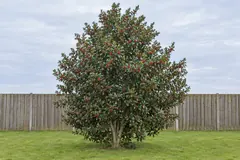
In autumn the leaves turn yellow or red. After that, the shrub stands bare, a cluster of straight, dark stems.
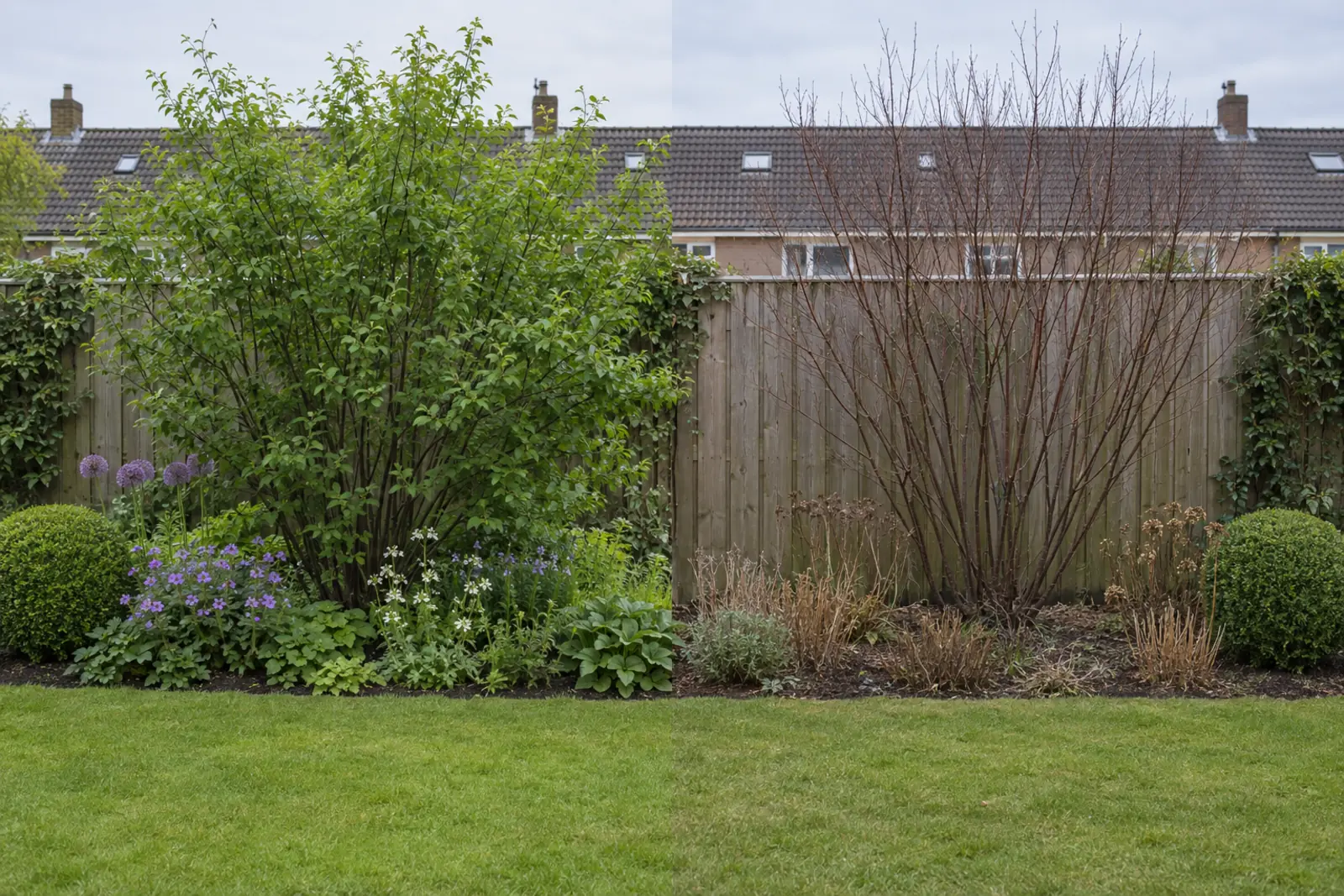 The same border in May and in January. This is a generated image, not a photo.
Whether there is enough room between your terrace and the fence, you can see in the app. Your own plot is drawn to scale there, with the houses around it.
Planting and caring for alder buckthorn
The cheapest option is a young bare-root plant, with no pot and no soil. Plant it between leaf fall and the end of winter.
Set the shrub deep enough that the root collar, where the roots meet the stem, sits level with the ground. Space two freestanding shrubs 2.5 to 4 metres apart. On planting day, that looks like an empty stretch. Once the shrubs are fully grown, the branches touch. For a hedge, allow 6 shrubs per metre. Water in the first two years whenever it stays dry for a long time.
| When | What to do |
|---|---|
| Early spring | Trim a hedge of alder buckthorn into shape |
A freestanding shrub hardly ever needs pruning. The flowers form on young wood, so it simply flowers again after a trim.
Many birds nest between March and July, and plenty of species carry on until August. If you prune during that time, check the branches for a nest first.
What can go wrong with alder buckthorn?
There are holes in the leaves and you see green caterpillars. Those can be brimstone butterfly caterpillars. They grow up to 33 millimetres long and are green with fine black speckles. Nothing needs to be done.
You never see the shrub flower. The flowers are small and greenish. Against the leaves, they are barely noticeable. Look closely in the leaf axils in June.
The leaves hang limp in a dry summer. For alder buckthorn, the soil is then too dry. Water generously a few times, so the soil becomes properly wet.
Beyond that, the shrub rarely suffers from pests or disease.
What do birds and insects get from alder buckthorn?
Alder buckthorn is a host plant for the brimstone butterfly: the plant its caterpillars eat. The female lays her eggs singly under young leaves, mostly on young shrubs in an open, sunny spot. The butterfly flies from late June to early October, and again from February after winter.
The holly blue also lays its eggs in spring, mostly on alder buckthorn and holly. Its caterpillars eat the flower buds and young fruit. The shrub is also a host plant for the brown scallop moth (Philereme vetulata). The purple hairstreak comes to feed on its nectar.
Blackbirds, song thrushes and blackcaps eat the berries.
Is alder buckthorn poisonous or edible?
Alder buckthorn is harmful if you eat it, and the berries especially so. Fresh bark causes severe diarrhoea. No edible parts of the plant are known.
The photos on this page were made with AI, based on real photos and descriptions of this plant.
Frequently asked questions
How big does alder buckthorn get?
Alder buckthorn grows 1.5 to 5 metres tall and 2.5 to 4 metres wide. A young shrub reaches full size after 5 to 10 years.
Does alder buckthorn have thorns?
No, alder buckthorn has no thorns anywhere. Its look-alike, common buckthorn, often has branches that end in a thorn.
Is alder buckthorn poisonous?
Yes. The plant is harmful if you eat it, especially the berries. No edible parts are known.
When do you prune alder buckthorn?
A freestanding shrub hardly ever needs pruning. Trim a hedge into shape in early spring. The flowers form on young wood, so the shrub simply flowers again afterwards.
Is alder buckthorn good for butterflies?
Yes. Caterpillars of the brimstone butterfly and the holly blue live on alder buckthorn. Blackbirds, song thrushes and blackcaps eat the berries.
Sources (21)
- Duistermaat, Sparrius & Denters, Standaardlijst van de Nederlandse flora 2020 (Gorteria 43)
- NDFF Verspreidingsatlas — Frangula alnus
- Flora van Nederland — Sporkehout
- Flora van Nederland — Wegedoorn
- RHS — Frangula alnus (alder buckthorn)
- RHS — Frangula alnus 'Aspleniifolia'
- RHS — Shade gardening (definities zon en halfschaduw)
- RHS — Planting hedges
- Plants For A Future — Frangula alnus
- Imkerpedia — Drachtplanten
- Pollennieuws — Aandachtspunten hooikoorts vriendelijke tuin
- De Vlinderstichting — Citroenvlinder
- De Vlinderstichting — Boomblauwtje
- Vogelbescherming — De vuilboom: geen lust voor het oog?
- Vogelbescherming — Snoeien in het broedseizoen, mag dat?
- Directplant — Sporkehout, bosplantsoen (prijs per maat, plantafstand)
- Garmundo — Sporkehout, blote wortel (prijs)
- Planta — Frangula alnus 125-150 cm (prijs)
- Wikimedia Commons — Leaf: photo by AnRo0002 (CC0)
- Wikimedia Commons — Flower: photo by AnRo0002 (CC0)
- Wikimedia Commons — Fruit: photo by David Perez (CC BY 3.0)