6 min read
Perforate St John's wort: planting, care and price
Hypericum perforatum
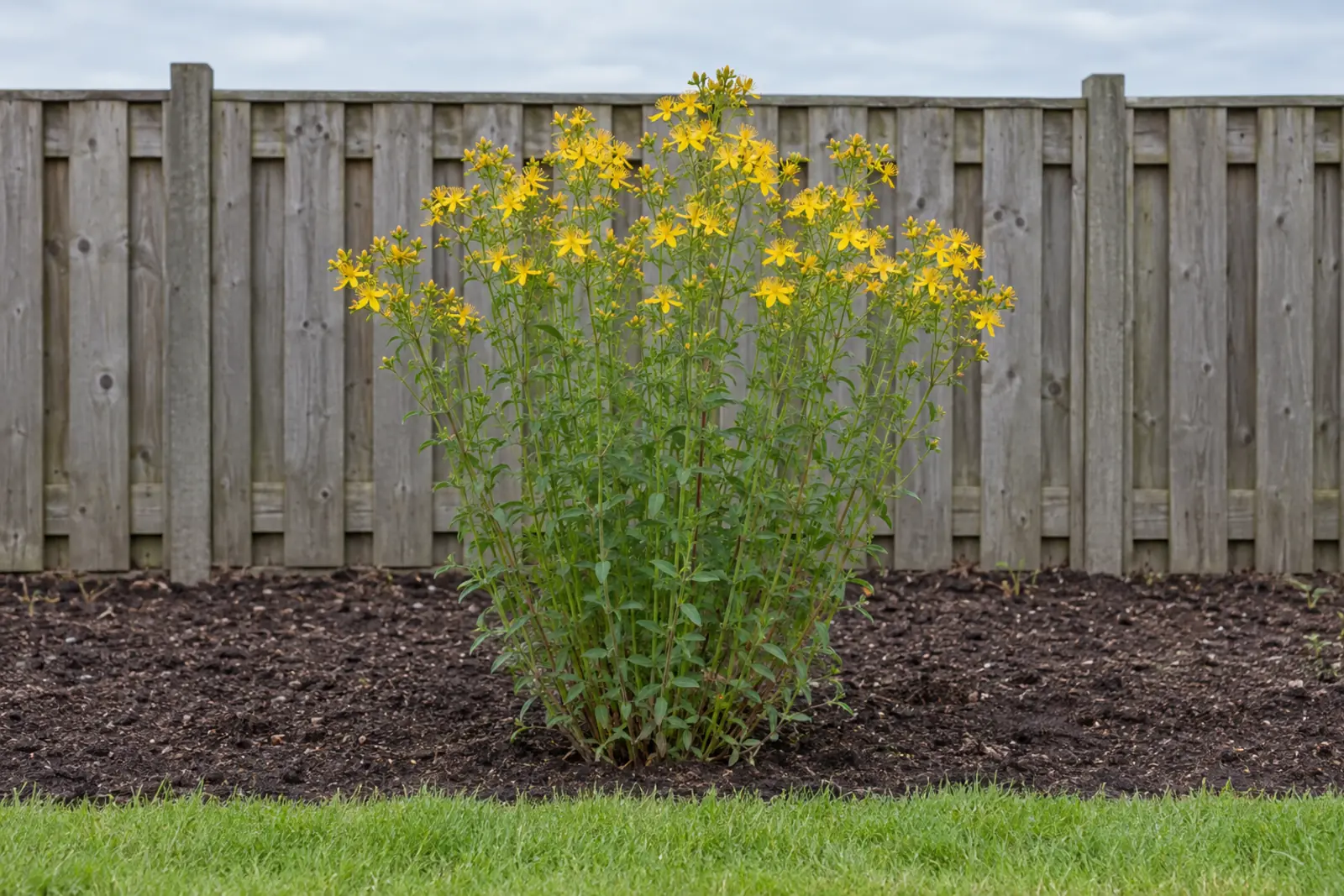
Perforate St John's wort (Hypericum perforatum) is a native perennial with stiff, upright stems. It grows 20 to 80 centimetres tall. From June to September the plant carries small yellow star-shaped flowers. It likes a sunny spot on dry soil. Hold a leaf up to the light and you see many translucent dots.
Perforate St John's wort at a glance
| Feature | Perforate St John's wort |
|---|---|
| Height | 0.2 to 0.8 m |
| Spread | 0.5 to 1 m |
| Full grown after | 2 to 5 years |
| Sun | Full sun to partial shade |
| Soil | Dry and rich in nutrients, drains well |
| Water | Little: grows on dry soil too |
| Maintenance | Low: clear the dead stems once a year |
| Flowers | June to September, golden yellow |
| For bees | Yes: pollen, June to September |
| Hay fever | Not or weakly allergenic |
| Leaves | Drop in autumn |
| Hardy | Yes |
| Native | Yes |
| Poisonous | Mildly: the sap can make skin sensitive to sunlight |
| Pricks or stings | No |
| Price, young | About €2.50 to €4.09 each, in a small pot |
| Price, grown | About €6.50 each, from 10 plants, in a larger pot |
- Leaf
- April to October
- Flower
- June to September
- Fruit
- July to October
Leaf 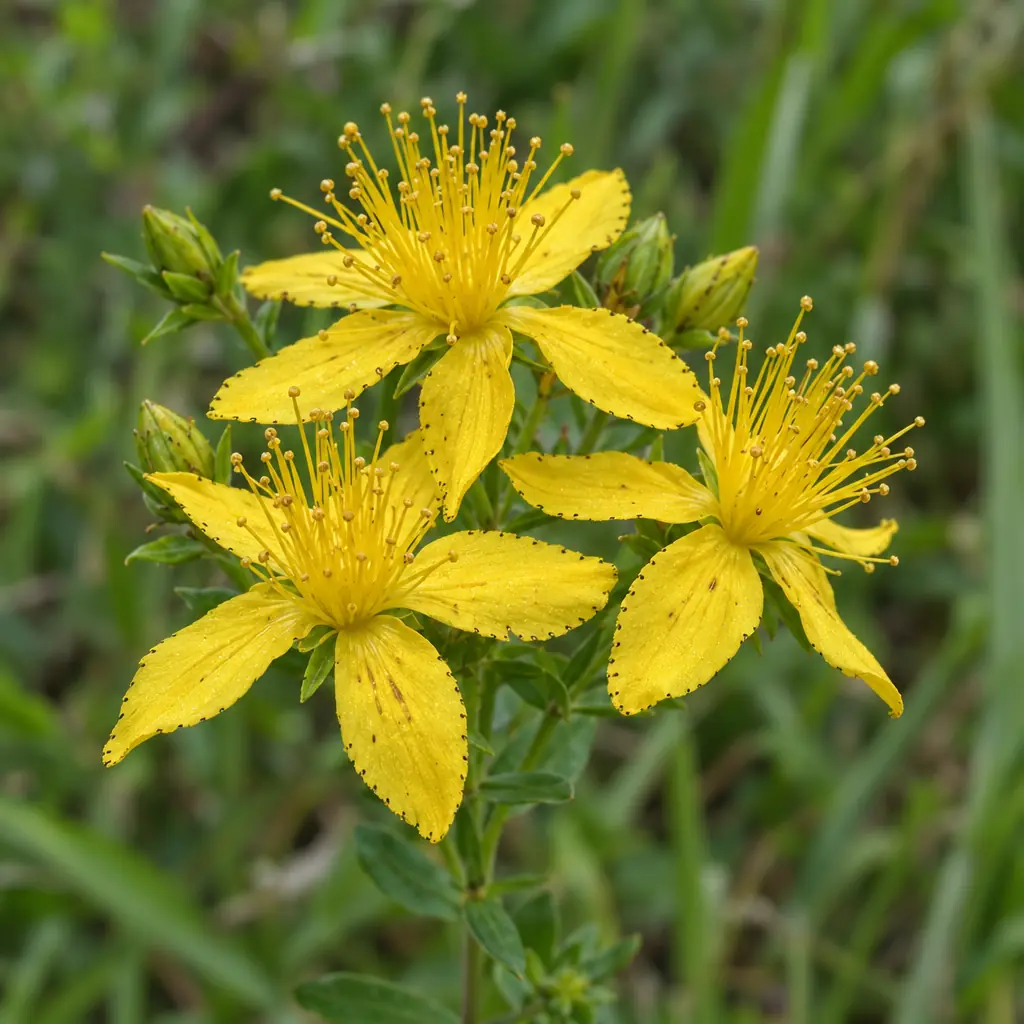
Flower 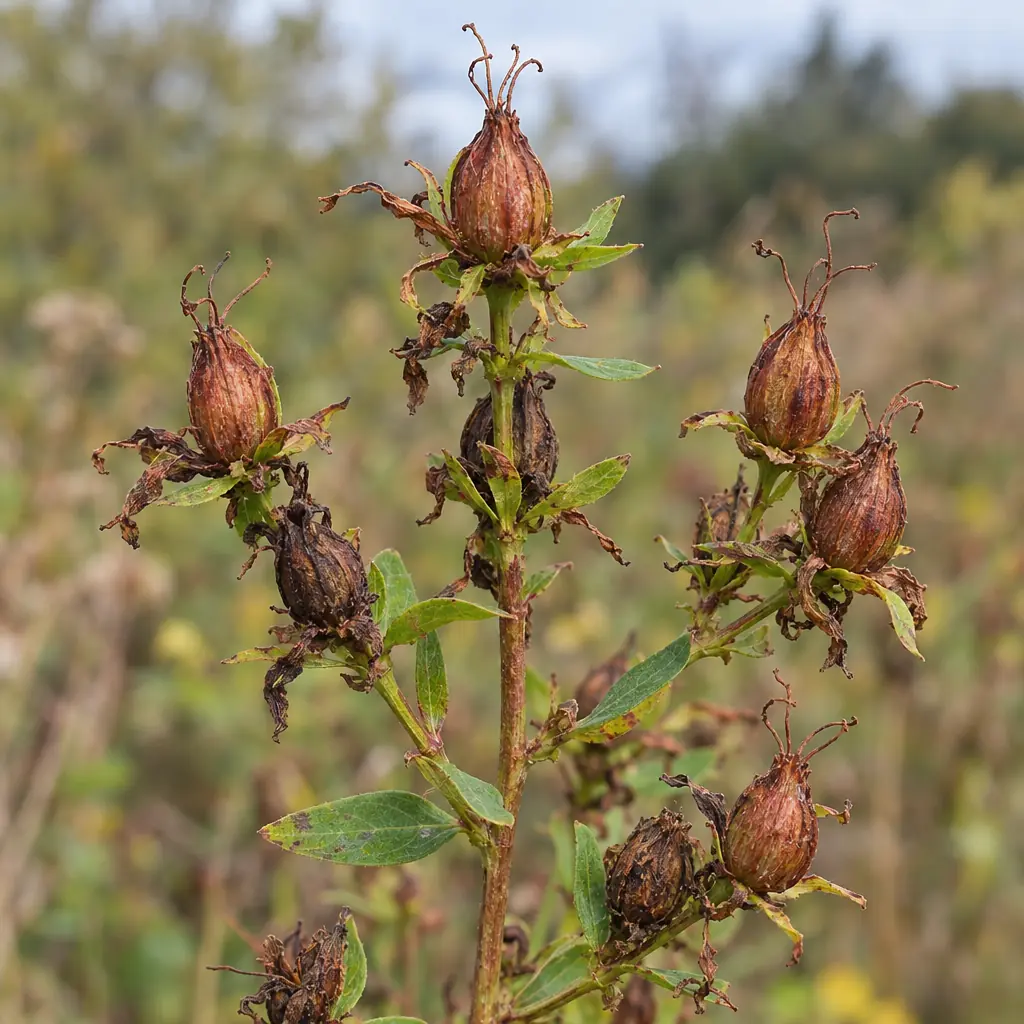
Fruit
How do you recognise perforate St John's wort?
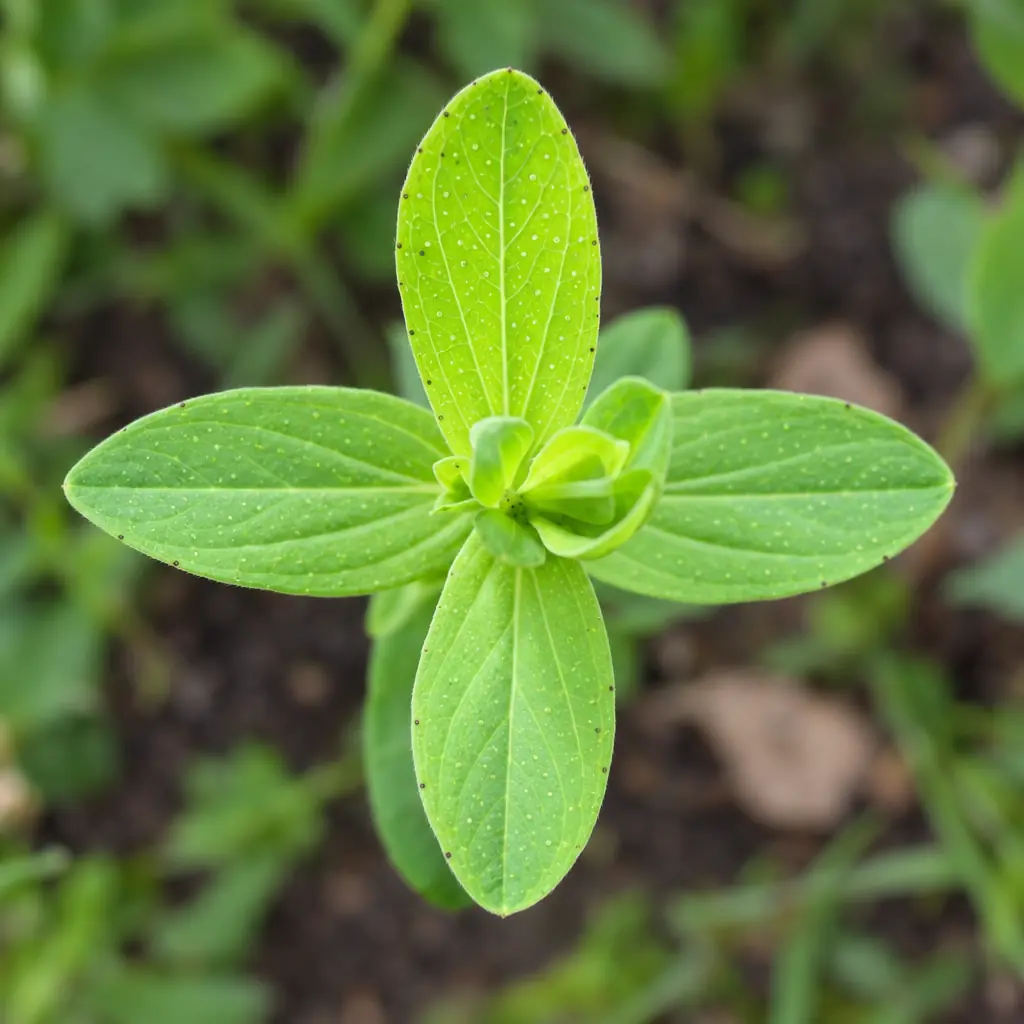
Start with the leaves. They sit in opposite pairs, without a stalk, and range from narrow to egg-shaped. Held against the light, each leaf seems full of tiny holes. A few black dots line the edge.
The stem is round, with two narrow ridges running along it. Near the top the plant branches a lot, and the flowers sit there in broad clusters. Each flower is 1 to 2.2 centimetres across, with five golden-yellow petals marked with black streaks. Crush a flower bud between your fingers and a blood-red drop comes out. After flowering comes a dry seed capsule, striped lengthwise.
Imperforate St John's wort (Hypericum maculatum) looks very similar. Its stem has four ridges and feels square, and the leaves are far less dotted. Garden centres often stock rose of Sharon (Hypericum calycinum), sold in Dutch as grootbloemig hertshooi. That is a low shrub which spreads as ground cover, with long, dark green leaves that stay green or half green in winter. Perforate St John's wort is a herb, not a shrub.
Where does perforate St John's wort grow best?
Full sun suits perforate St John's wort best: a spot with more than six hours of direct sunlight a day around midsummer. The plant copes in partial shade too, with three to six hours of direct sunlight. Dry soil rich in nutrients is fine, as long as rainwater drains away well. In the wild the species grows on road verges, on waste ground, along railways and even between paving stones.
Skip two kinds of spot in a garden:
- A corner with standing water after a shower. The roots want soil that holds moisture and still drains well.
- A spot with less than three hours of direct sunlight a day. That is too little light for this plant, and few flowers appear.
In autumn the plant dies back above ground. Through the winter only dead stems remain, or short stubs if you have already cut them.
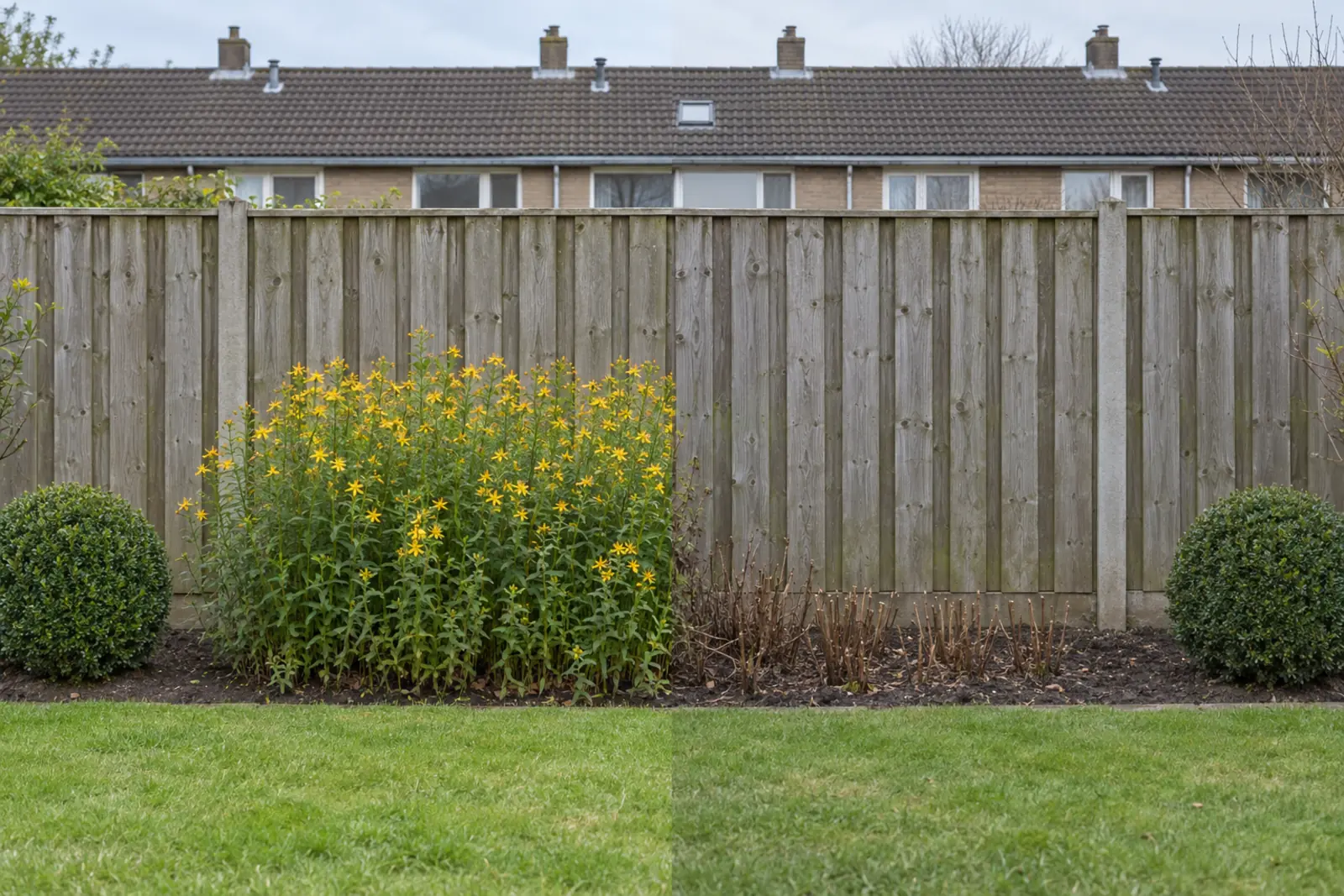 The same border in July and in January. This is a generated image, not a photograph.
On the plan the app makes of your plot, you place perforate St John's wort in a border, with your own house and your neighbours' houses beside it to scale.
Planting and caring for perforate St John's wort
Nurseries sell the plant young, in a pot, and Dutch nurseries label it sint-janskruid. A potted plant can go into the ground in any season, except when the soil is frozen or waterlogged. After planting, water well, even if the soil is already moist. For a summer planting, keep the soil moist for the first few weeks.
Give each plant about 50 centimetres of space, the narrowest spread in the table. Around a small potted plant, that first looks like an empty patch. After a few summers the gap fills in.
| When | What to do |
|---|---|
| Late winter, before new growth starts | Cut the dead stems off just above the ground |
| Spring or autumn | Dig up a clump that has grown too big and split it into pieces |
Many bird species nest from March through July, and some carry on into August. If you leave the cutting until March, look among the old stems for a nest first.
What goes wrong with perforate St John's wort?
Only a few flowers appear. The spot is probably too dark. Perforate St John's wort flowers better in sun than in partial shade. Move the clump to a sunnier place in spring or autumn.
Bits have been eaten out of the leaves. Moth caterpillars that live on this plant may be the cause. Leave them alone: pests otherwise give the plant little trouble.
The whole plant wilts and dies. Sometimes the soil holds honey fungus, a fungus that attacks roots. With this plant that is rare. Dig up a dead clump, roots and all.
St John's wort comes up where you did not plant it. The plant often turns up uninvited in gardens. Pull out the seedlings, or lift them with a trowel.
Which insects and birds use perforate St John's wort?
The caterpillars of ten moth species feed on perforate St John's wort. Two of those moths carry the plant in their Dutch names: sint-janskruiduil (Chloantha hyperici) and sint-janskruidblokspanner, the lesser treble-bar (Aplocera efformata). The lesser treble-bar caterpillar eats nothing but this plant. The moth is fairly common south of a line from Amsterdam to Zwolle, mainly in gardens, field edges and grassland. The caterpillar sits out the winter and pupates underground.
Birds eating its seeds have not been described for this species.
Is perforate St John's wort poisonous or edible?
Perforate St John's wort is mildly poisonous. In some people the sap can make the skin sensitive to sunlight, an effect called phototoxicity. People who eat the plant can be affected too.
For livestock the plant is poisonous. That is why it often survives in rough grassland: grazing animals leave it alone.
The photos on this page were made with AI, based on real photos and descriptions of this plant.
Frequently asked questions
How tall does perforate St John's wort grow?
Usually 20 to 80 centimetres, sometimes about a metre.
When does perforate St John's wort flower?
From June to September. The name comes from St John: around 24 June the plant is in flower.
When should I cut back perforate St John's wort?
At the end of winter, before the new growth starts. Cut last year's dead stems off just above the ground.
Is perforate St John's wort poisonous?
Mildly. In some people the sap can make the skin sensitive to sunlight. For livestock the plant is poisonous.
Is perforate St John's wort native to the Netherlands?
Yes, perforate St John's wort is originally native to the Netherlands. The species is common here, on road verges, on waste ground and along railways.
Sources (25)
- Duistermaat, Sparrius & Denters, Standaardlijst van de Nederlandse flora 2020 (Gorteria 43)
- NDFF Verspreidingsatlas — Hypericum perforatum
- Heukels' Flora van Nederland (Naturalis) — Hypericum perforatum
- Flora van Nederland — Sint-janskruid
- Flora van Nederland — Kantig hertshooi
- RHS — Hypericum perforatum
- RHS — Hypericum calycinum
- RHS — Shade gardening (definities zon en schaduw)
- RHS — Perennials: planting (vaste planten uit een pot)
- RHS — Honey fungus
- PFAF — Hypericum perforatum
- Pollennieuws / Flora van Nederland — Aandachtspunten hooikoorts vriendelijke tuin
- Imkerpedia — Drachtplanten
- De Vlinderstichting — Sint-janskruid (waardplant)
- De Vlinderstichting — Sint-janskruidblokspanner
- De Vlinderstichting — Sint-Jan en Sint-Jacob: een lastig duo
- Vogelbescherming — Snoeien in het broedseizoen, mag dat?
- RIVM / NVIC — Seizoengebonden vergiftigingen
- Tuincentrum Soontiëns — Hypericum perforatum (prijs)
- Natuurlijk Sterker — Hypericum perforatum (prijs)
- De Cruydt-Hoeck — Sint-janskruid (prijs)
- Puur van 't Veld — Sint-janskruid (prijs)
- Wikimedia Commons — Leaf: photo by AnRo0002 (CC0)
- Wikimedia Commons — Flower: photo by AnRo0002 (CC0)
- Wikimedia Commons — Fruit: photo by AnRo0002 (CC0)