5 min read
Reed canary grass: where it grows, care and moths
Phalaris arundinacea
Reed canary grass (Phalaris arundinacea) is a native bankside grass in the Netherlands. The grass grows 50 centimetres to 2 metres tall. Below ground, the plant keeps creeping outward on its rhizomes. In summer, narrow flower heads appear, white-green to pink. Plant reed canary grass in moist to wet soil, in full sun or partial shade.
Reed canary grass at a glance
| Feature | Reed canary grass |
|---|---|
| Height | 0.5 to 2 m |
| Spread | More than 8 m: keeps spreading |
| Full grown after | 5 to 10 years |
| Sun | Full sun to partial shade |
| Soil | Moist to wet and rich in nutrients |
| Water | Plenty: the soil can be wet |
| Maintenance | Average: remove dead stems, cut back runners |
| Flowers | June and July, white-green or reddish |
| For bees | Yes: plenty of pollen, June and July |
| Hay fever | Very strongly allergenic, June and July |
| Leaves | Drop in autumn: dead stems stand through winter |
| Hardy | Yes |
| Native | Yes |
| Poisonous | No, as far as is known |
| Pricks or stings | No |
| Price, young | About €2.50 to €7.45 each, in a small pot |
| Price, grown | Not for sale |
- Leaf
- April to October
- Flower
- June to July
- Fruit
- no noticeable fruit
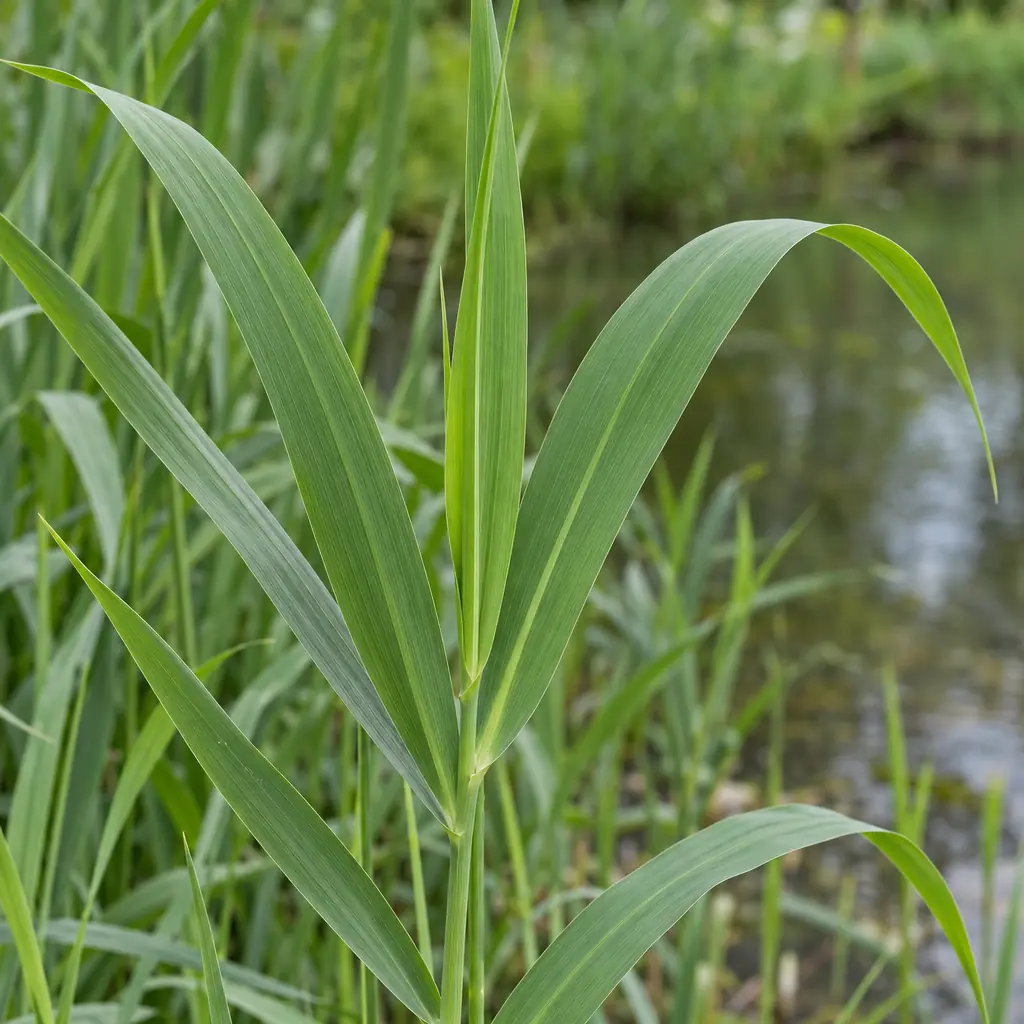
Leaf 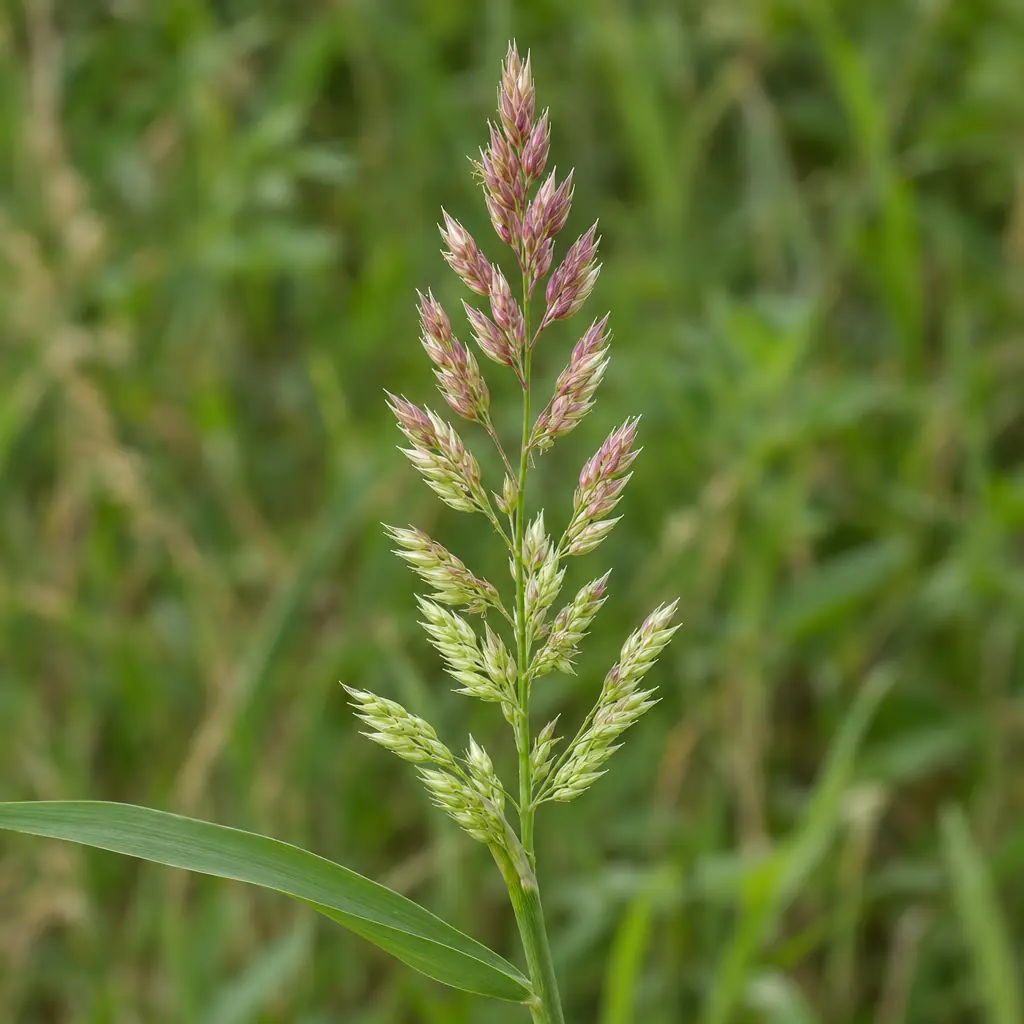
Flower
How do you recognise reed canary grass?
Start with a leaf. The blade is flat, 0.6 to 2 centimetres wide, with a smooth edge. A broad, flat midrib runs down the middle. Young leaves come out rolled up.
Next, bend a leaf away from the stem. Where blade and stem meet sits a thin, papery tongue, called the ligule. This tongue can grow to more than 1 centimetre long and often frays.
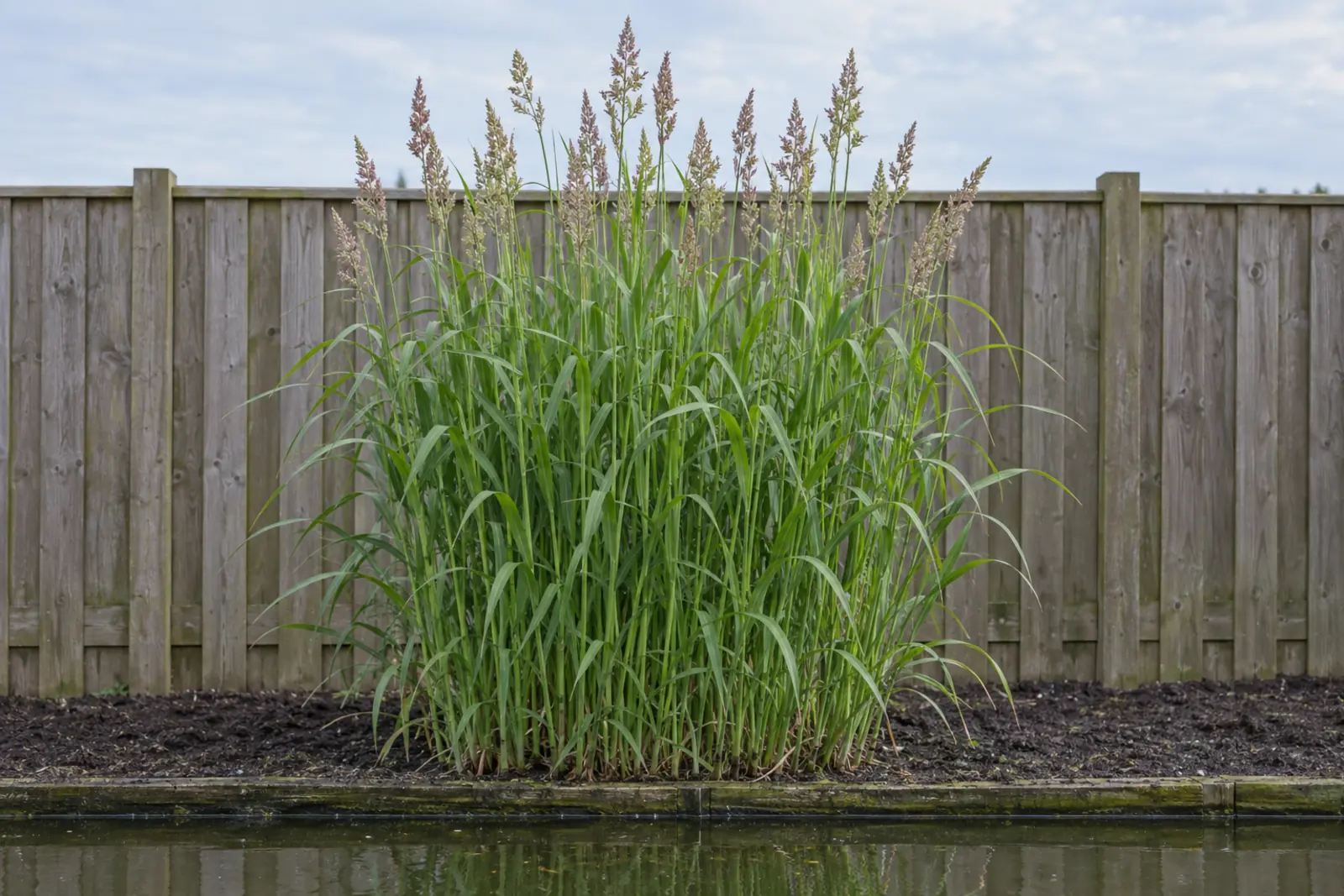
Every stem ends in a narrow, cone-shaped flower head of 10 to 25 centimetres. Its spikelets sit together in dense little clusters. Below ground run thick rhizomes, mostly pink.
Common reed (Phragmites australis) grows on the same banks and looks similar from a distance. The ligule tells them apart: common reed has a ring of hairs there instead. Garden centres also sell 'Picta', a cultivar of reed canary grass with leaves striped white and green. The wild species has plain green leaves.
Where does reed canary grass grow best?
Reed canary grass grows in full sun and in partial shade. Around midsummer, a spot with three to six hours of direct sun is still fine for this grass. Its favourite ground is moist to wet and rich in nutrients. In the wild you find it at the water's edge, beside ditches, in reed beds and in rough grassland.
Two places in a garden lead to trouble:
- A border full of perennials. The rhizomes branch far underground. That way reed canary grass claims more and more of the border.
- A dry, sandy spot. Reed canary grass wants moist to wet soil and gets too little water there.
In autumn the leaves die off. Dead, straw-coloured stems then stand all winter, until you cut them down in spring.
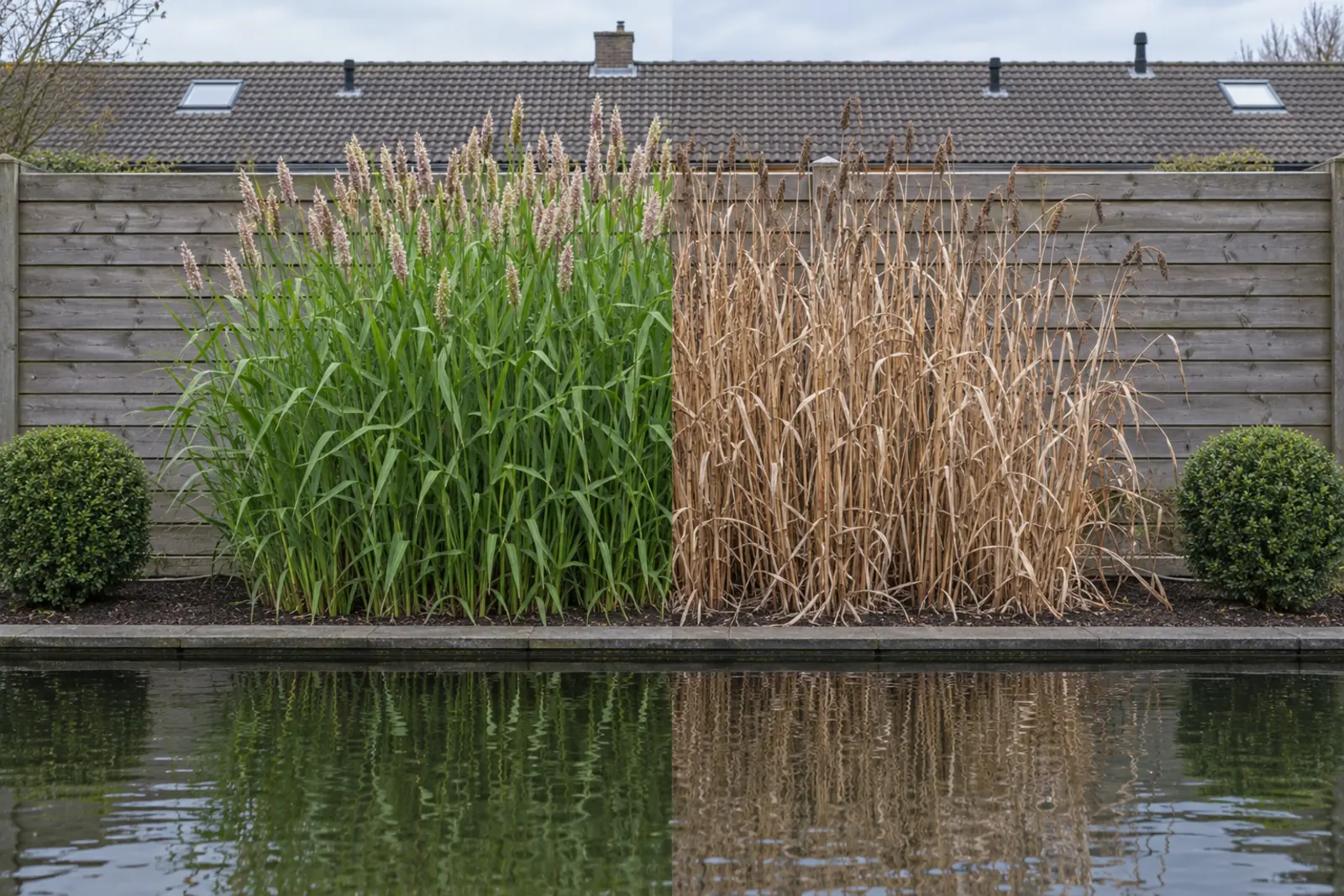 The same pond edge in June and in January. This is a generated image, not a photograph.
On a plan of your own plot you can see how much room a strip of reed canary grass gets along your pond. The app draws that plot to scale, with the nearby buildings on it.
Planting and caring for reed canary grass
Nurseries sell the wild species as a young plant in a small pot. Dutch shops label it rietgras. Dividing a clump works best from mid-April to midsummer.
Space the plants about 60 centimetres apart. The spread in the table is no guide here, because that figure describes a whole colony. On planting day, 60 centimetres looks bare. The rhizomes soon close that gap. Keep the soil wet through the first summer.
| When | What to do |
|---|---|
| Early spring | Cut the dead stems back to just above the ground |
| Mid-April to midsummer | Slice off runners at the edge, or divide a clump that has grown too big |
That spring cut sometimes falls in the breeding season. From March through July, many kinds of birds sit on their nests. So check between the old stems before you start cutting.
What goes wrong with reed canary grass?
The grass pops up all over the border. Those are the rhizomes. Between mid-April and midsummer, slice off the runners at the edge with a spade. Pull out the shoots already growing in the border too. Repeat this every year.
The leaves hang limp or wither. The soil is too dry. Water generously, or move the clump to the edge of the pond.
No flower heads appear. Mowing or cutting in June removes the flowering stems. Leave the clump alone in June and July.
Everything is brown in winter. That is normal. Cut the dead stems off in early spring.
Something is on the leaves. Pests and diseases rarely trouble reed canary grass. Usually nothing needs doing.
Which insects and birds use reed canary grass?
Reed canary grass is a host plant for moths. The caterpillar of the small clouded brindle (Apamea unanimis) feeds on various grasses, and reed canary grass is an important one among them. The adult moth flies from early May to early August.
The caterpillar of the double lobed (Apamea ophiogramma) eats reed canary grass and reed sweet-grass. This common moth also turns up in gardens.
The caterpillar of the southern wainscot (Mythimna straminea) feeds on common reed and reed canary grass as well. Among birds there is the bearded reedling (Panurus biarmicus), which lives in reed beds. In winter it eats the seed of common reed and reed canary grass.
Is reed canary grass poisonous or edible?
Reed canary grass is not known to be poisonous. No edible part of the plant is known either.
The photos on this page were made with AI, based on real photos and descriptions of this plant.
Frequently asked questions
How tall does reed canary grass grow?
Reed canary grass grows 50 centimetres to 2 metres tall. The narrow flower heads sit at the top of the stems.
Does reed canary grass spread?
Yes. Reed canary grass creeps outward on long rhizomes and can take over a large patch of ground that way. Slice off the edges of the clump with a spade between mid-April and midsummer.
When do you cut back reed canary grass?
In early spring. Cut last year's dead stems back to just above the ground.
Is reed canary grass bad for hay fever?
The pollen of reed canary grass is very strongly allergenic, like the pollen of all grasses. The grass releases it while flowering, in June and July.
Is reed canary grass native to the Netherlands?
Yes. Reed canary grass is native to the Netherlands and was not brought in by people. The grass is common along ditches, on riverbanks and in reed beds.
Sources (21)
- Duistermaat, Sparrius & Denters, Standaardlijst van de Nederlandse flora 2020 (Gorteria 43)
- NDFF Verspreidingsatlas — Phalaris arundinacea
- Wilde planten in Nederland en België — Rietgras
- Flora van Nederland — Rietgras
- RHS — Phalaris arundinacea (reed canary grass)
- RHS — Phalaris arundinacea 'Variegata' ('Picta')
- RHS — Shade gardening (definities zon en halfschaduw)
- Plants For A Future — Phalaris arundinacea
- Imkerpedia — Drachtplanten
- Wageningen UR — Stuifmeel, in de serie over bijenproducten
- Pollennieuws / Flora van Nederland — Aandachtspunten hooikoorts vriendelijke tuin
- De Vlinderstichting — Rietgras (waardplant)
- De Vlinderstichting — Rietgrasuil
- De Vlinderstichting — Moeras-grasuil
- De Vlinderstichting — Spitsvleugelgrasuil
- Vogelbescherming — Baardman
- Vogelbescherming — Snoeien in het broedseizoen, mag dat?
- Natuurlijk Sterker — Rietgras (prijs)
- Bakker — Rietgras (prijs)
- Wikimedia Commons — Leaf: photo by Robert Flogaus-Faust (CC BY 4.0)
- Wikimedia Commons — Flower: photo by Robert Flogaus-Faust (CC BY 4.0)