5 min read
Soapwort plant: identification, spread, care and price
Saponaria officinalis
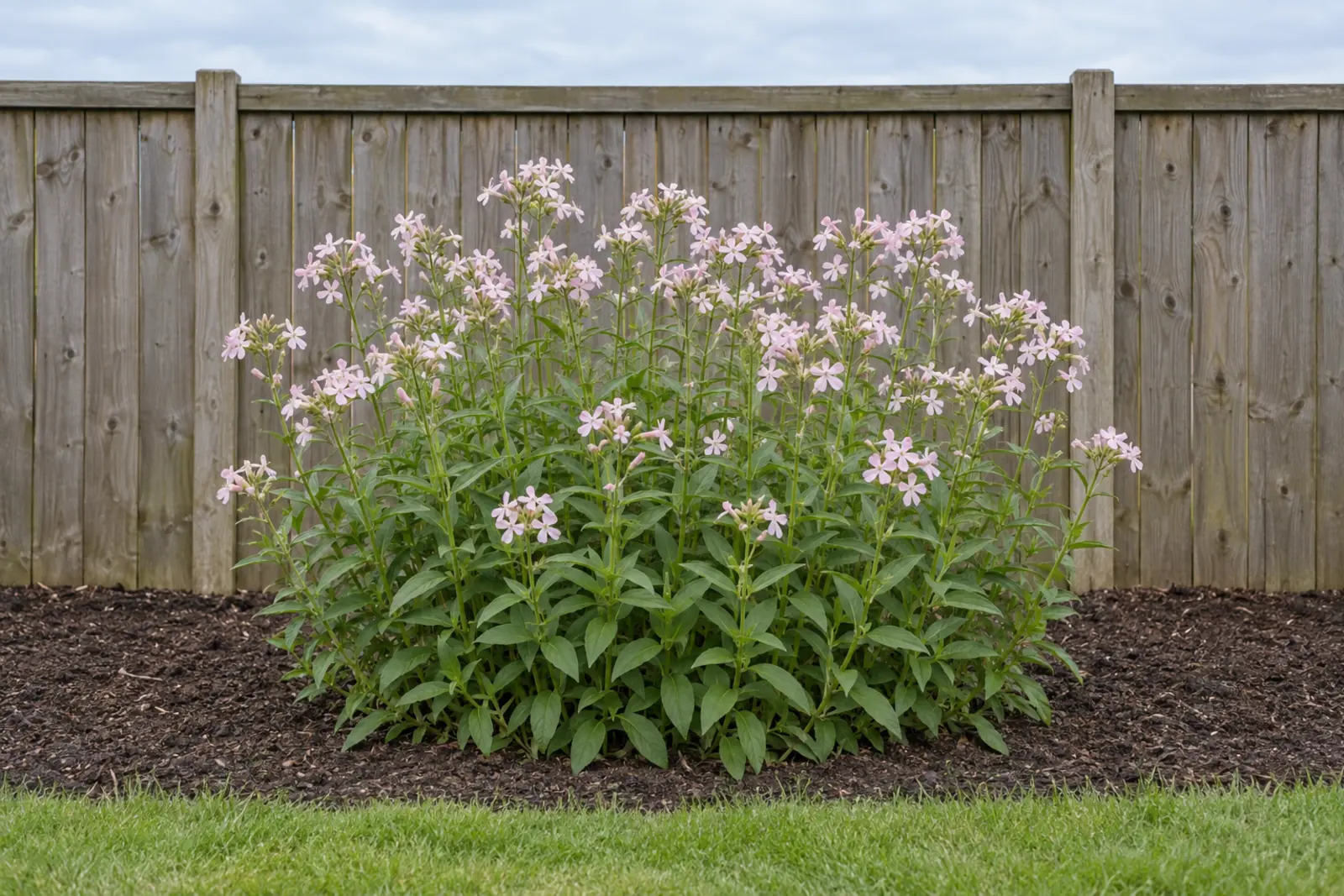
Soapwort (Saponaria officinalis) is a perennial plant, 40 to 70 cm tall, with pale pink or white flowers. They open from July to September and smell faintly sweet. Soapwort needs sun and grows in dry to moist soil, preferably chalky. Runners creep under the ground, so one clump turns into a patch by itself.
Soapwort at a glance
| Feature | Soapwort |
|---|---|
| Height | 40 to 70 cm |
| Spread | 10 to 50 cm per clump, keeps spreading |
| Full grown after | 2 to 5 years |
| Sun | Full sun to partial shade |
| Soil | Dry to moist, preferably chalky |
| Water | Average: dry and moist soil both suit it |
| Maintenance | Low: keep the runners in check |
| Flowers | July to September, pale pink or white |
| For bees | Little: some nectar, July to September |
| Hay fever | Not or weakly allergenic |
| Leaves | Drop in autumn: the plant dies back above ground in winter |
| Hardy | Yes |
| Native | Yes |
| Poisonous | Mildly: mainly the rhizome and the seed |
| Pricks or stings | No |
| Price, young | About €2.45 to €4.09 each, in a small pot |
| Price, grown | About €6.50 per plant in a larger pot, minimum order 10 |
- Leaf
- April to October
- Flower
- July to September
- Fruit
- no noticeable fruit
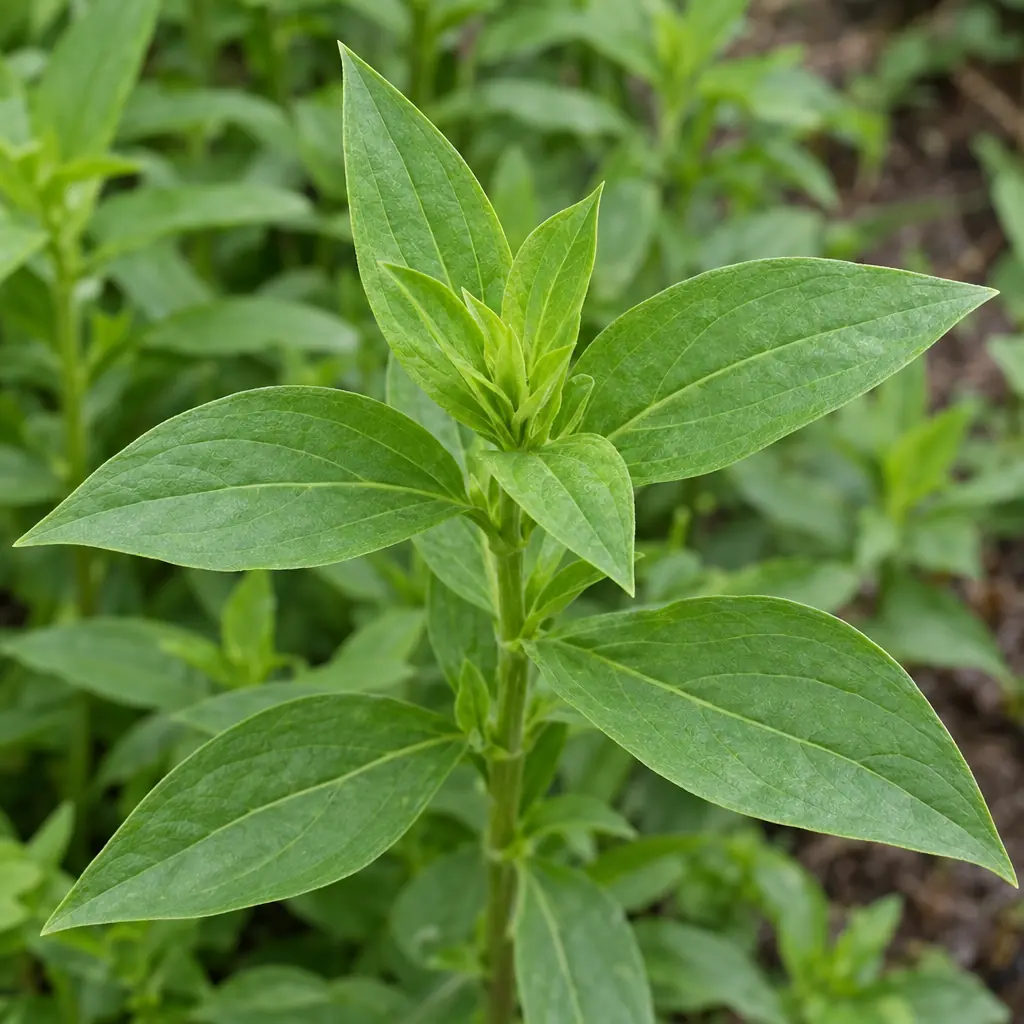
Leaf 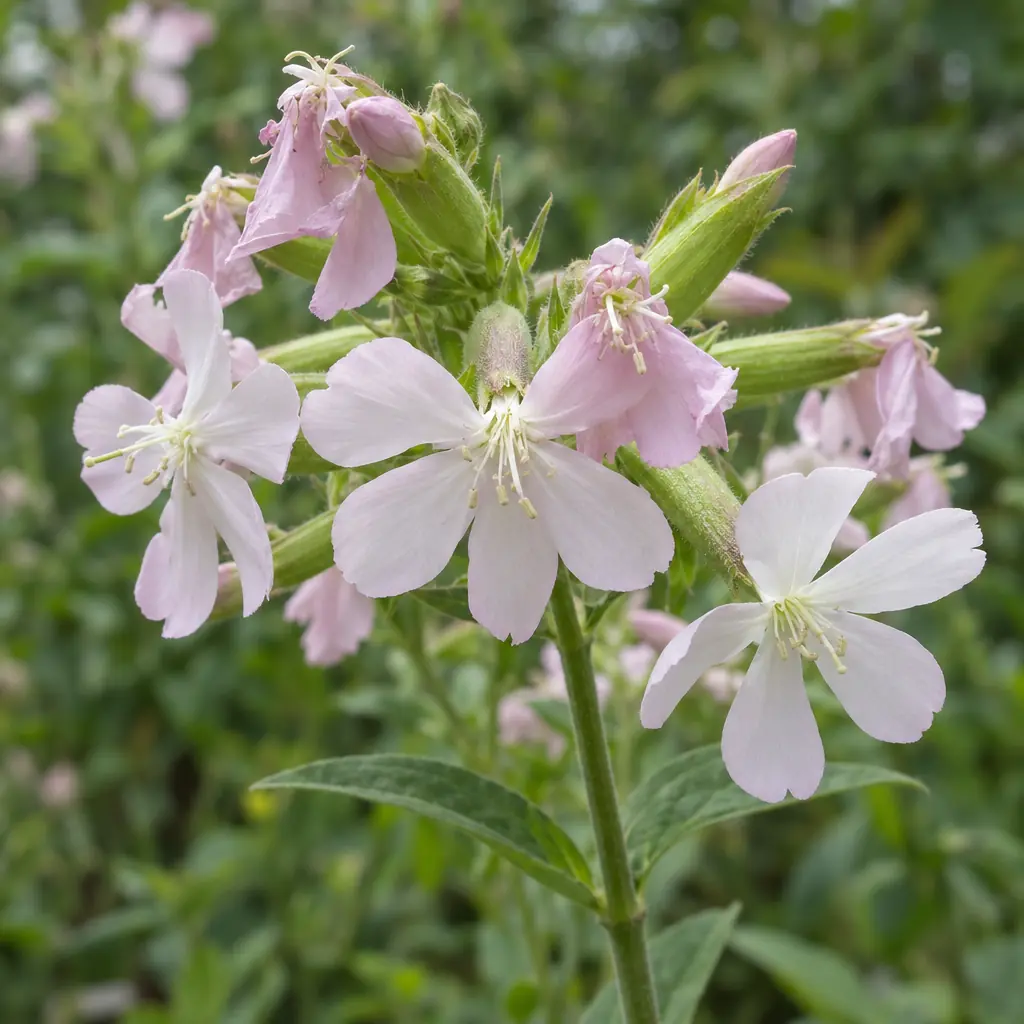
Flower
How do you recognise soapwort?
The stems grow upright, are hairless and feel slightly rough. Soapwort grows in small groups: a clump of many stems side by side.
The leaves sit in opposite pairs. Each leaf is oval or oblong, with a pointed tip, and 5 to 10 cm long. Three or five clear veins run along its length.
At the top of the stem the flowers are packed close together. Every flower has five separate petals and measures 2.5 to 4 cm across. Below the petals sits a narrow, round calyx tube. After flowering, a dry capsule full of seed remains.
Garden forms with double flowers, such as 'Rosea Plena', are also grown as ornamentals. Those flowers are a deeper pink and packed with petals, like small roses. The wild species has single flowers with five petals.
Where does soapwort grow best?
Soapwort suits a sunny spot. That means full sun: more than six hours of direct sunlight a day around midsummer. In partial shade, where the sun shines for three to six hours, the plant still grows. Neutral or chalky soil is fine, but acid soil is not. People brought soapwort to the Netherlands before the year 1500, so it has been at home here for centuries.
Avoid these spots for soapwort:
- Right beside a pond with fish or frogs. If the plant trails into the water, its sap can poison them.
- A border where nothing should spread. The rhizomes creep underground and come up again further along.
In winter, soapwort dies back above ground. By January there are at most a few dry stem remains, and next spring's buds wait just at soil level.
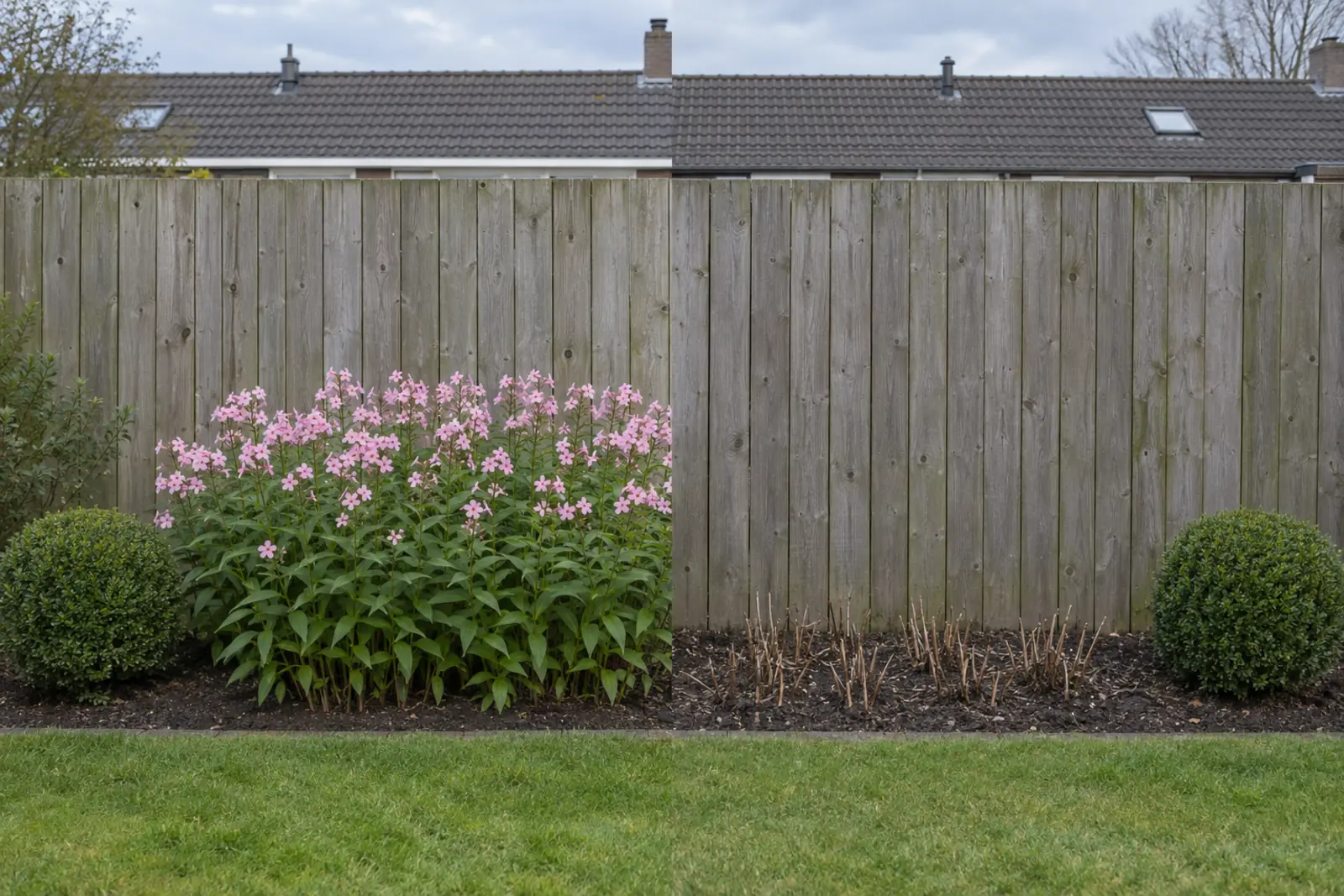 The same border in August and in January. This is a generated image, not a photograph.
A small pot holds a narrow young plant. To see whether a clump fits beside the path or the terrace, drop soapwort into a drawing of your own plot. The app draws the plant at a grown plant's width, not at pot size.
Planting and caring for soapwort
Soapwort is sold as a young plant in a small pot. A potted plant like that can go in the ground at any time of year. Sowing works too, but the seed needs a winter of cold before it germinates. So sow outdoors in autumn, and let the winter do that work.
Leave about 40 cm between plants, some 6 to 7 per square metre. On planting day that looks like a lot of space. Yet each clump grows up to half a metre wide.
In the first summer, water in dry weeks until the roots have taken hold. Fertiliser is not needed, because moderately fertile soil is enough.
No pruning is needed.
What goes wrong with soapwort?
The leaves are full of holes. Usually that is slugs. Pick them off the plant after a rain shower.
Soapwort keeps popping up all over the border. Those are runners from the rhizome. Cut off whatever grows outside its spot with a sharp spade, and lift out the pieces of root.
There are small holes low down in the flower tubes. Short-tongued bumblebees made them. These bumblebees cannot reach the nectar the normal way, so they bite the calyx open. That way they do not pollinate the flower, but the plant comes to no other harm.
The plant hardly flowers. Most likely it gets too little sun. Move the clump to a lighter spot in spring or autumn.
Which insects and birds use soapwort?
Two moths raise their caterpillars on soapwort. For the Bordered Gothic (Sideridis reticulata), soapwort is the main host plant: the plant its caterpillar lives on. From June to September that caterpillar feeds at night on the unripe seed capsules. This moth is fairly rare and is listed as threatened on the provisional Red List. It occurs mainly in the dunes, but also in gardens. The caterpillar of the Campion (Sideridis rivularis), a fairly common moth, lives on soapwort as well. When young, it lives inside the seed capsules. If you leave the spent stems, these caterpillars keep their food.
Which birds, if any, use soapwort has not been described by name.
Is soapwort poisonous?
Soapwort is mildly poisonous. The whole plant contains saponin, the rhizome most of all. The seed poses the greatest risk, to birds as well. Saponin irritates the stomach and gut, and a large amount causes vomiting and diarrhoea.
The photos on this page were made with AI, based on real photos and descriptions of this plant.
Frequently asked questions
Is soapwort poisonous?
Yes, mildly. The whole plant contains saponin, especially the rhizome and the seed. A large amount irritates the stomach and gut.
Does soapwort spread?
Yes, on good soil soapwort can spread vigorously. Runners creep underground and send up new stems further along. Cut off whatever grows outside its spot with a sharp spade.
Is soapwort a native plant in the Netherlands?
Yes, the plant belongs here. Soapwort came to the Netherlands before the year 1500 and has grown wild ever since, in the dunes among other places.
How much sun does soapwort need?
Full sun or partial shade. Full sun means more than six hours of direct sunlight a day around midsummer. Partial shade means three to six hours.
How tall does soapwort grow?
Usually 40 to 70 centimetres. One clump grows up to half a metre wide, but a patch keeps spreading through its runners.
Sources (18)
- Duistermaat, Sparrius & Denters, Standaardlijst van de Nederlandse flora 2020 (Gorteria 43)
- NDFF Verspreidingsatlas — Saponaria officinalis
- Flora van Nederland — Zeepkruid
- Wilde planten in Nederland en België — Zeepkruid
- RHS — Saponaria officinalis (soapwort)
- RHS — Saponaria officinalis 'Rosea Plena'
- RHS — Shade gardening (definities zon en schaduw)
- PFAF — Saponaria officinalis
- Knight, Guide to Poisonous House and Garden Plants — Saponaria (IVIS)
- Imkerpedia — Drachtplanten
- Pollennieuws / Flora van Nederland — Aandachtspunten hooikoorts vriendelijke tuin
- De Vlinderstichting — Gelijnde silene-uil
- De Vlinderstichting — Gevorkte silene-uil
- Yarinde — Zeepkruid (prijs)
- Cruydt-Hoeck — Zeepkruid (prijs en zaaien)
- Puur van 't Veld — Zeepkruid (prijs, plantafstand en planttijd)
- Wikimedia Commons — Leaf: photo by Daderot (CC0)
- Wikimedia Commons — Flower: photo by AnRo0002 (CC0)