6 min read
Wild Chicory: Identify, Plant and Care for It
Cichorium intybus
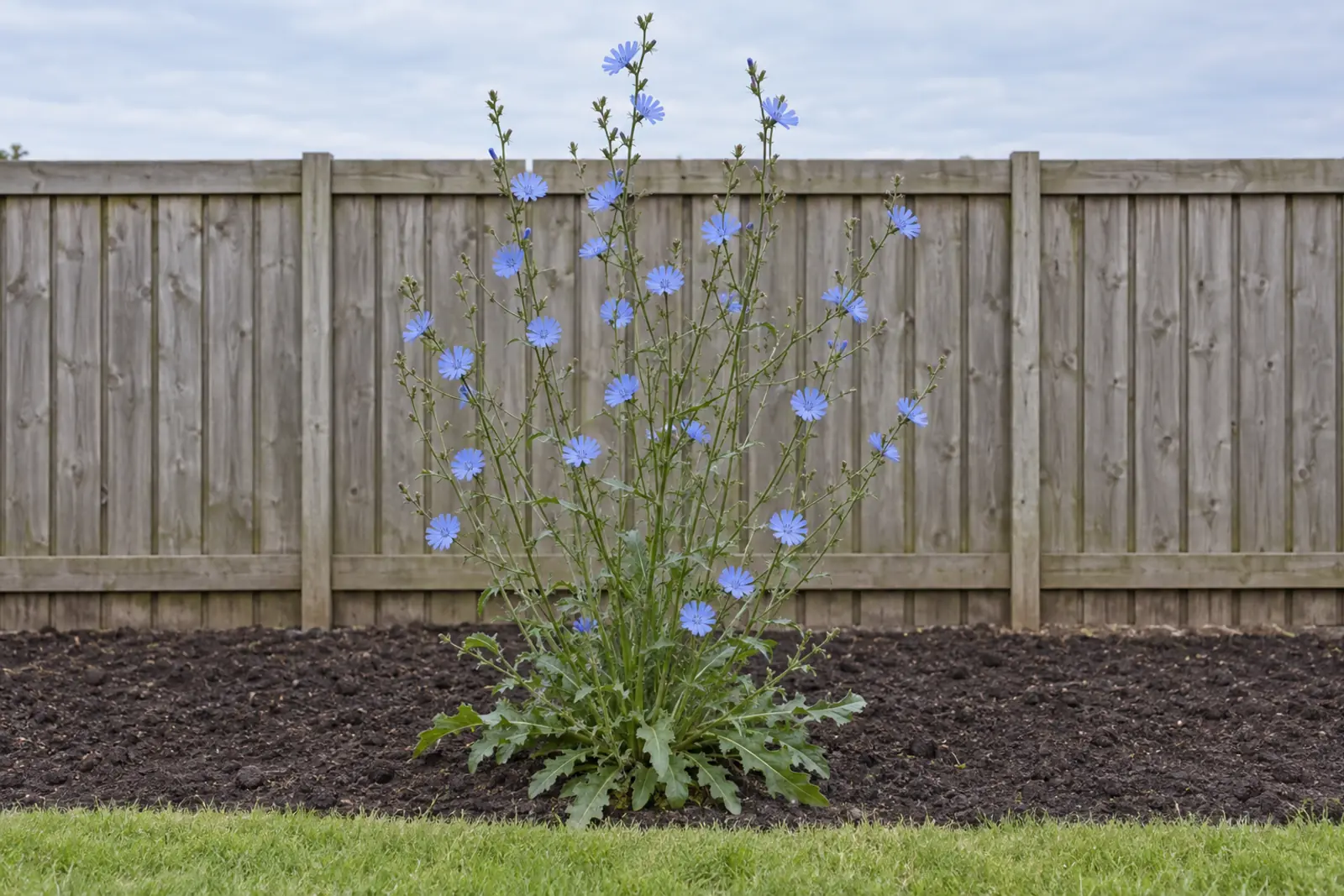
Wild chicory (Cichorium intybus) is a perennial with light blue flowers. Its stiff, branching stems grow 30 centimetres to 1.2 metres tall. In July and August the plant carries flower heads about 2 to 4 centimetres across. It wants full sun and soil where water drains away freely.
Wild Chicory at a Glance
| Feature | Wild Chicory |
|---|---|
| Height | 0.3 to 1.2 m |
| Spread | 0.5 to 1 m |
| Full grown after | 1 to 2 years |
| Sun | Full sun |
| Soil | Free-draining, preferably chalky |
| Water | Little: a long taproot |
| Maintenance | Low: no pruning needed |
| Flowers | July and August, light blue |
| For bees | Yes: nectar and pollen, July to September |
| Hay fever | Not or weakly allergenic |
| Leaves | Drop in autumn |
| Hardy | Yes |
| Native | Yes |
| Poisonous | No, as far as known |
| Pricks or stings | No |
| Price, young | About €1.90 to €4.61 each, 5 to 10 cm, in a small pot |
| Price, grown | About €6.50 to €7.99 each, in a larger pot |
- Leaf
- April to October
- Flower
- July to August
- Fruit
- no noticeable fruit
Leaf 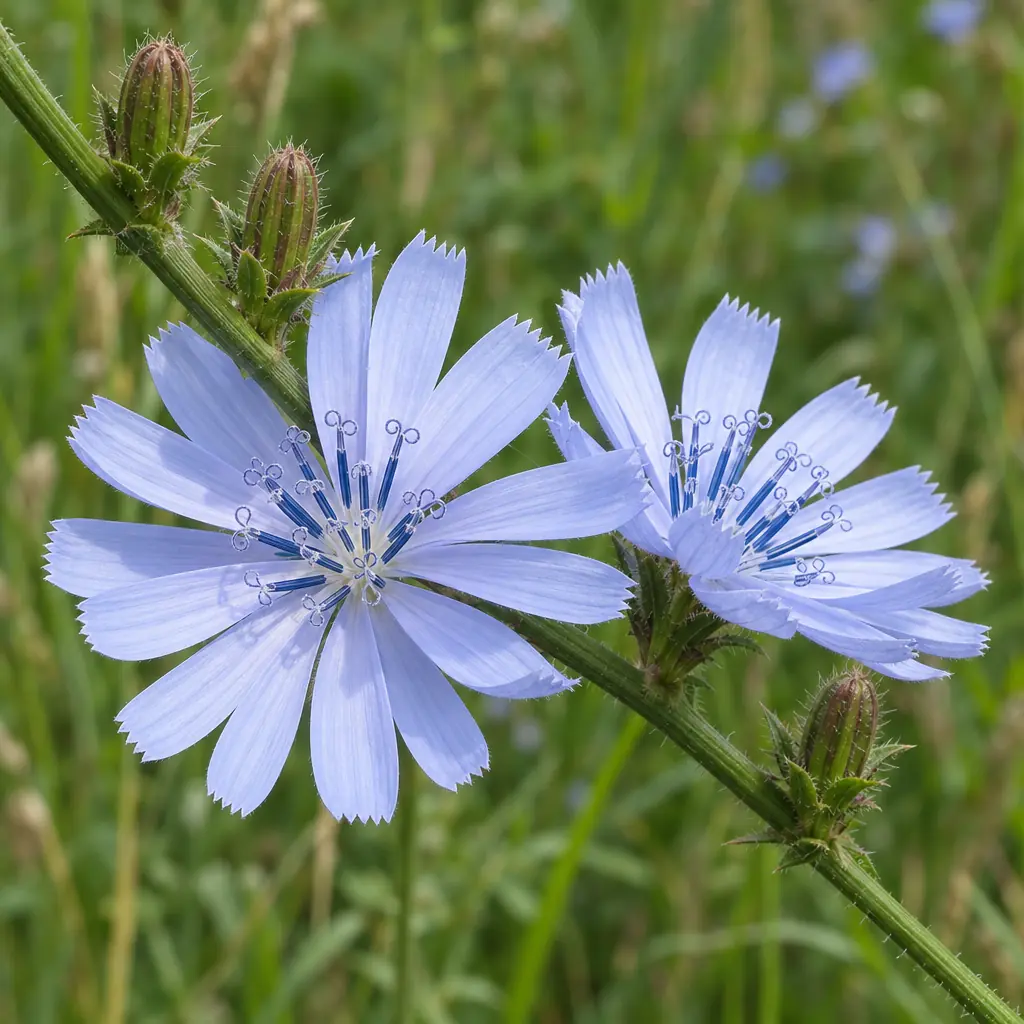
Flower
How Do You Recognise Wild Chicory?
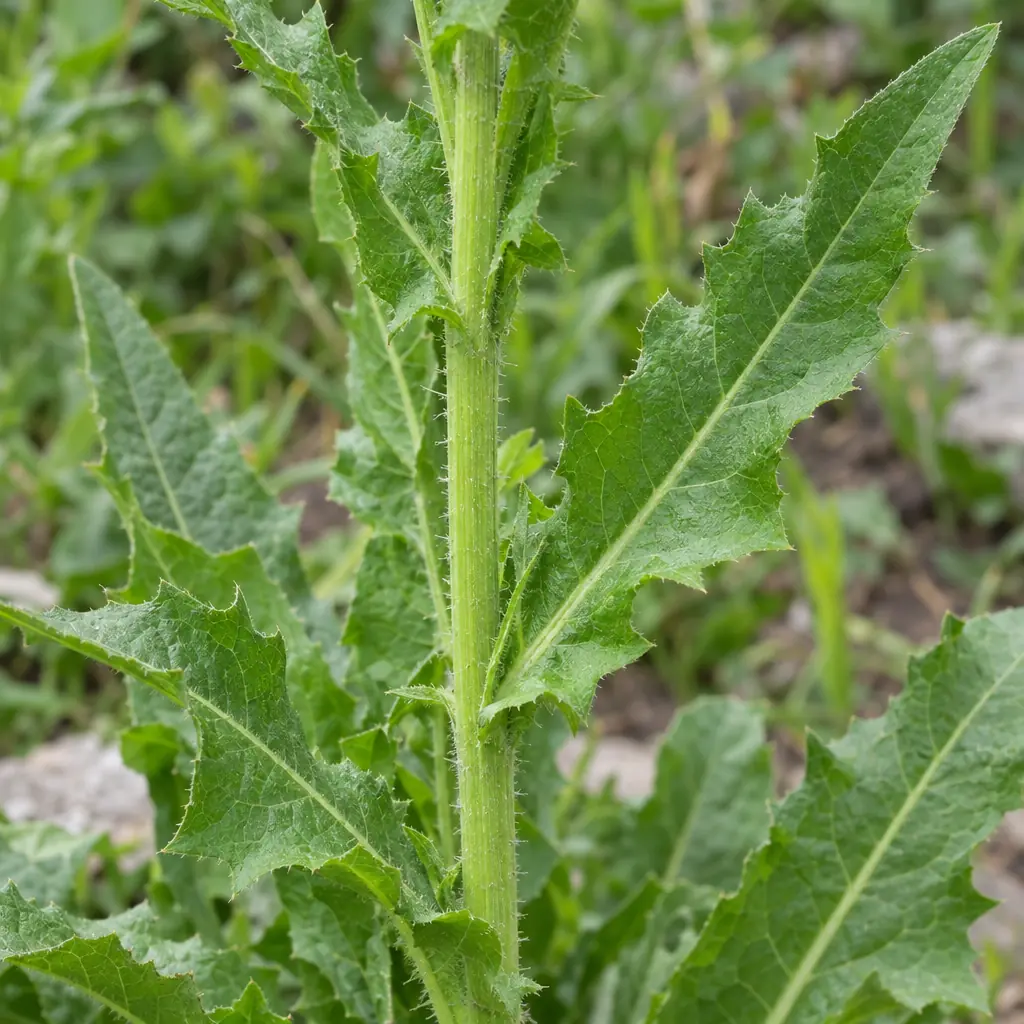
Start at the base of the plant. There sits a rosette of long, deeply cut leaves, a little like a dandelion's. Higher up the stem carries few leaves. Those stem leaves are smaller and less cut, and their base clasps the stem.
The stems are stiff, grooved and dull green, and usually roughly hairy. Because they branch so much, the plant looks like a small broom. A milky sap runs inside the stems.
Flower heads sit spread along the branches and at the forks. Each head is made only of narrow, flat petals with a toothed tip. Almost all of them are light blue, very rarely pink or white.
Cornflower also carries blue heads. Its flowers sit alone on a stem, not in a row along the branches. Around the edge sit about eight wide trumpets, much longer than the florets in the middle.
Where Does Wild Chicory Grow Best?
Give wild chicory a spot in full sun. Such a spot gets more than six hours of direct sunlight a day around midsummer. The soil may be sand, loam or chalk. Compacted ground is no problem: in the wild the plant grows on verges, along dykes and next to walls. The species originally comes from the region around the Mediterranean. It arrived in the Netherlands before 1500, so it has grown here for centuries.
Two spots go wrong:
- In a pot. Even in its first year the plant makes a taproot as much as 75 centimetres long. A pot is too small for a root like that.
- Where water stands after rain. The roots need soil that lets water drain away well.
In autumn everything above ground dies back, but the root lives on. If you cut the dead stems back, only bare soil and short stubs are left by January.
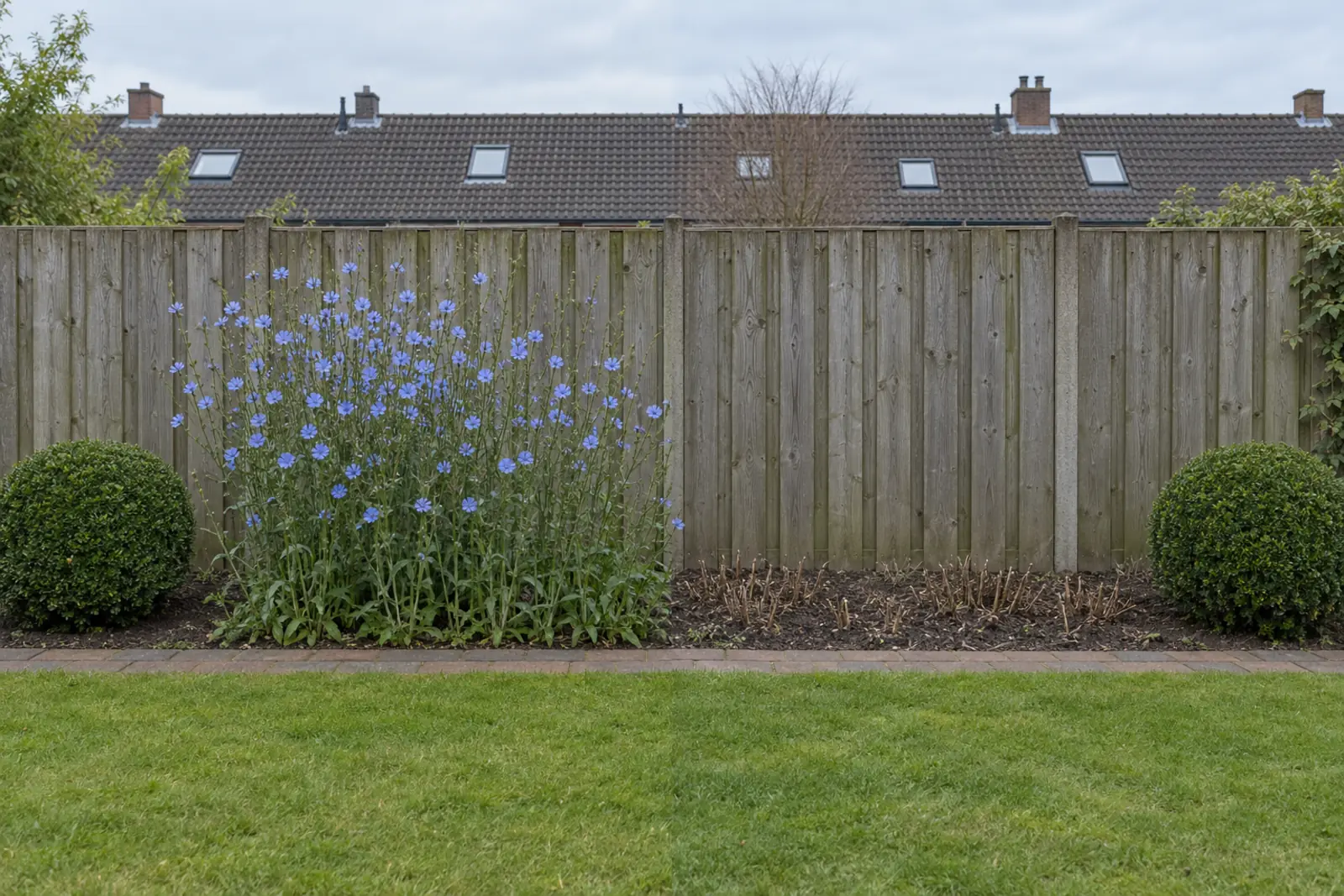 The same border in July and in January. This is a generated image, not a photo.
A clump grows half a metre to a metre wide. Whether a group of them fits beside your terrace is something you check on a map of your own plot. The app draws that to scale, with the houses around it.
Planting and Care
A plant from a pot can go into the ground all year round, as long as the soil is not frozen or waterlogged. March to early May and late September to October work best, because the soil is moist then. Sowing works too, straight into the spot where the plant should stand.
Space the plants 50 centimetres to a metre apart. On planting day that looks like a lot of room, because a young plant is only 5 to 10 centimetres. Water well after planting. Keep the soil moist through the first year, even though the plant can later cope with dry spells.
Pruning is not needed. Only the dead stems come off:
| When | What you do |
|---|---|
| Autumn | Cut off dead stems, or leave them standing until March |
| From March | Cut back what still stands upright, just above the ground |
The breeding season runs for many birds from March to the end of July. Some breed more than once and continue into August. If you cut back during that time, check for nests first.
What Can Go Wrong?
The leaves are covered in a white powder. That is powdery mildew, a fungus. Cut off affected stems straight away. Water regularly in dry spells, because that helps against the mildew.
Ragged holes appear in the leaves. Those are slugs and snails, recognisable by their slime trails. Young plants suffer the most. Look for them in the evening with a torch and move them elsewhere.
No flowers appear. A plant grown from seed makes only a rosette and a root in its first year. The flowers come only in the second year.
All the flowers are closed in the afternoon. That is normal. They open in the morning and close as the afternoon goes on.
Which Birds and Insects Use It?
The caterpillars of the marbled clover moth (Heliothis viriplaca) eat wild chicory. From July to October they live on the flowers and the unripe seeds. This moth is rare and listed as vulnerable on the Red List. You see it mostly in the dunes.
The large-headed resin bee (Heriades truncorum), a small solitary bee, collects pollen from chicory. It is not her favourite flower, but she visits it anyway.
In one bird garden in Oost-Groningen, wild chicory appeared on its own. The goldfinches there are very fond of it.
Is Wild Chicory Poisonous or Edible?
As far as is known, wild chicory is not poisonous. Root, leaves and flowers are edible. The leaves taste bitter, especially once the plant flowers. Dried and roasted roots give a kind of coffee with no caffeine. Around 1800, in Napoleon's time, people often drank it instead of expensive coffee.
The photos on this page were made with AI, based on real photos and descriptions of this plant.
Frequently asked questions
How tall does wild chicory grow?
Usually 30 centimetres to 1.2 metres. A full-grown clump spreads half a metre to a metre wide.
Is wild chicory a native plant?
Yes, it has grown here since before the year 1500. Wild chicory originally comes from the region around the Mediterranean.
Is wild chicory poisonous?
No, not as far as is known. Root, leaves and flowers are edible, but the leaves taste bitter.
Why do wild chicory flowers close in the afternoon?
That is normal. The flowers open in the morning and close as the afternoon goes on.
Sources (24)
- Duistermaat, Sparrius & Denters, Standaardlijst van de Nederlandse flora 2020 (Gorteria 43)
- NDFF Verspreidingsatlas — Cichorium intybus
- Flora van Nederland — Wilde cichorei
- Nederlandse Vereniging van Botanische Tuinen — Wilde cichorei
- RHS — Cichorium intybus (chicory)
- RHS — Shade gardening (definities zon en schaduw)
- RHS — Perennials: planting
- RHS — Perennials: cutting back
- RHS — Powdery mildews
- RHS — Slugs and snails
- PFAF — Cichorium intybus
- Imkerpedia — Drachtplanten
- Pollennieuws / Flora van Nederland — Aandachtspunten hooikoorts vriendelijke tuin
- NDFF Verspreidingsatlas — Centaurea cyanus (korenbloem)
- De Vlinderstichting — Lichte daguil
- EIS Kenniscentrum Insecten (Bestuivers.nl) — Gasten van bijenhotels, hoofdstuk 13: Tronkenbijen in nestblokken
- Vogelbescherming — Schapen eruit, vogels erin
- Vogelbescherming — Snoeien in het broedseizoen, mag dat?
- Heijnen Planten — Wilde cichorei (prijs)
- De Cruydt-Hoeck — Wilde cichorei (prijs)
- Puur van 't Veld — Wilde cichorei (prijs)
- Vogelbeschermingshop — Wilde cichorei (prijs)
- Wikimedia Commons — Leaf: photo by AnRo0002 (CC0)
- Wikimedia Commons — Flower: photo by AnRo0002 (CC0)