5 min read
Water violet: identify, plant and care for it in a pond
Hottonia palustris
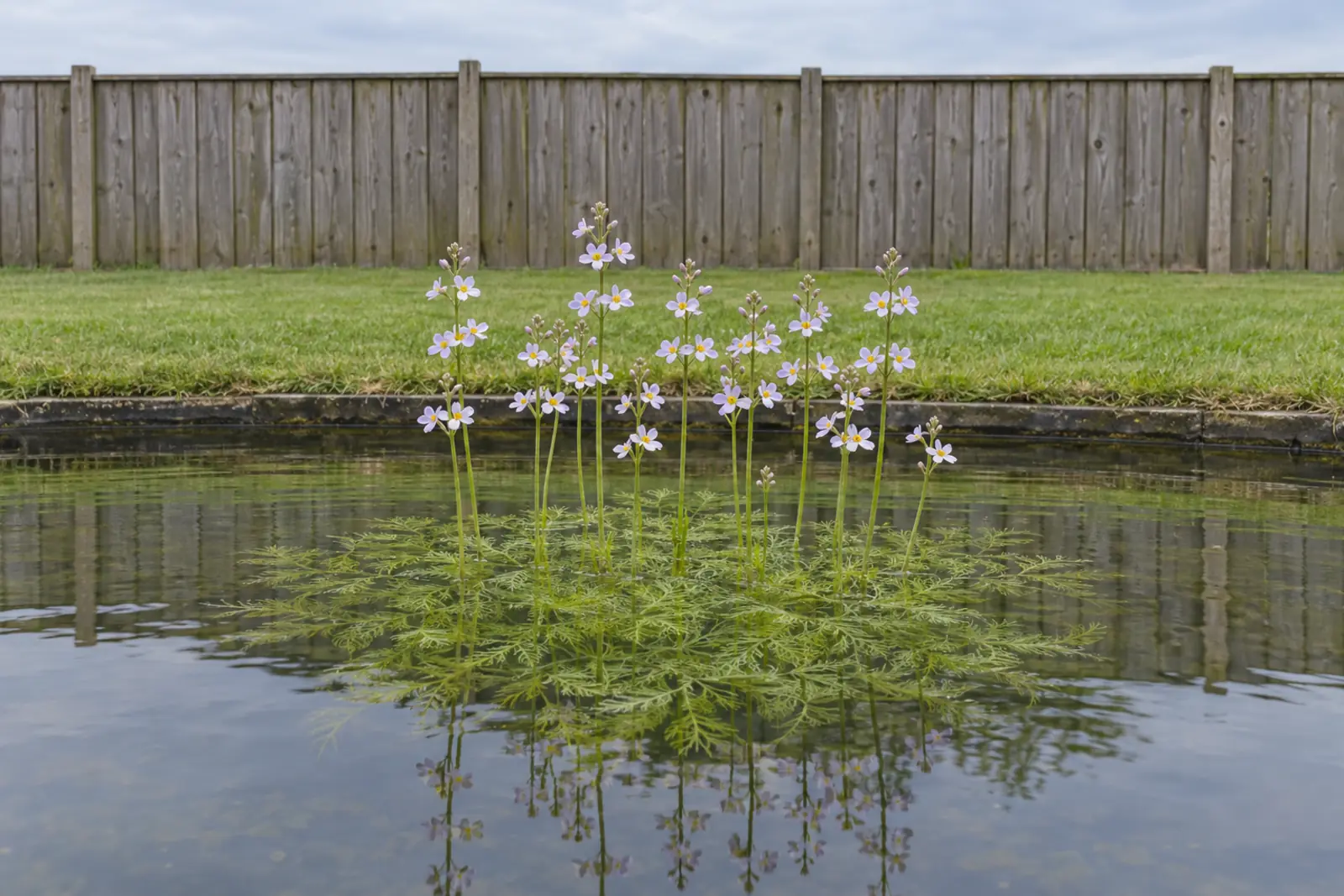
Water violet (Hottonia palustris) is a native water plant for still, clear water. Its finely divided leaves stay under water. The plant grows 20 to 60 centimetres tall. In May and June, leafless stems rise above the surface with whorls of pale lilac or white flowers. Give water violet a pond in full sun.
Water violet at a glance
| Feature | Water violet |
|---|---|
| Height | 0.2 to 0.6 m |
| Spread | 0.5 to 1 m |
| Full grown after | 5 to 10 years |
| Sun | Full sun |
| Soil | Mud or clayey pond soil, under water |
| Water | Plenty: grows under water |
| Maintenance | Low: no pruning needed |
| Flowers | May and June, pale lilac or white |
| For bees | Yes: nectar for bees and hoverflies, May and June |
| Hay fever | Not or weakly allergenic |
| Leaves | Drop in autumn |
| Hardy | Yes |
| Native | Yes |
| Poisonous | No, as far as is known |
| Pricks or stings | No |
| Price, young | About €3.50 to €5.45 each, in a small pot |
| Price, grown | About €15 to €20 per pond basket, already planted |
- Leaf
- April to October
- Flower
- May to June
- Fruit
- June to July
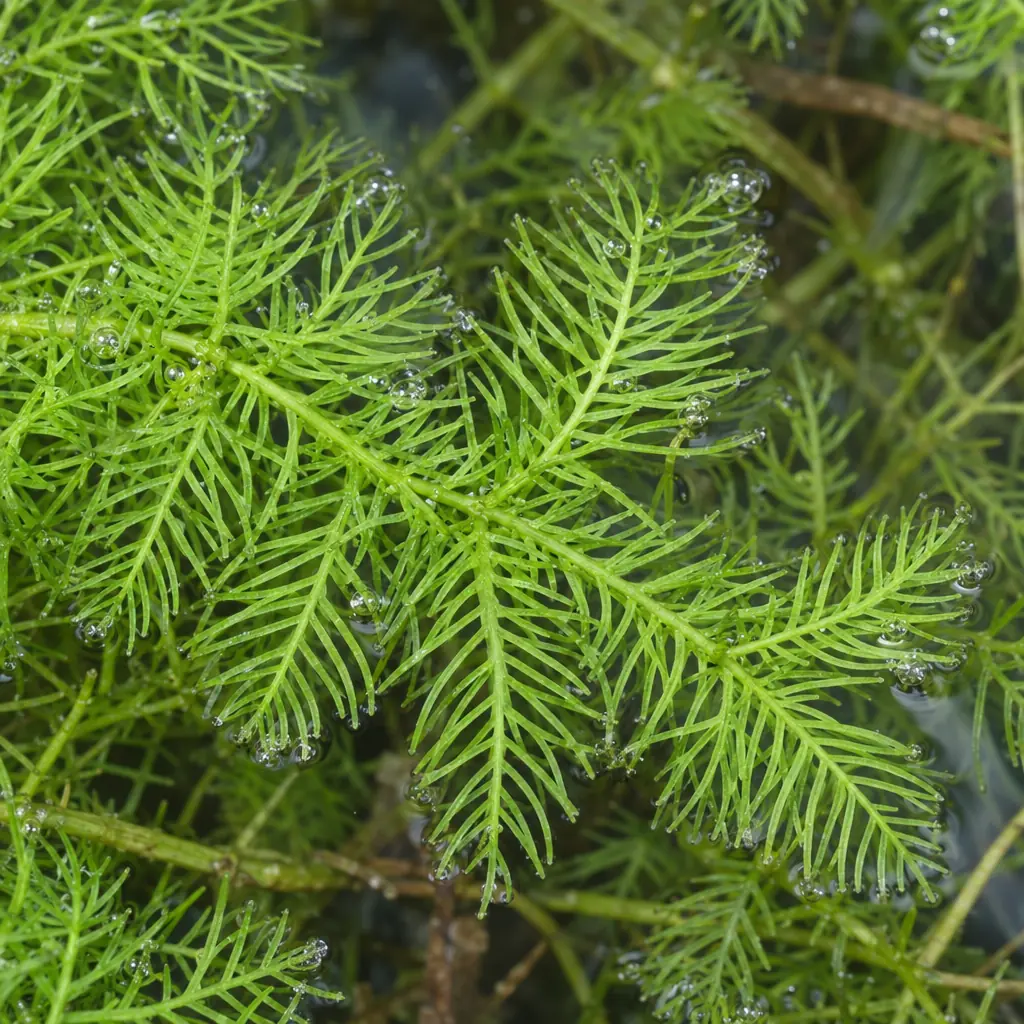
Leaf 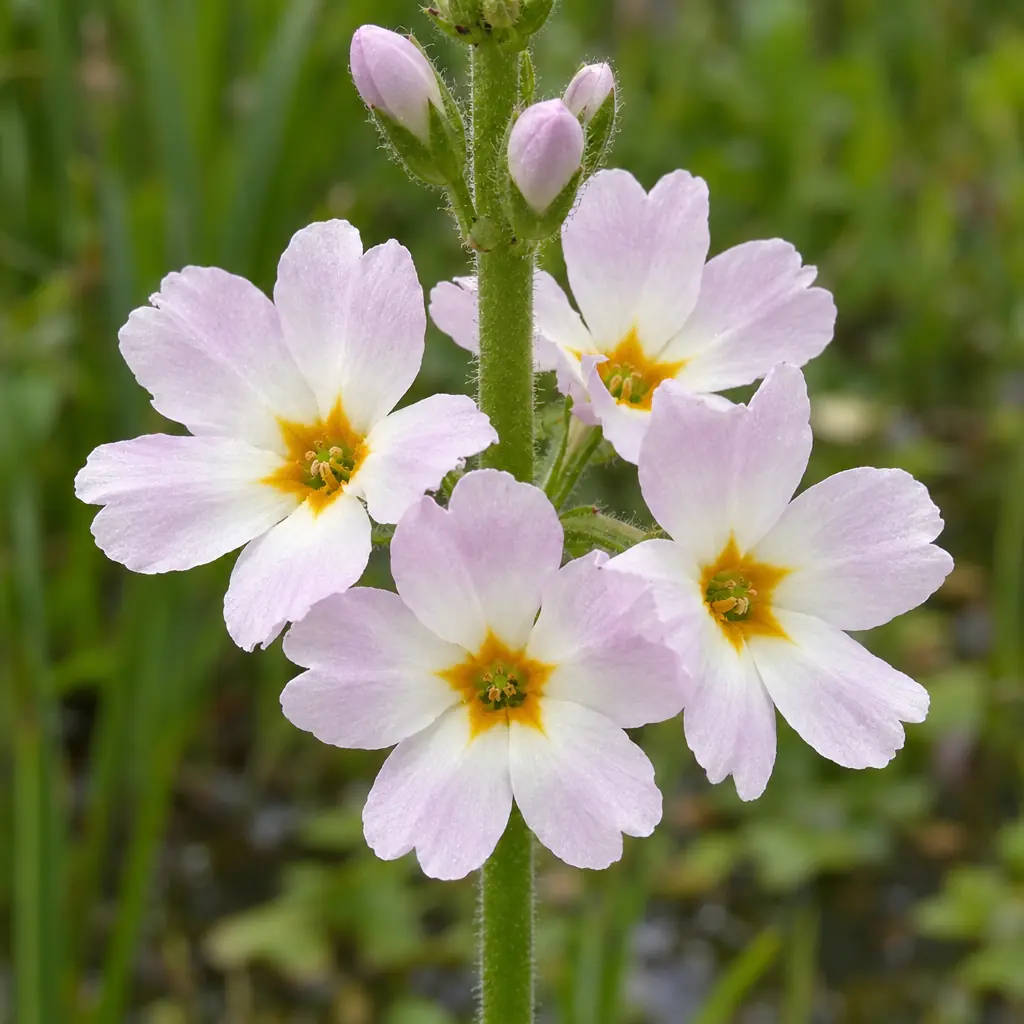
Flower 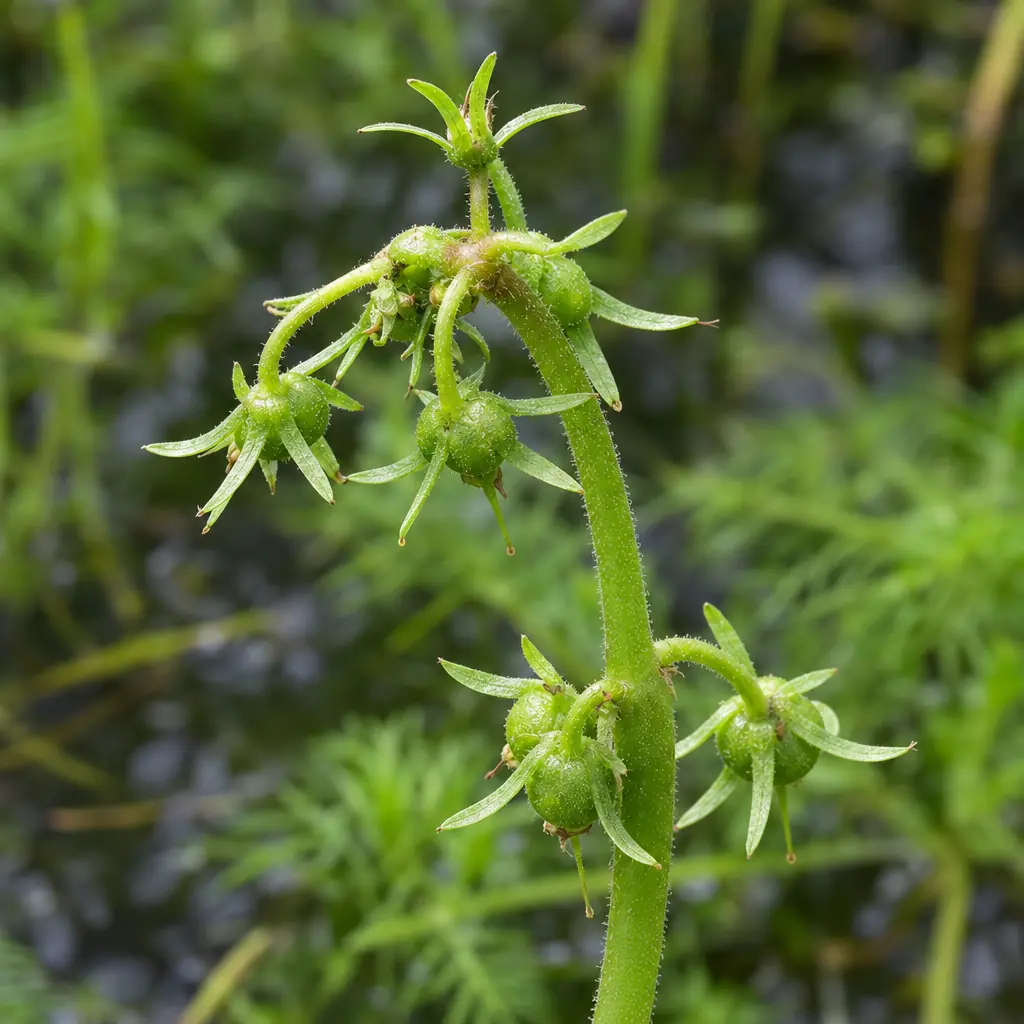
Fruit
How do I recognise water violet?
Look in the water first, where the leaves form a soft, light green mat. Each leaf is cut right down to the midrib, like a comb with narrow teeth. Along the stem the leaves grow apart from each other, sometimes almost in whorls. The stems are light green and slightly hairy.
Above the water rises a flower stem without leaves. The flowers sit on it in whorls, a few tiers one above the other. Each flower has five joined petals, pale lilac or white, with a yellow throat. In bud the colour is light lilac.
After flowering comes a capsule: a round case of seeds that splits open along five slits. As the fruit ripens, the fruit stalks bend downwards.
Under water, spiked water-milfoil (Myriophyllum spicatum) looks a lot like it. In that species the leaves grow in whorls of four. The clearest difference is the flower. Spiked water-milfoil flowers from July to September, with brick-red flowers of about 3 millimetres.
Where does water violet grow best?
Water violet wants full sun: around midsummer, the sun shines straight on the water for more than six hours a day. The plant grows in shallow, still or slowly flowing water that is moderately rich in nutrients. In the wild it grows mainly where seepage water comes up: groundwater that wells up into the ditch from below.
This is where it goes wrong:
- A pond with a pump or a fountain. That keeps the water moving, while water violet wants still or very slowly flowing water.
- Cloudy water. The plant belongs in clear water. Blanket weed, the stringy green algae, can also smother the fine leaves.
In autumn most of the plant dies back. In January none of the plant shows above the water. Sometimes buds sink to the bottom, and in spring new leaves grow from them.
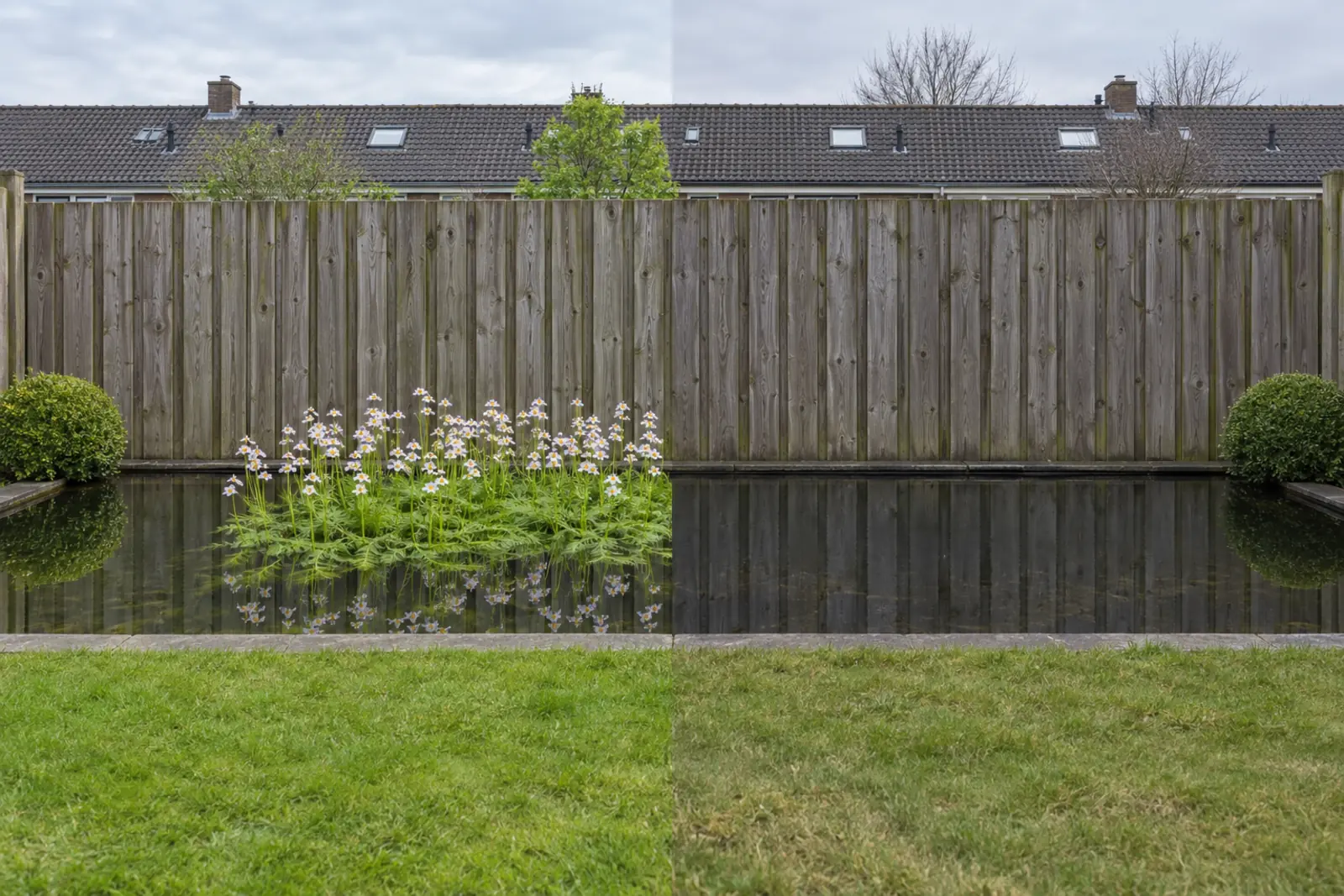 The same pond in May and in January. This is a generated image, not a photograph.
The app sets out your own plot to scale, with the houses around it. On that plan you pick the spot for your pond before you start digging.
Planting and caring for water violet
Nurseries sell water violet in a small pot or as a bunch: loose stems tied together. Always take a potted plant out of its plastic pot. Then set the root ball, the roots with their soil, in the pond bottom or in a basket. Plant a bunch in a basket of clayey pond soil first. If you plant straight into the pond bottom, make sure it has at least 10 centimetres of soil. That gives the roots something to hold on to.
Place the plant under 20 to 50 centimetres of water. A mature plant can grow up to 60 centimetres deep. Allow about 5 pots per 1,000 litres of pond water.
A mature plant grows half a metre to a whole metre wide, so keep half a metre between the pots. On planting day that looks like a lot of open water. The leaves fill that space later.
Watering is never needed, because the plant lives in the water. Pruning is not needed either.
Water violet problems and what to do
No flowers appear. No clear cause of this has been described for water violet. Even without flowers, the leaves under water still release oxygen.
The leaves are full of green threads. That is blanket weed, and it can smother the leaves of water violet. Pull the threads out of the water by hand or with a stick.
After summer the plant has almost gone. That is normal for this species. Wait for spring, when new leaves grow.
Diseases are rare on water violet.
Which birds and insects use water violet?
The flowers make nectar. Exactly which species of insect and bird use water violet has hardly been described for this plant.
Below the surface, water violet works as an oxygenating plant: its leaves release oxygen into the water. Plants like this belong in a pond made for dragonflies and damselflies.
Is water violet poisonous or edible?
Water violet is not known to be poisonous. That does not make the plant edible. No use as food is known.
The photos on this page were made with AI, based on real photos and descriptions of this plant.
Frequently asked questions
How deep should water violet be planted in a pond?
Usually with 20 to 50 centimetres of water above the plant. A mature plant can grow up to 60 centimetres deep, in still, clear water.
How much water violet do I need for my pond?
Allow about 5 pots per 1,000 litres of pond water. The fine leaves grow under water and release oxygen.
When does water violet flower?
In May and June. The flowers sit in whorls on leafless stems above the water, pale lilac or white with a yellow throat.
Is water violet poisonous?
Water violet is not known to be poisonous. That does not make the plant edible: no use as food is known.
Is water violet native to the Netherlands?
Yes, water violet is native to the Netherlands. In the low-lying peat districts the species is fairly common in places, although it has declined since 1950.
Sources (18)
- Duistermaat, Sparrius & Denters, Standaardlijst van de Nederlandse flora 2020 (Gorteria 43)
- NDFF Verspreidingsatlas — Hottonia palustris
- NDFF Verspreidingsatlas — Aarvederkruid (Myriophyllum spicatum)
- Flora van Nederland — Waterviolier
- Wilde planten in Nederland en België — Waterviolier
- RHS — Hottonia palustris
- RHS — Shade gardening (definities zon en schaduw)
- PFAF — Hottonia palustris
- Pollennieuws / Flora van Nederland — Aandachtspunten hooikoorts vriendelijke tuin
- De Vlinderstichting — Planten voor een libellenvijver
- Vijverplantenland — Hottonia palustris (prijs en waterdiepte)
- Vijverkenner — Hottonia palustris (prijs)
- Vijverplanten webshop — 2 manden waterviolier (prijs)
- Vijverplanten webshop — Waterviolier in bundels
- Biovijver — Waterviolier (bodem en aantal per 1.000 liter)
- Wikimedia Commons — Leaf: photo by AnRo0002 (CC0)
- Wikimedia Commons — Flower: photo by Wim Rubers (CC BY 3.0)
- Wikimedia Commons — Fruit: photo by AnRo0002 (CC0)