5 min read
Mugwort plant: how to recognise, plant and care for it
Artemisia vulgaris
Mugwort (Artemisia vulgaris) is a native perennial plant with deeply cut leaves, dark green above and white underneath. The stems grow 0.6 to 1.5 metres tall. From July to September they carry plumes of tiny, inconspicuous flower heads. Mugwort wants sun and soil rich in nutrients.
Mugwort at a glance
| Feature | Mugwort |
|---|---|
| Height | 0.6 to 1.5 m, sometimes taller |
| Spread | 0.5 to 1 m |
| Full grown after | 2 to 5 years |
| Sun | Full sun to partial shade |
| Soil | Dry to moist, rich in nutrients |
| Water | Little: also grows on dry soil |
| Maintenance | Low: cut back in autumn |
| Flowers | July to September, yellowish to reddish-brown, inconspicuous |
| For bees | Little: wind-pollinated, at most some pollen, July to September |
| Hay fever | Unknown |
| Leaves | Drop in autumn |
| Hardy | Yes |
| Native | Yes |
| Poisonous | Not known as a poisonous plant |
| Pricks or stings | No |
| Price, young | About €2.50 to €4.59 each, plant 5 to 10 cm tall |
| Price, grown | About €6.50 each, in a larger pot |
- Leaf
- April to October
- Flower
- July to September
- Fruit
- no noticeable fruit
Leaf 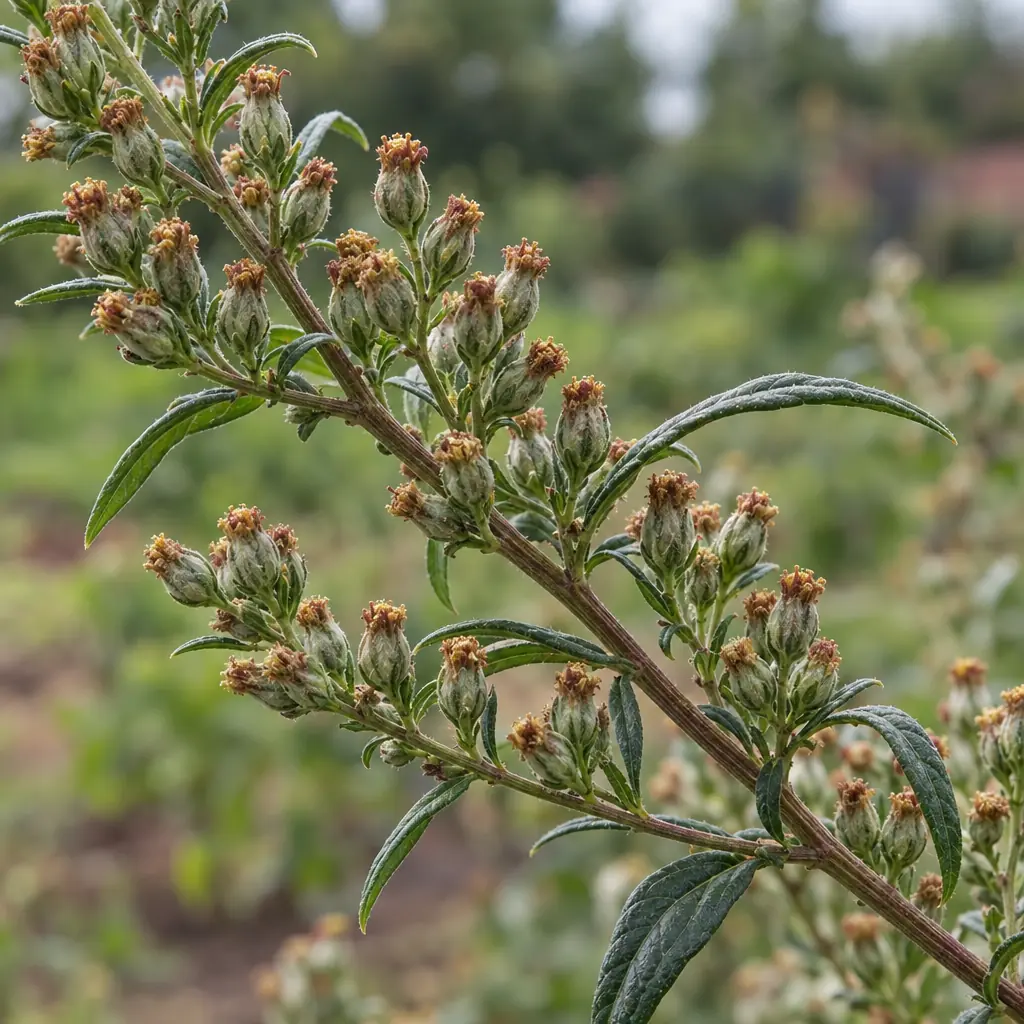
Flower
How do I recognise mugwort?
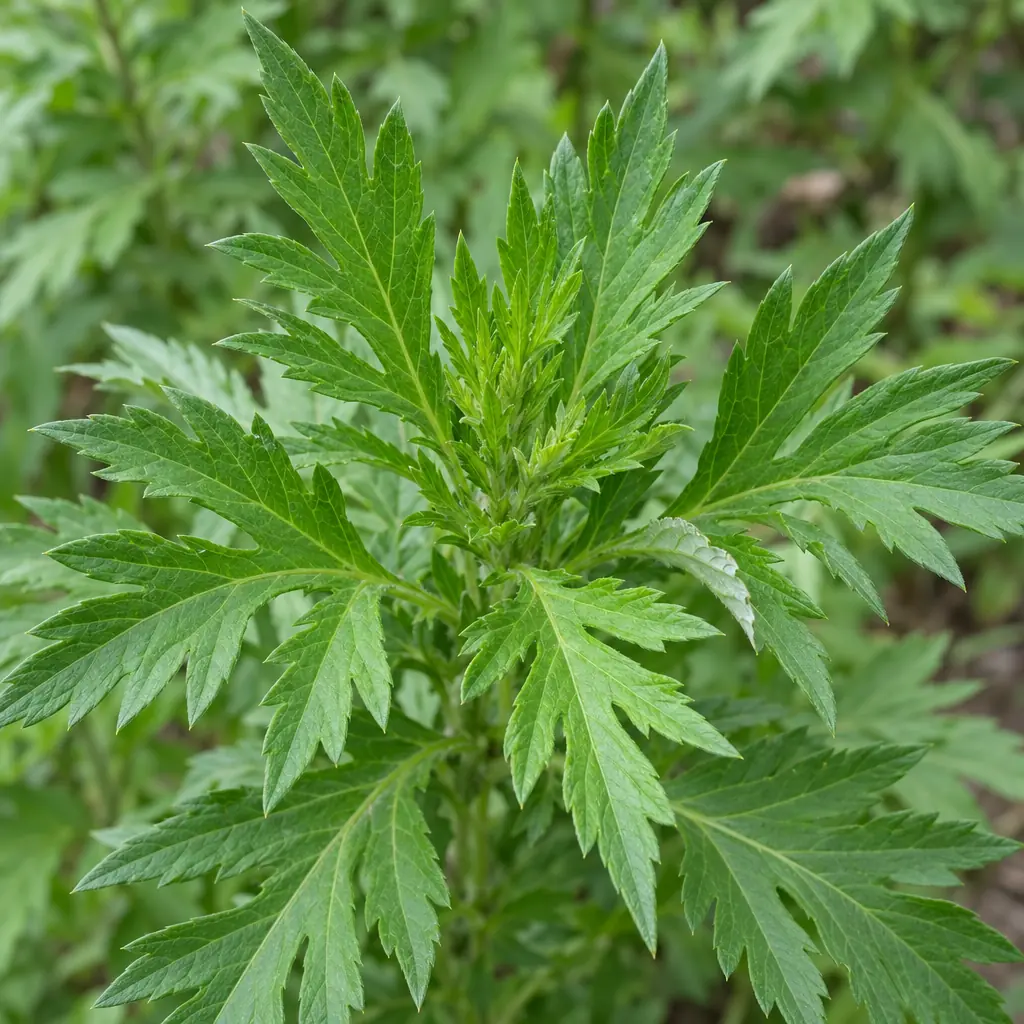
Start with the leaves. Each leaf is deeply cut, like a feather, into narrow pointed lobes. The upper side is dark green and almost hairless. Turn a leaf over and the underside is white and felted. A bruised leaf gives off a faint herbal scent.
The stems are tough, grooved and red to purple-red, right up to the top. They feel slightly woody, so this herbaceous plant looks a little like a shrub. At the top sit richly branched plumes full of egg-shaped heads of 3 to 4 millimetres. There are no petals to see: each head is made of tiny tubular florets.
A relative looks similar: wormwood (Artemisia absinthium). Its leaves are grey and silky-felted on both sides. Wormwood also has round heads that droop slightly and flower lemon-yellow. On mugwort only the underside of the leaf is white, and the heads stand upright.
Where does mugwort grow best?
Mugwort grows best in full sun: more than six hours of direct sun a day in summer. Three to six hours works too. The soil can be dry or moist, as long as it is rich in nutrients. In the wild, mugwort grows on dikes, on road verges and on waste ground.
In a garden, these spots cause trouble:
- Under a dense canopy of leaves. The sun reaches the ground there for less than two hours, and mugwort wants an open, light spot.
- In soil that stays wet in winter. The roots want soil where water drains away well.
- At the front of a small border. Mugwort towers over low neighbours and blocks their light.
In winter, little of the plant is left above ground. After an autumn cut, only short stubs show. In spring, new stems come up from the underground rhizomes.
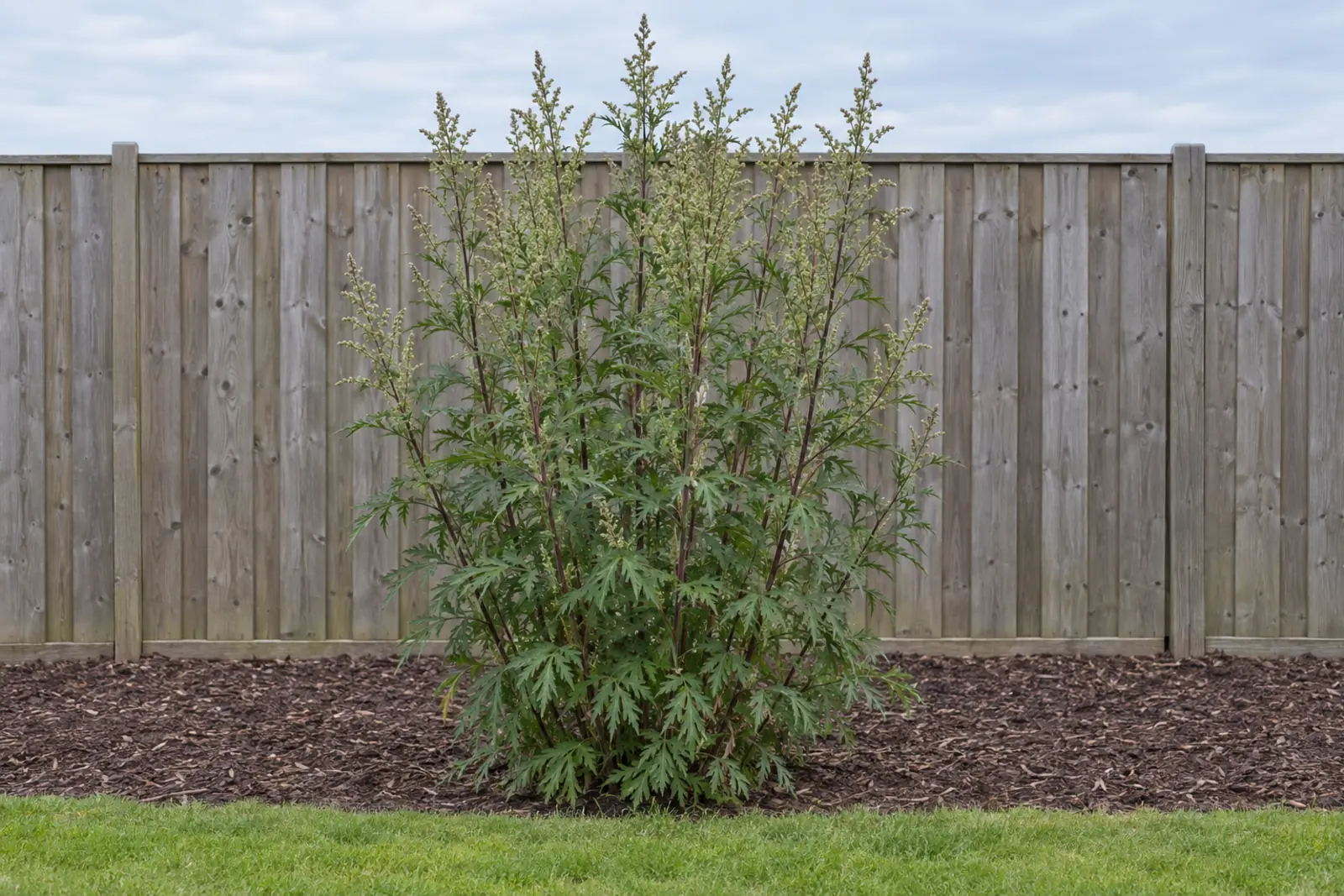
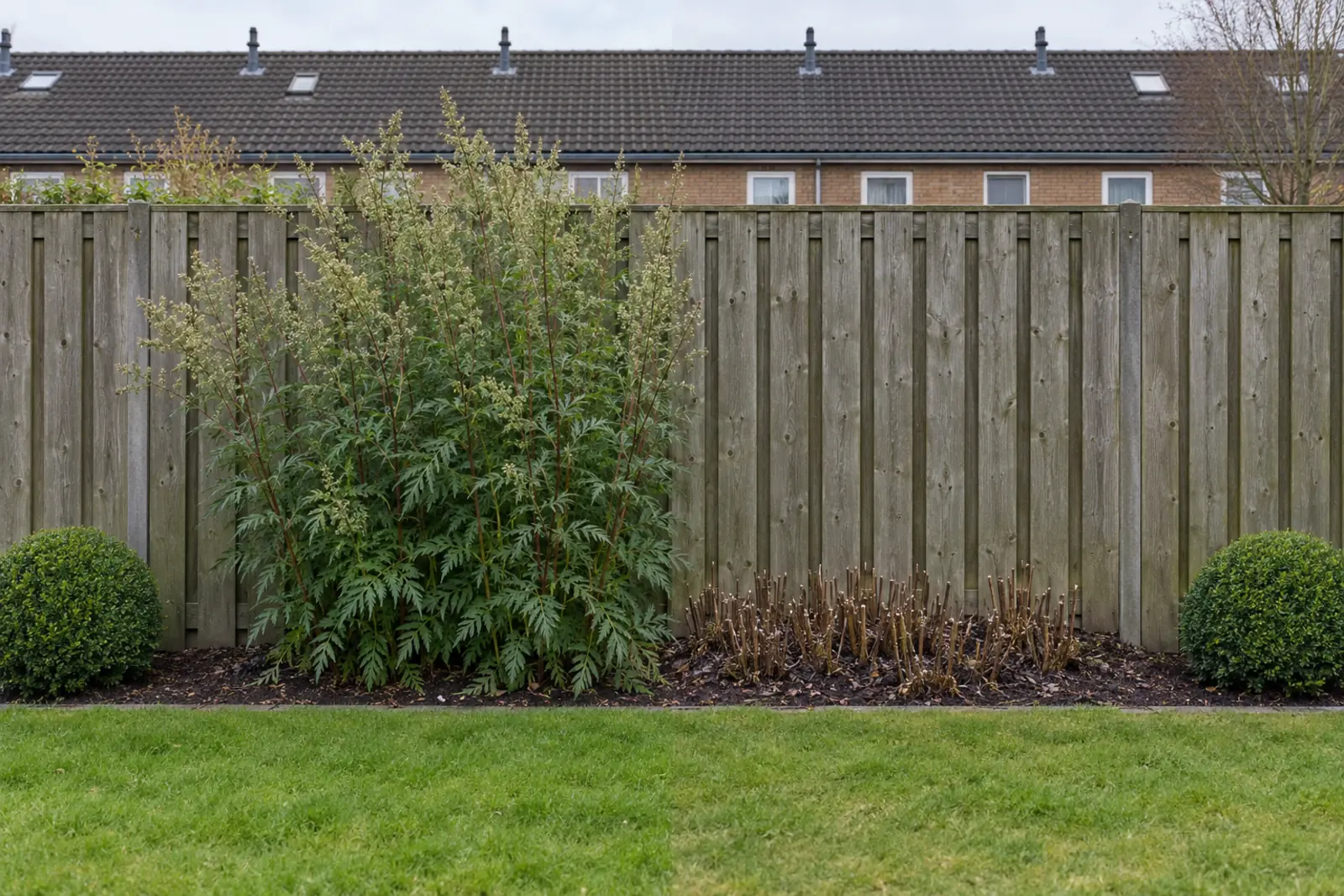 The same border in August and in January. This is a generated image, not a photograph.
A tall plant like mugwort belongs at the back of the border. In the app you can see how deep that border can be in your garden: your own plot to scale, with the buildings around it, and you draw the border on it yourself.
Planting and caring for mugwort
Mugwort is sold as a young plant in a small pot, or as seed. Dutch nurseries label it bijvoet. A potted plant can go into the ground whenever the soil is neither frozen nor waterlogged. Water it in well afterwards, even when the soil is already moist. After a summer planting, keep the soil moist for the first few weeks.
Space the plants about 40 centimetres apart: 5 to 7 per square metre. On planting day that looks generous. After a few years the plants grow together into one dense mass.
| When | What to do |
|---|---|
| After flowering | Cut off the spent plumes, so mugwort self-seeds less |
| Autumn | Cut all stems back to 5 to 10 cm above the ground |
| Spring or autumn | Lift a clump that has grown too big and divide it into pieces |
The nesting season runs roughly from March through July. Birds with several broods carry on into August. When you cut in those months, first check for a nest among the stems.
What goes wrong with mugwort?
Young mugwort seedlings come up all over the border. The plant self-seeds. Cut off the plumes after flowering, before the seed ripens. Pull out the seedlings while they are small.
The clump gets wider every year. Mugwort spreads through woody underground rhizomes. In spring or autumn, slice off part of the clump with a spade and replant only one piece.
You see no flowers. They are there, but so small that they are easy to miss. The grey-green plumes at the top of the stems are the flowers.
The plant suddenly dies in a hot, dry summer. That can be honey fungus, a fungus that attacks the roots. Between the bark and the wood of the roots you then find a white sheet of fungus. Dig up the plant with all its roots and throw it away, but not on the compost heap.
Beyond that, mugwort rarely has trouble with pests.
Which insects and birds use mugwort?
Mugwort is wind-pollinated: the wind spreads the pollen. Even so, many insects visit the plant and use it as food. One of them is the caterpillar of the tawny speckled pug (Eupithecia icterata), a small moth. That caterpillar feeds mainly on yarrow, but eats mugwort too.
Nothing about birds on mugwort has been described with certainty.
Is mugwort poisonous?
Mugwort is not known as a poisonous plant in the garden. In some people, though, touching the plant causes skin inflammation: red, irritated skin.
The photos on this page were made with AI, based on real photos and descriptions of this plant.
Frequently asked questions
How tall does mugwort grow?
Usually 0.6 to 1.5 metres, sometimes a little taller. The stems stand upright and are often red to purple-red.
Does mugwort spread?
Mugwort self-seeds easily and spreads through underground rhizomes. Cut off the plumes after flowering. A clump that has grown too big can be divided in spring or autumn.
When should you cut back mugwort?
In autumn, cut all the stems back to 5 to 10 centimetres above the ground. For fewer seedlings, also cut off the plumes after flowering.
Is mugwort poisonous?
Mugwort is not known as a poisonous plant in the garden. In some people, though, touching the plant causes skin inflammation.
Is mugwort native to the Netherlands?
Yes. Mugwort is originally native and common in the Netherlands, on dikes, on road verges and on waste ground.
Sources (21)
- Duistermaat, Sparrius & Denters, Standaardlijst van de Nederlandse flora 2020 (Gorteria 43)
- NDFF Verspreidingsatlas — Artemisia vulgaris
- NDFF Verspreidingsatlas — Absintalsem
- Flora van Nederland — Bijvoet
- Pollennieuws — Bijvoet onder de loep
- RHS — Artemisia vulgaris (mugwort)
- RHS — Shade gardening (definities zon en schaduw)
- RHS — Perennials: planting
- RHS — Honey fungus
- PFAF — Artemisia vulgaris
- Antigifcentrum — Brochure planten
- De Vlinderstichting — Oranje dwergspanner
- De Vlinderstichting — Bijvoetmonnik
- Vogelbescherming — Snoeien in het broedseizoen, mag dat?
- Natuurlijk Sterker — Artemisia vulgaris (prijs)
- De Cruydt-Hoeck — Bijvoet (prijs)
- PlantBezorgd — Artemisia vulgaris (prijs)
- Puur van 't Veld — Bijvoet (prijs)
- Maréchal — Artemisia vulgaris (planten per m²)
- Wikimedia Commons — Leaf: photo by AnRo0002 (CC0)
- Wikimedia Commons — Flower: photo by AnRo0002 (CC0)