5 min read
Common beech: where to plant it, hedges, pruning and nuts
Fagus sylvatica
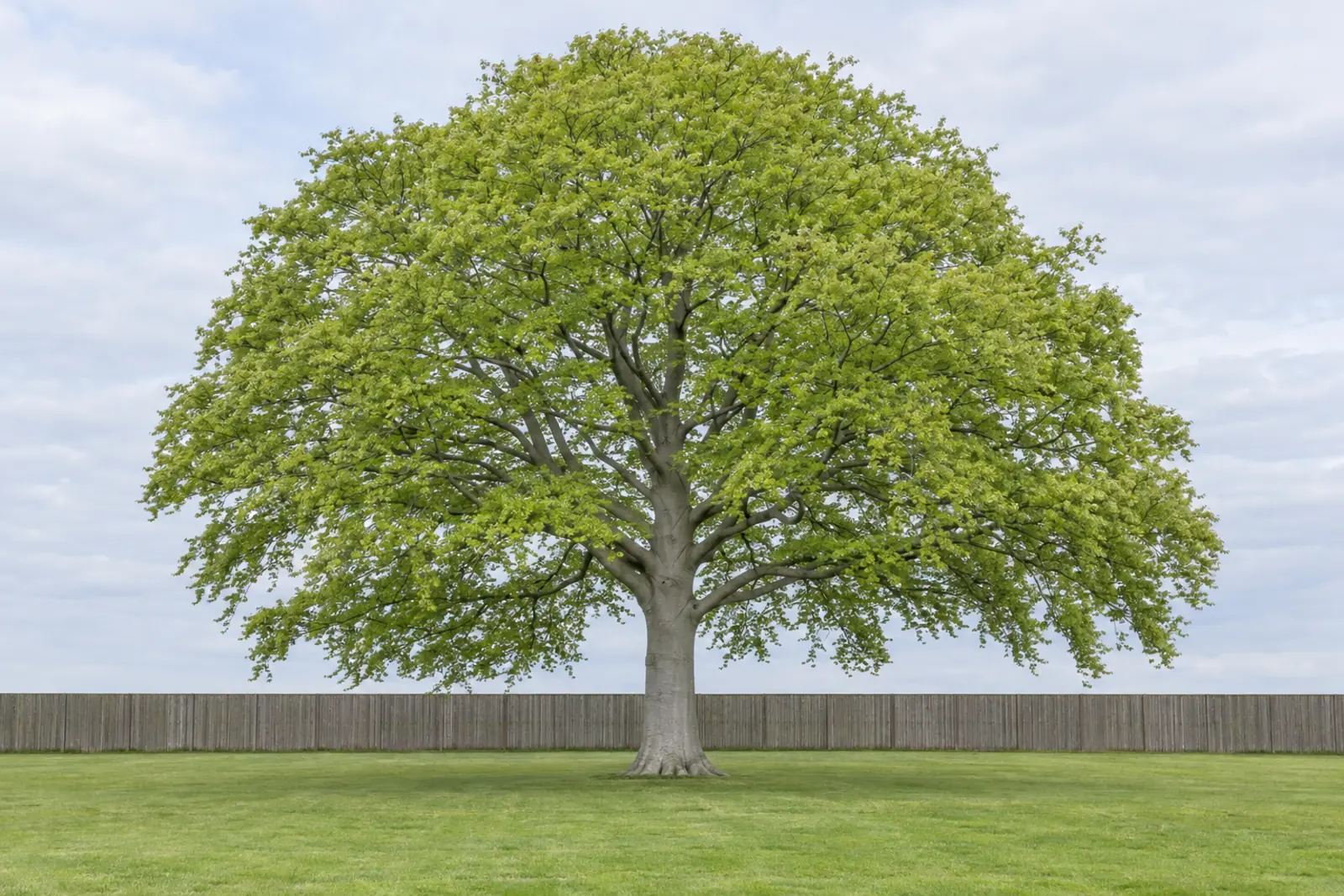
Common beech (Fagus sylvatica) is a large native tree with a smooth grey trunk and a broad, dense crown. The leaves are oval with a wavy edge. In autumn, prickly husks with nuts hang from the branches. The tree likes soil that holds moisture yet drains well. As a hedge, beech keeps its brown leaves in winter.
Common beech at a glance
| Feature | Common beech |
|---|---|
| Height | 24 to 30 m |
| Spread | More than 8 m; 25 to 30 m when grown freely |
| Full grown after | 20 to 50 years |
| Sun | Sun to partial shade |
| Soil | Holds moisture but drains well, ideally loam |
| Water | Average: not too wet and not too dry |
| Maintenance | Low: prune a free-standing tree only when needed |
| Flowers | April and May, inconspicuous, yellow and green |
| For bees | Little: the wind pollinates the flowers |
| Hay fever | Moderately allergenic, April and May |
| Leaves | Drop in autumn |
| Hardy | Yes |
| Native | Yes |
| Poisonous | Nuts: harmful if you eat a lot of them |
| Pricks or stings | No |
| Price, young | About €1.50 to €2.20 each, 60-80 cm, bare-root |
| Price, grown | About €22 to €24 each, 150-200 cm, in a pot or with a root ball |
- Leaf
- April to November
- Flower
- April to May
- Fruit
- August to October
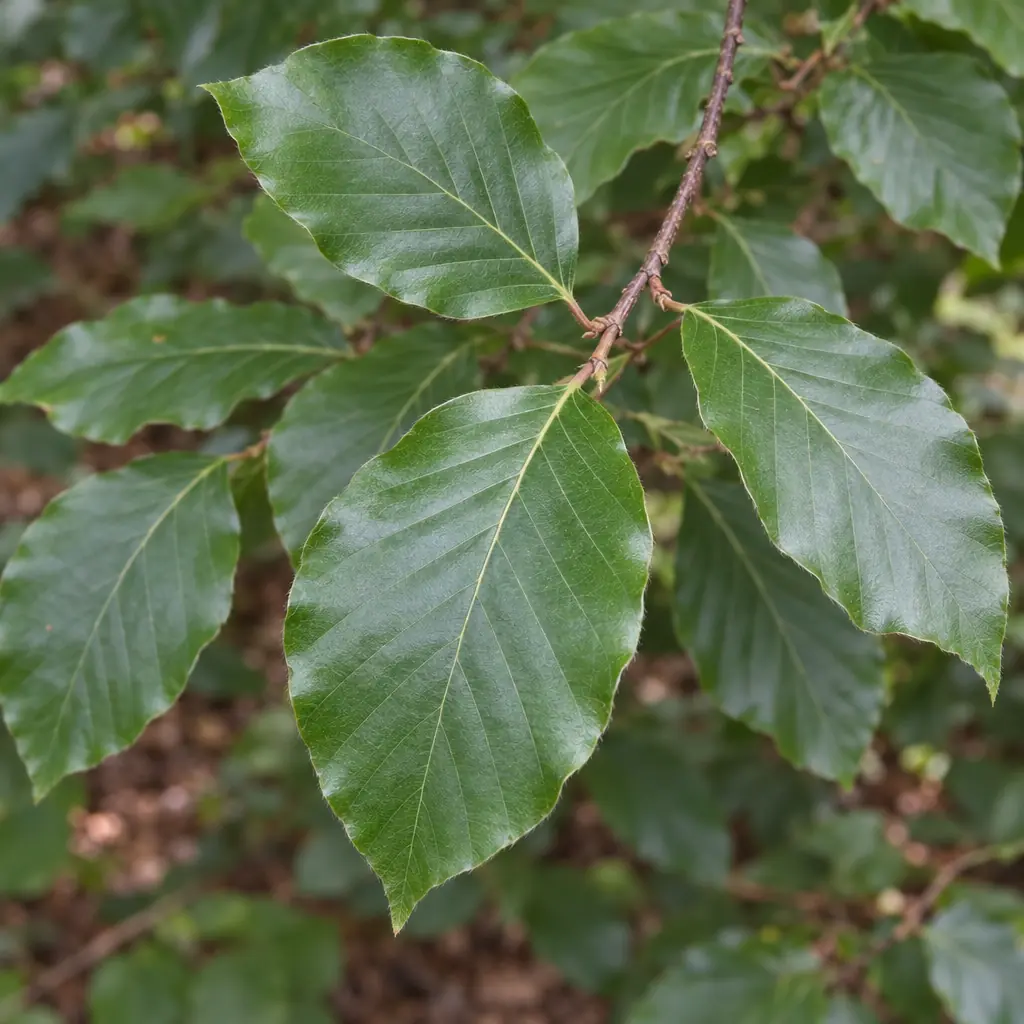
Leaf 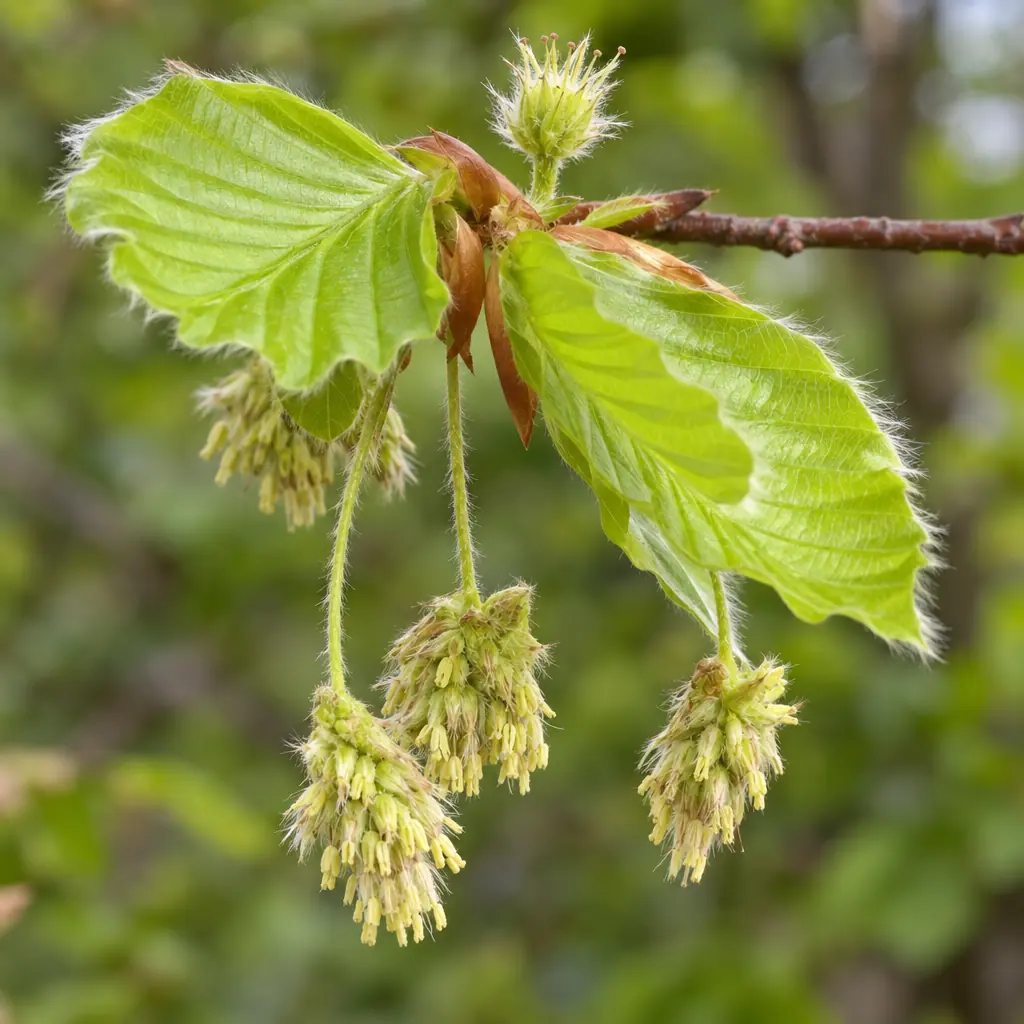
Flower 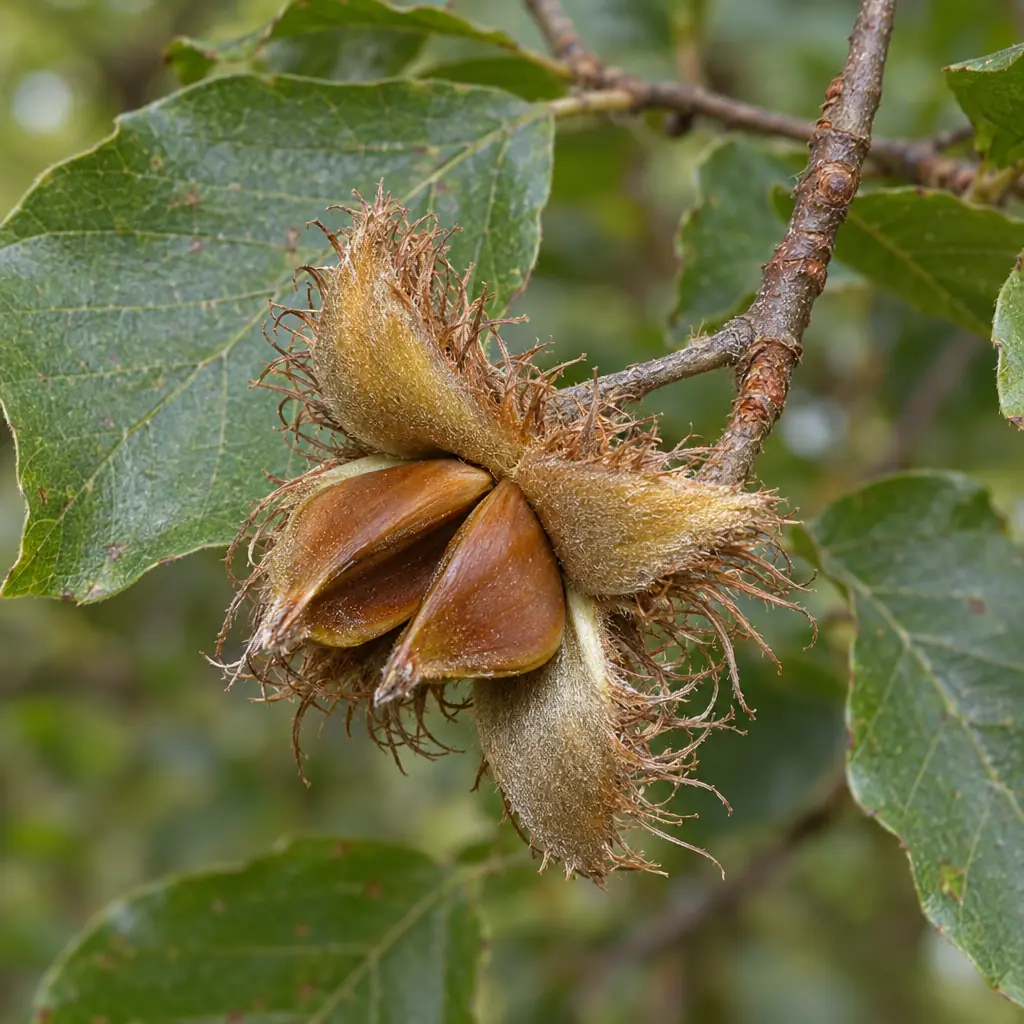
Fruit
How do I identify a common beech?
Start with the trunk. The bark is usually smooth and a dull grey. On the side that catches the rain, algae sometimes turn the trunk green.
A leaf grows up to 10 centimetres long. Its shape is oval with a pointed tip. The edge is slightly wavy and fringed with fine hairs. Young leaves feel soft and hairy. Along one twig the leaves sit in two rows, all in the same plane.
The male flowers hang down like yellow catkins. The female flowers sit in a small cup. That cup grows into a prickly brown husk, usually holding two nuts. When ripe, the husk splits open in four parts. The nuts are sharply three-sided.
Hornbeam looks like beech, but its leaves are double-toothed. On hornbeam the veins run straight to the coarse teeth. Garden centres also sell copper beech: the same species, with purple leaves.
Where does common beech grow best?
A spot in full sun suits a beech. Around midsummer such a spot gets more than six hours of direct sunlight a day. Partial shade works well too, meaning three to six hours of sunlight. A young beech even grows well under taller trees. The soil should hold moisture and still let water through. Loam and chalk are fine.
A beech struggles in these places:
- Soil that stays wet. In waterlogged soil the roots rot away.
- Beside a drive or a terrace. Beech does not tolerate paving.
- Close to the house. When the tree grows freely, its broad crown reaches the house wall.
In January a large beech is bare. A young or clipped beech, on the other hand, holds its dead brown leaves all winter.
A full-grown beech needs a lot of room between trunk and wall. In the app you draw on a real plan of your own plot, to scale, with the neighbouring houses on it.
How to plant and look after a common beech
Plant a bare-root beech between October and February, while the tree is dormant. Bare-root means sold without soil around the roots. That form is the cheapest to buy. A beech in a pot is on sale all year.
Keep a free-standing beech at least 12.5 to 15 metres from your house. That distance is half the spread of a full-grown tree. On planting day the gap looks far too big. For a hedge, space the plants 45 to 60 centimetres apart. Water a young beech or hedge for the first season or two, especially in a dry spring or summer.
| When | What to do |
|---|---|
| Second week of August | Trim the sides of a beech hedge |
| Autumn to early spring | Prune a free-standing tree only when needed, and never hard |
Many birds nest from March through July. Some species carry on into August, so check the hedge for a nest before you trim.
Common beech problems and what to do
White fluff under the leaves, and the leaves are sticky. These are aphids under a white waxy coat. This woolly beech aphid lives only on beech, from April to August. The tree is usually not seriously harmed, so there is no need to control it.
The young leaves turn brown after a cold spring night. A late night frost can kill young beech leaves.
No beech nuts appear. A beech often flowers only once every five to eight years. A hedge that is trimmed in summer usually gives no nuts at all.
The leaves hang limp in a dry summer. Long drought weakens a beech. Give a young tree a good soaking then.
Which birds and insects use common beech?
Beech nuts are winter food. In autumn, flocks of chaffinches search the ground under beeches for the nuts. The brambling arrives as a migrant from Scandinavia and also spends the winter here. In winter the brambling eats only seeds, and beech nuts are among its most important foods.
Caterpillars feed on the leaves too. The caterpillar of the barred hook-tip, a moth, eats only beech. That moth flies in beech woods, but also near single, full-grown beeches. The lobster moth caterpillar eats the leaves of beech and of other broadleaved trees, such as hazel and oak.
Is common beech poisonous?
Beech nuts are harmful if you eat a lot of them. The harm lies in the seeds: the three-sided nuts from the husk.
The photos on this page were made with AI, based on real photos and descriptions of this plant.
Frequently asked questions
How big does a common beech grow?
Grown freely, a common beech reaches 24 to 30 metres tall. The crown grows wider than 8 metres, and 25 to 30 metres in an open spot. The tree reaches that size after 20 to 50 years.
When should I trim a beech hedge?
Trim the sides of a beech hedge once a year, in the second week of August. First check whether birds are still nesting in the hedge. Prune a free-standing beech only when needed, between autumn and early spring.
Why does a beech hedge keep its leaves in winter?
A young or clipped beech holds on to its dead, brown leaves all winter. So a beech hedge still screens the garden in winter. A large beech grown freely is bare in January.
Are beech nuts poisonous?
Beech nuts are harmful if you eat a lot of them. Chaffinches and bramblings eat them in autumn and winter.
How much sun does a common beech need?
A beech grows in full sun, with more than six hours of direct sunlight a day around midsummer. Partial shade, with three to six hours of sunlight, also works. A young beech even grows well under taller trees.
Sources (24)
- Duistermaat, Sparrius & Denters, Standaardlijst van de Nederlandse flora 2020 (Gorteria 43)
- NDFF Verspreidingsatlas — Fagus sylvatica
- Flora van Nederland — Beuk
- Flora van Nederland — Haagbeuk
- Nature Today — Natuurkalender: beuk
- RHS — Fagus sylvatica (common beech)
- RHS — Beech (Fagus)
- RHS — How to grow beech
- RHS — Woolly beech aphid
- RHS — Shade gardening (definities zon en halfschaduw)
- Van den Berk Boomkwekerijen — Fagus sylvatica
- PFAF — Fagus sylvatica
- LUMC — Bomenkompas voor allergeniciteit (2023)
- De Vlinderstichting — Beukeneenstaart
- De Vlinderstichting — Eekhoornvlinder
- Vogelbescherming — Keep
- Vogelbescherming — Vink
- Vogelbescherming — Snoeien in het broedseizoen, mag dat?
- Directplant — Beukenhaag (prijs per maat)
- Heijnen — Groene beukenhaag 60-80 cm, wortel (prijs)
- Planta — Fagus sylvatica 150-175 cm met kluit (prijs)
- Wikimedia Commons — Leaf: photo by AnRo0002 (CC0)
- Wikimedia Commons — Flower: photo by Velela (Public domain)
- Wikimedia Commons — Fruit: photo by Probodue (CC0)