5 min read
Greater celandine: identifying, planting and care
Chelidonium majus
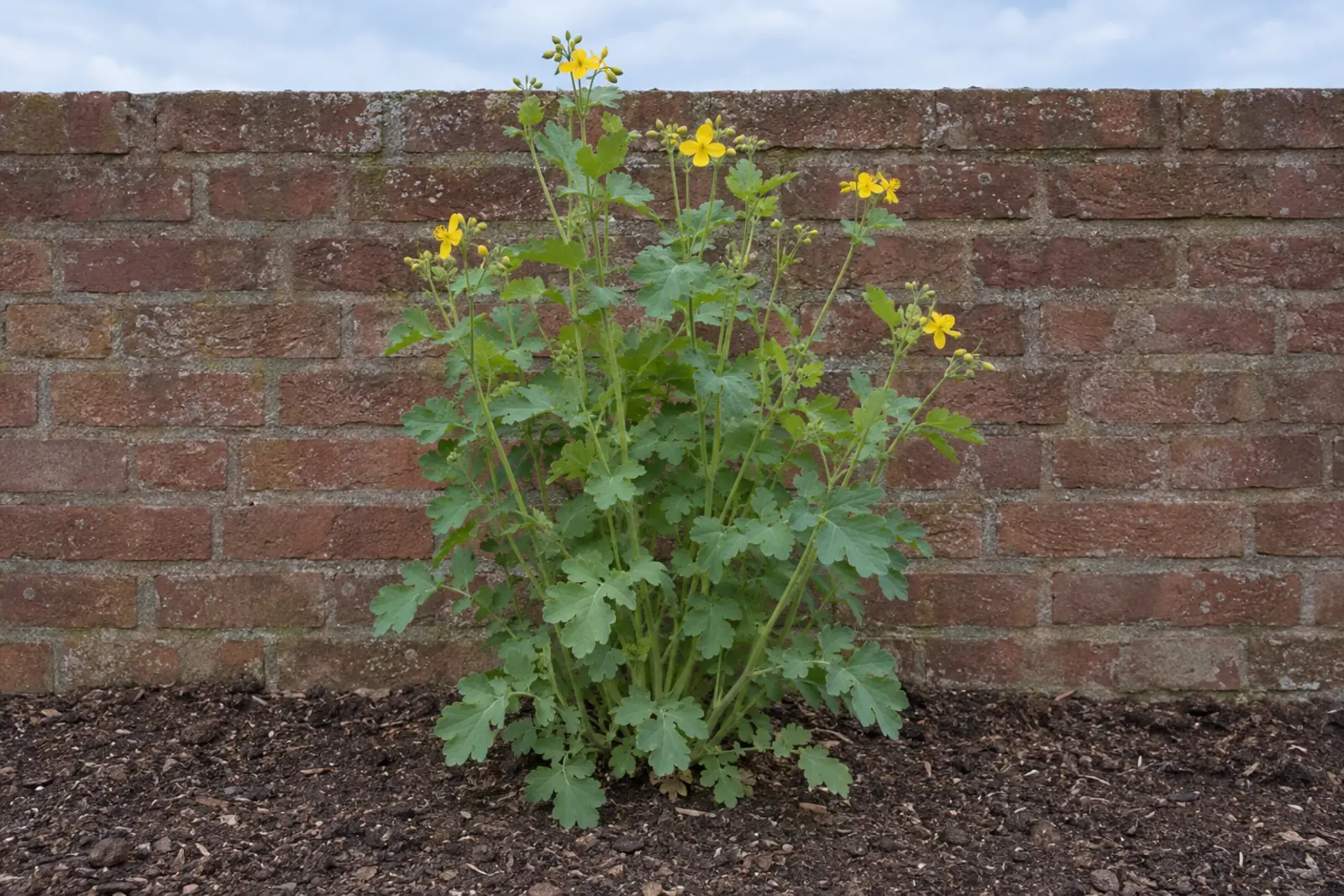
Greater celandine (Chelidonium majus) is a native perennial that grows 30 to 90 centimetres tall. From May into autumn it bears small yellow flowers with four petals. Break a stem and orange sap runs out at once. The plant likes light shade and rich soil.
Greater celandine at a glance
| Feature | Greater celandine |
|---|---|
| Height | 0.3 to 0.9 m |
| Spread | About 0.4 m |
| Full grown after | 2 to 5 years |
| Sun | Full sun to shade, best in light shade |
| Soil | Rich, often with lime |
| Water | Average: moist, not waterlogged |
| Maintenance | Low: no pruning needed |
| Flowers | May to October, yellow |
| For bees | Yes: pollen, May to October |
| Hay fever | Not or weakly allergenic |
| Leaves | Stay green: overwinters as a low rosette |
| Hardy | Yes |
| Native | Yes |
| Poisonous | The orange sap: harmful if eaten, irritates skin and eyes |
| Pricks or stings | No |
| Price, young | About €2.50 to €4.09 per young plant, in a pot |
| Price, grown | Not for sale |
- Leaf
- all year
- Flower
- May to October
- Fruit
- June to October
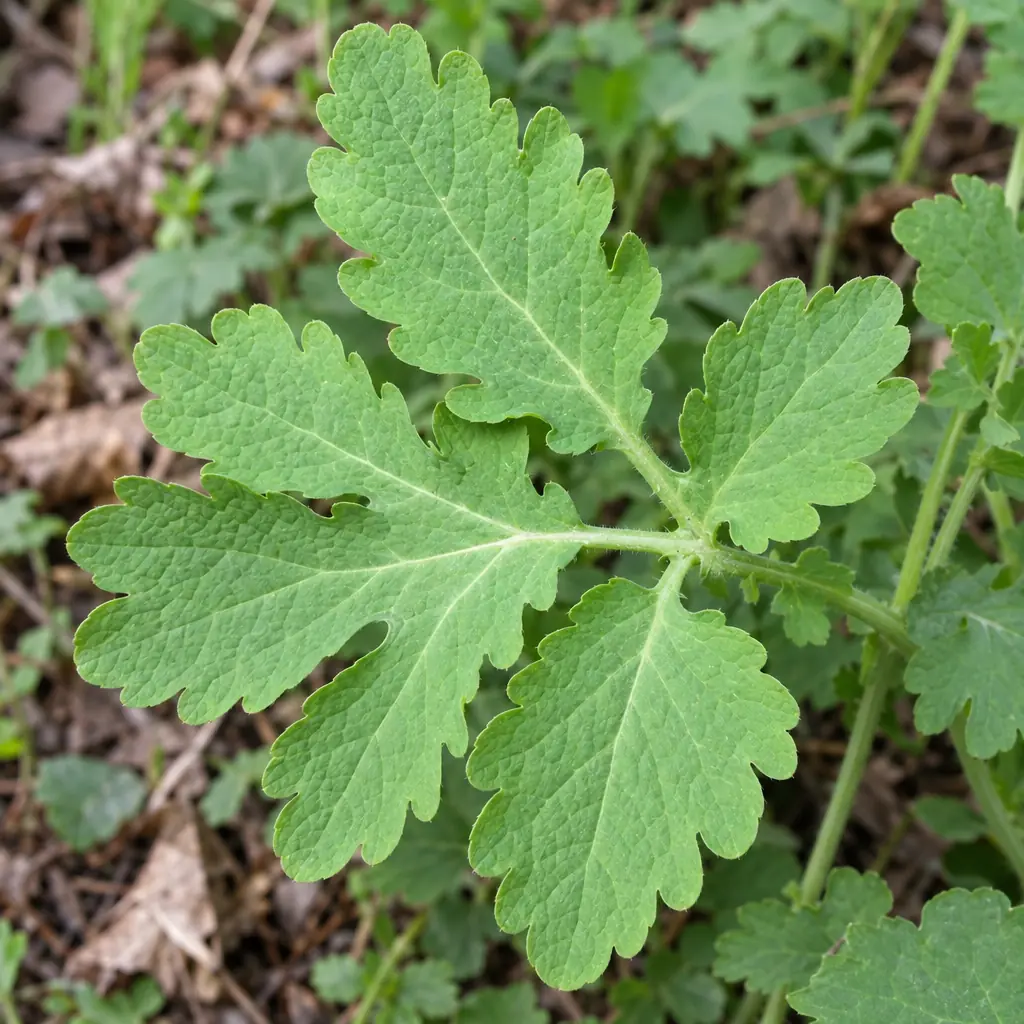
Leaf 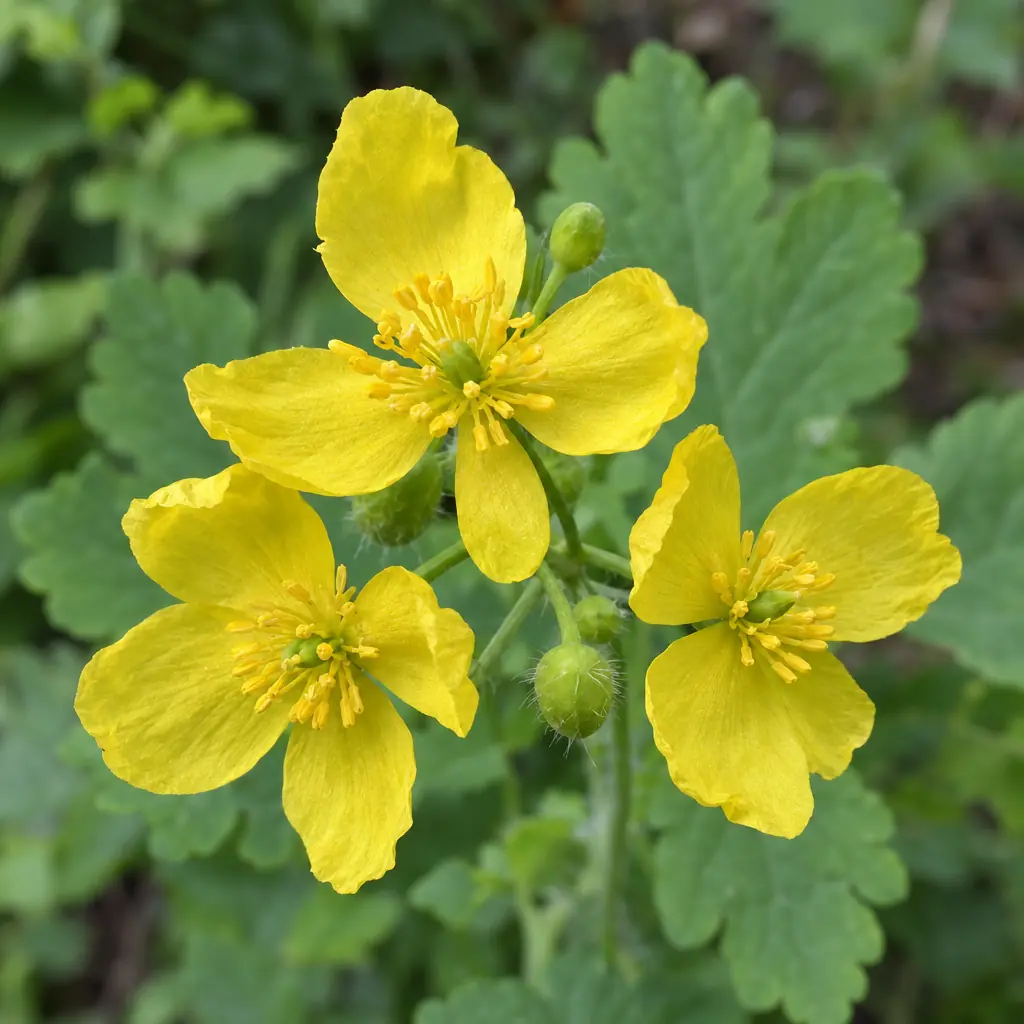
Flower 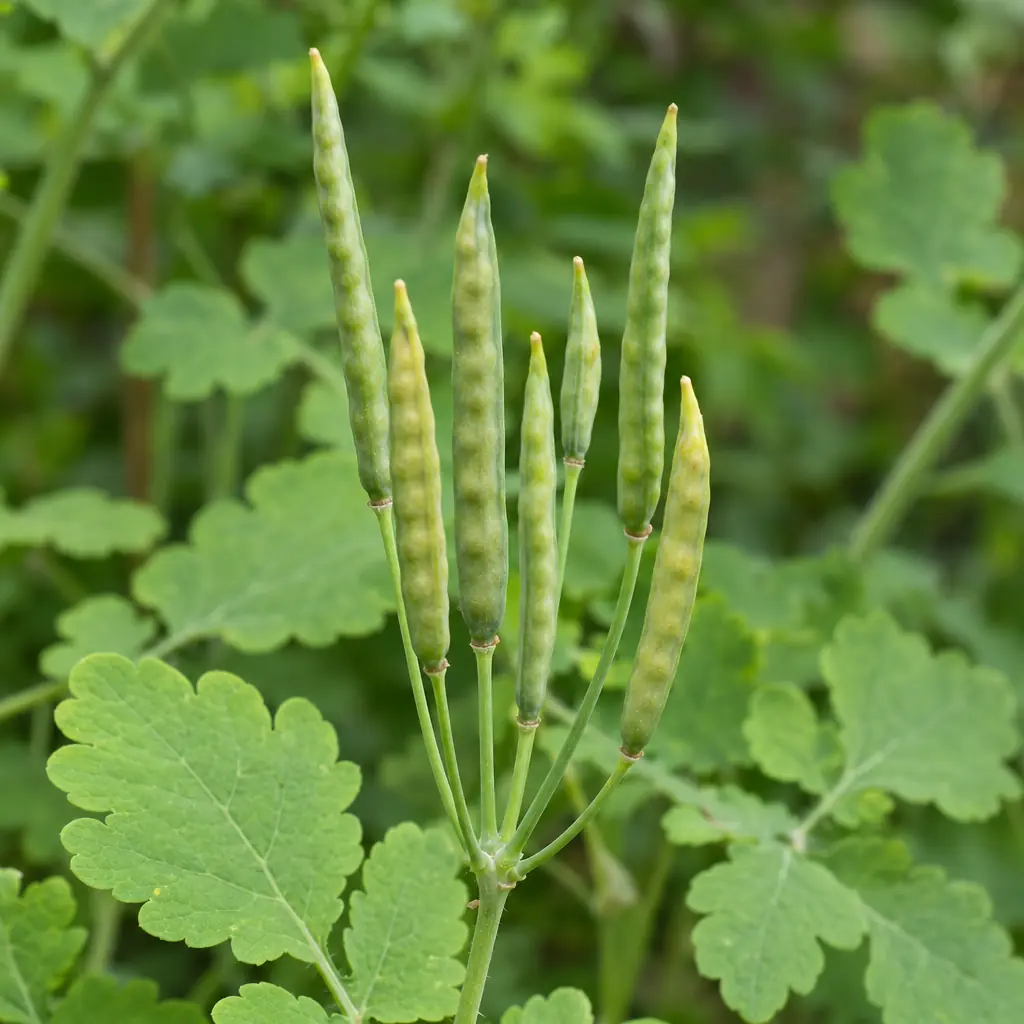
Fruit
How do I recognise greater celandine?
Start with the leaf. It is deeply cut into a few broad lobes, with a larger three-lobed end leaf. The edge is scalloped, in rounded curves. The upper side of the leaf is bright green, the underside blue-green. Stem and leaf are sparsely hairy in places.
The flowers are bright yellow and 1 to 2 centimetres across. Each flower has four petals of equal shape. Two to six flowers grow together in a loose umbel. After that comes a thin, straight capsule 2 to 5 centimetres long. It looks like a pea pod. The capsule holds black seeds with a white appendage.
If you are still not sure, put on gloves and break off a leaf. With greater celandine, orange-yellow sap runs out at once.
Lesser celandine is sometimes confused with this plant, because it also flowers yellow. The difference is large, though. Lesser celandine stays low, up to 30 centimetres, and flowers as early as March to May. Its leaf is glossy and undivided. Each flower has six to twelve narrow petals.
Where does greater celandine grow best?
Greater celandine grows in full sun, in partial shade and in full shade. A spot with three to six hours of direct sunlight a day around midsummer counts as partial shade. In the wild the plant favours slightly shaded spots: scrub edges, open deciduous woods and sometimes an old wall. The soil is rich and often contains lime. In the wild it also likes disturbed ground near houses.
Greater celandine struggles in these spots:
- A waterlogged corner by the pond. The roots need moist soil, but water still has to drain through it.
- A border of poor, dry sand. The plant grows best in rich soil full of leaf mould, like a woodland edge.
In winter, a low rosette of green leaves remains. New stems grow from it the following spring.
A clump at the foot of the shed or under shrubs spreads further and further by seed. Place it on a plan of your own plot, with the shed and the neighbouring houses to scale. The app draws the plant at the width of a full-grown plant, not at pot size.
Planting and caring for greater celandine
Nurseries sell greater celandine as a young plant in a pot, or as seed. Sow in early spring, straight into the spot where the plant should grow.
Space the plants about 30 centimetres apart. On planting day that looks bare, but one full-grown plant ends up wider than that gap. Water in the first year if it stays dry for long. Always wear gloves, because of the sap.
No pruning is needed. If you want fewer seedlings, there is one job:
| When | What to do |
|---|---|
| May to October | Snip off spent flowers, before seed forms |
Many bird species nest between March and the end of July. If you work in the border then, check the shrubs for a nest first.
What goes wrong with greater celandine?
The plant turns up all over the garden. Greater celandine self-seeds easily. Ants carry the seeds to their nest for the white appendage. Seed in the soil stays viable for more than five years. Pull seedlings out while they are young. Dig an older plant out deep, close to its base.
An old plant dies, but the clump stays. A single greater celandine plant does not live long. Seedlings nearby take over its spot, so the group itself remains.
In the middle of summer, stems and leaves collapse. The soil has usually dried out. Greater celandine needs moist soil, so pour a full bucket of water around its base.
Pests and diseases are rare on this plant.
Which insects and birds use greater celandine?
Which insects and birds use greater celandine has not been described by name. The flowers do offer pollen.
Is greater celandine poisonous or edible?
The orange sap is in the stems and leaves, and is harmful if you eat it. The plant contains toxic substances, alkaloids. On skin, the sap leaves strong orange stains and causes irritation. In the eyes it is irritating too.
The photos on this page were made with AI, based on real photos and descriptions of this plant.
Frequently asked questions
Is greater celandine poisonous?
The orange sap is harmful if you eat it. On skin, the sap causes stains and irritation. In the eyes it is irritating too.
How tall does greater celandine get?
Usually 30 to 90 centimetres. A full-grown plant becomes about 40 centimetres wide.
Does greater celandine grow in shade?
Yes. Greater celandine tolerates full sun and full shade. In the wild, the plant grows in slightly shaded spots, such as woodland edges, scrub and the foot of a wall.
How do I stop greater celandine self-seeding everywhere?
Snip off the spent flowers before seed forms. Pull out seedlings while young, wearing gloves because of the sap.
Sources (20)
- Duistermaat, Sparrius & Denters, Standaardlijst van de Nederlandse flora 2020 (Gorteria 43)
- NDFF Verspreidingsatlas — Chelidonium majus
- NDFF Verspreidingsatlas — Ficaria verna (gewoon speenkruid)
- Flora van Nederland — Stinkende gouwe
- Wilde planten in Nederland en België — Stinkende gouwe
- Wageningen UR — Stinkende gouwe (Chelidonium majus L.)
- RHS — Chelidonium majus (greater celandine)
- RHS — Greater celandine (onkruid)
- RHS — Shade gardening (definities zon en schaduw)
- PFAF — Chelidonium majus
- Imkerpedia — Drachtplanten
- Pollennieuws / Flora van Nederland — Aandachtspunten hooikoorts vriendelijke tuin
- Vogelbescherming — Snoeien in het broedseizoen, mag dat?
- Natuurlijk Sterker — Chelidonium majus (prijs)
- Van der Dussen Groencentrum — Chelidonium majus (prijs)
- Cruydt-Hoeck — Stinkende gouwe (prijs)
- Yarinde — Stinkende gouwe (plantafstand)
- Wikimedia Commons — Leaf: photo by AnRo0002 (CC0)
- Wikimedia Commons — Flower: photo by AnRo0002 (CC0)
- Wikimedia Commons — Fruit: photo by Rob Hille (Public domain)