5 min read
Lesser celandine: planting and care for a spring carpet
Ficaria verna
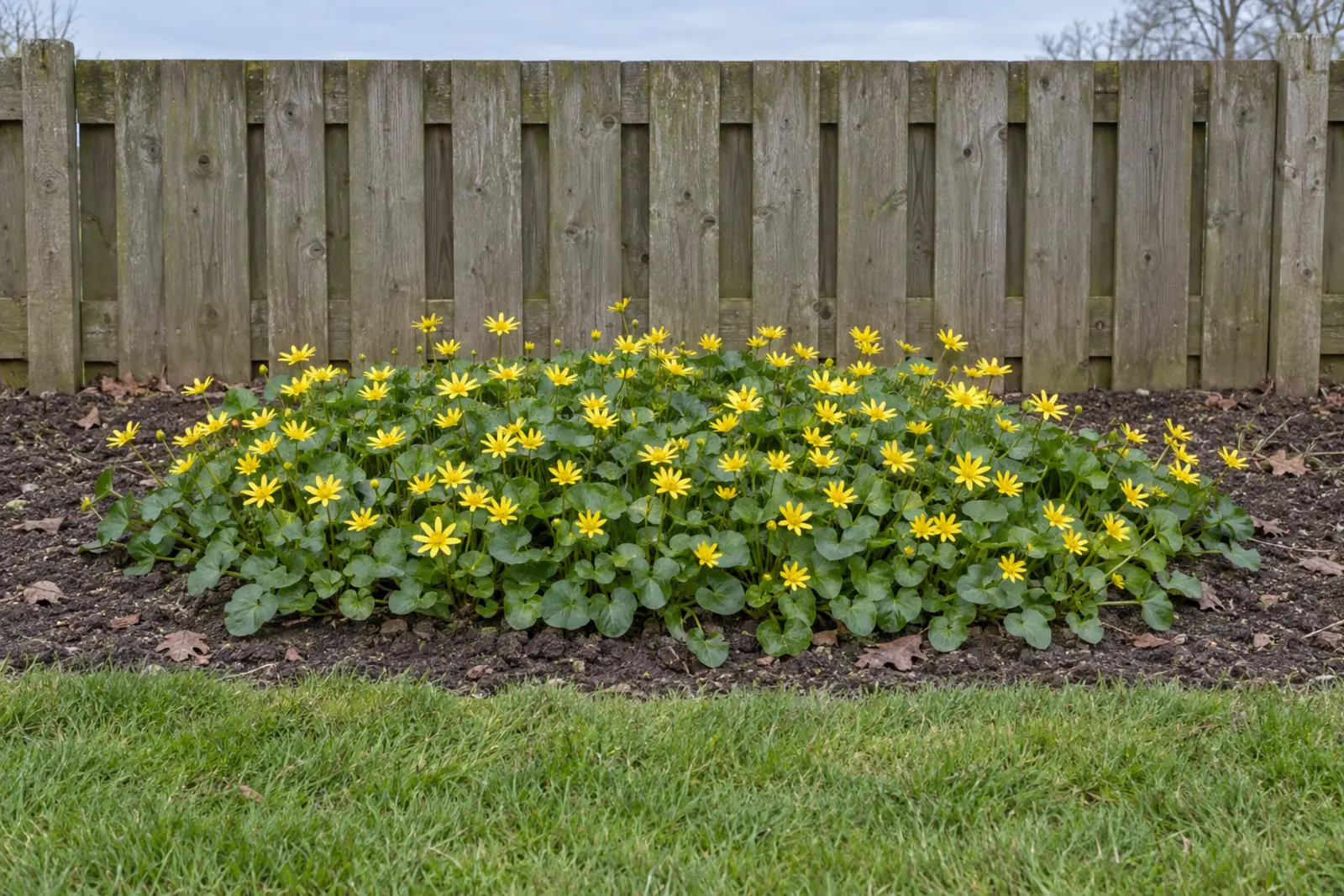
Lesser celandine (Ficaria verna) is a native, low spring plant 5 to 30 centimetres tall. From March to May it bears glossy yellow star-shaped flowers above heart-shaped leaves. The plant likes moist, fertile soil in partial shade. Small tubers let lesser celandine spread fast into a dense carpet.
Lesser celandine at a glance
| Feature | Lesser celandine |
|---|---|
| Height | 5 to 30 cm |
| Spread | 10 to 50 cm per plant |
| Full grown after | 1 to 2 years |
| Sun | Partial shade to shade |
| Soil | Moist and fertile, ideally loam or clay |
| Water | Average: moist in spring |
| Maintenance | Low: no pruning needed |
| Flowers | March to May, yellow |
| For bees | Yes: nectar and pollen, March to May |
| Hay fever | Not or weakly allergenic |
| Leaves | Drop in summer |
| Hardy | Yes |
| Native | Yes |
| Poisonous | Mildly: the sap can irritate the skin |
| Pricks or stings | No |
| Price, young | About €2.35 to €3.50 each, 10 to 30 cm tall |
| Price, grown | Not for sale |
- Leaf
- February to May
- Flower
- March to May
- Fruit
- no noticeable fruit
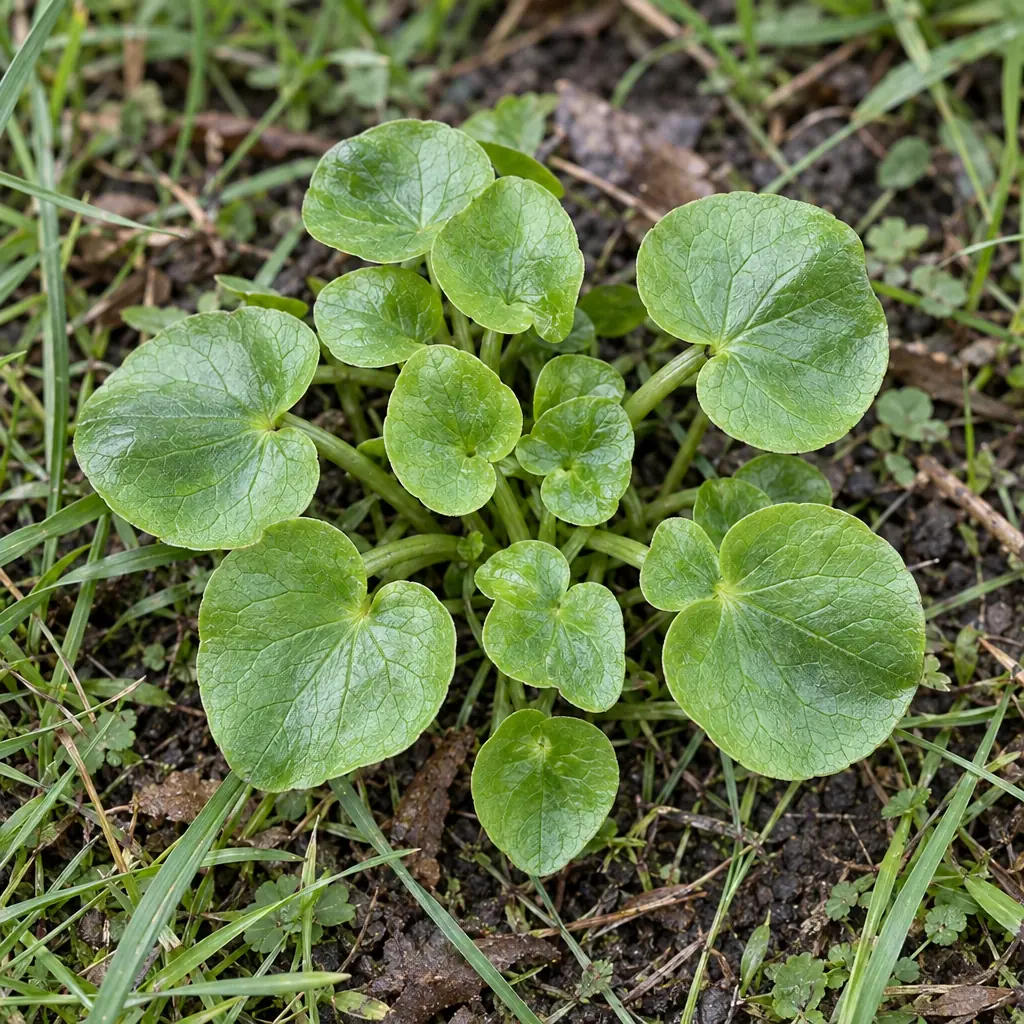
Leaf 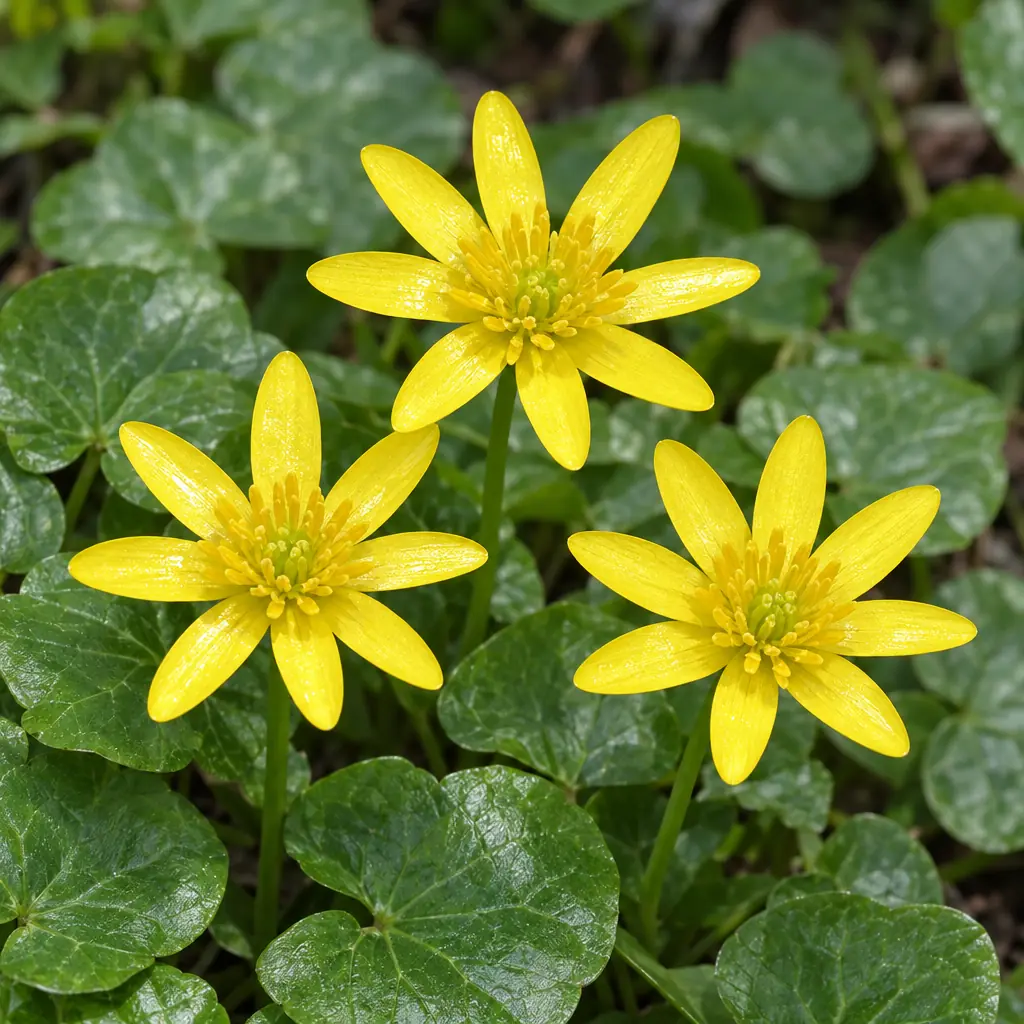
Flower
How do I recognise lesser celandine?
Start with the leaves. Each leaf sits on a long stalk and is heart-shaped or round. The edge is smooth or slightly wavy, with no teeth. The leaf is glossy and feels a little fleshy. Sometimes a dark marking shows on it.
The flowers each sit on a stalk of their own and are 2 to 3 centimetres across. Each flower has eight to twelve narrow petals, which do not overlap. Below them sit three, sometimes four green sepals. You will almost never see fruit. Small round tubers do grow where the leaf stalks join the stem.
Lesser celandine looks like marsh marigold (Caltha palustris), which also has glossy yellow flowers above heart-shaped leaves. Look at the leaf edge and at the flower. Marsh marigold has toothed leaves up to 15 centimetres across and usually five broad petals. On lesser celandine the edge is smooth or wavy, and the petals are narrow.
Where does lesser celandine grow best?
Lesser celandine wants partial shade to shade. Partial shade means 3 to 6 hours of direct sunlight a day around midsummer. A spot under trees that come into leaf late suits it as well. In March plenty of light still reaches the ground there, and that is exactly when lesser celandine grows and flowers. The soil should be moist and fertile. In the wild, the plant grows in deciduous woods, hedges, road verges and shady lawns.
Lesser celandine does poorly in these spots:
- On dry, acid sand. The plant needs soil that stays moist in spring, and lesser celandine avoids acid soil.
- In a fine lawn. The tubers spread through the grass, and that is how large patches form.
- Among low perennials in a border. The dense carpet holds back the plants next to it.
From early summer into winter, nothing of lesser celandine shows above ground. All that is left then are the small tubers in the soil.
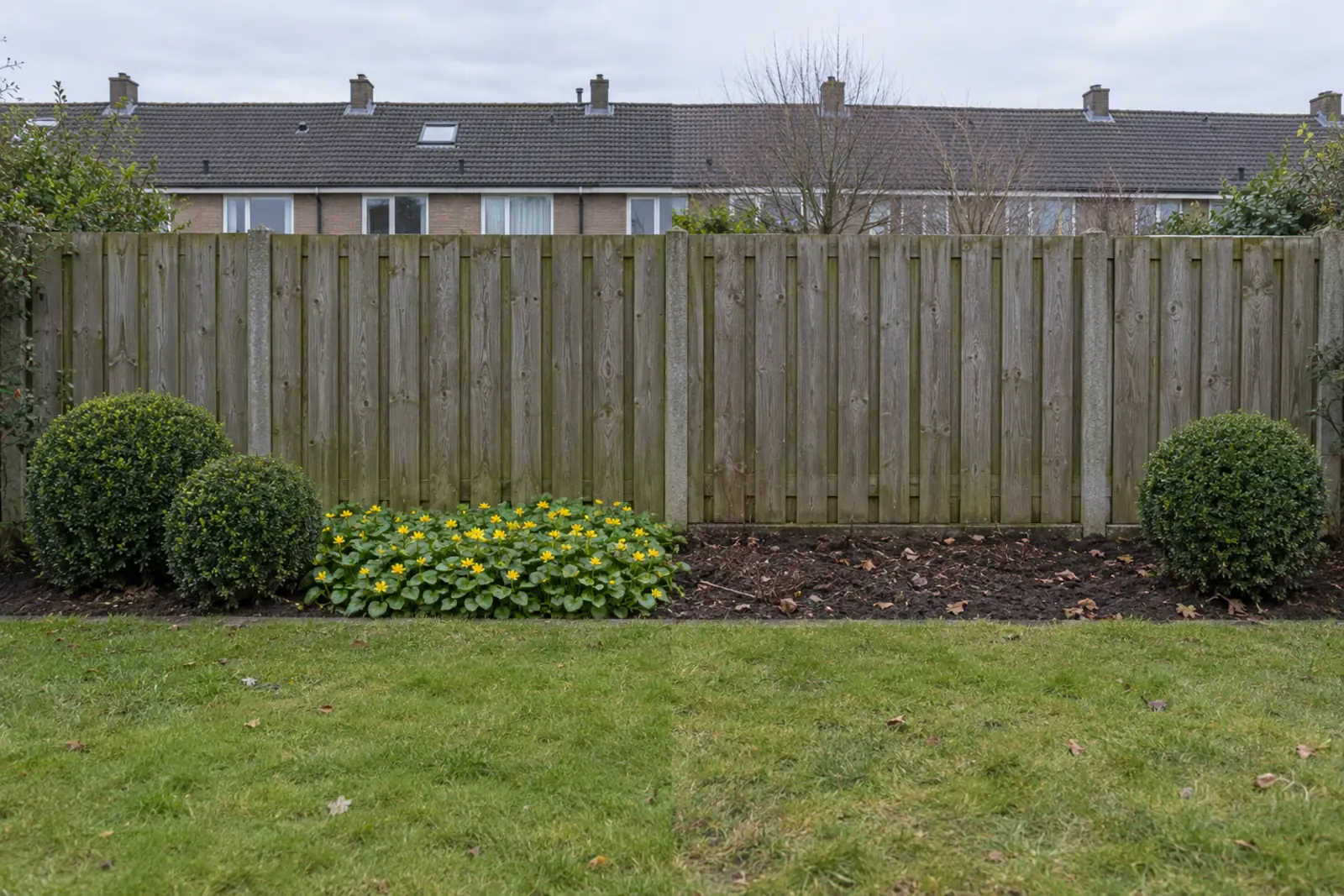 The same border in March and in January. This is a generated image, not a photograph.
In the app you work on a scale drawing of your own plot, with your house and the houses next door on it. There you pick the corner that lesser celandine gets.
Planting and caring for lesser celandine
Nurseries sell lesser celandine as a young plant in a small pot. Plant it in spring, while the leaves are up. After flowering you can no longer see where it grows.
Space the plants about 26 centimetres apart. That comes to 11 to 15 per square metre. On planting day the bed looks bare, but the tubers fill the gaps by themselves. Keep the soil moist in the first spring, above all in a dry month.
No pruning is needed.
What goes wrong with lesser celandine?
Lesser celandine is taking over the lawn or the border. Tubers break off easily when you weed, and every loose tuber becomes a new plant. Pull off the leaves as soon as they appear, because that weakens the plant. Weed before flowering, and do not dig the soil over. You can also cover a bed for a few seasons with cardboard and 10 centimetres of mulch. In a border, a dense evergreen ground cover such as lesser periwinkle helps. Many weedkillers work poorly on lesser celandine.
The flowers stay closed. In grey or rainy weather they do not open. Even on a sunny day the flowers open only around nine in the morning. By five in the afternoon they have closed again. Nothing needs doing.
The leaves turn yellow and disappear. That is normal. After flowering, the part above ground dies back in early summer.
A white coating covers the leaves. That is powdery mildew, a fungus. It turns up mostly on drier soil.
Which insects and birds use lesser celandine?
The white-marked (Cerastis leucographa), a moth, uses lesser celandine as a host plant. Its caterpillar feeds on lesser celandine and on other plants from April to June. The moth itself flies from mid-March to the end of April. In the Netherlands the white-marked is rare and critically endangered. Now and then it turns up in the south and east of the country.
No fixed link between lesser celandine and a particular bird has been described.
Is lesser celandine poisonous or edible?
Lesser celandine is mildly poisonous. The whole plant contains weak toxins, which are harmful if eaten. Their level in the plant rises in the course of spring. The sap can irritate the skin. If you weed a lot of lesser celandine, wear gloves.
The photos on this page were made with AI, based on real photos and descriptions of this plant.
Frequently asked questions
Is lesser celandine poisonous?
Yes, mildly. The whole plant contains weak toxins that are harmful if eaten, and the sap can irritate the skin. The level of those toxins rises in the course of spring.
How do I get rid of lesser celandine?
Pull off the leaves as soon as they appear, and weed before flowering without turning the soil over. Loose tubers otherwise grow into new plants. You can also cover a bed for a few seasons with cardboard and 10 cm of mulch.
Where does lesser celandine grow best?
In partial shade to shade, on moist and fertile soil. Under trees that come into leaf late, plenty of light still reaches the ground in March.
When does lesser celandine flower?
From March to May. The flowers only open in bright weather. In grey weather, early in the morning and late in the afternoon, they stay closed.
Is lesser celandine native to the Netherlands?
Yes. Lesser celandine is originally native to the Netherlands. In the wild it grows in deciduous woods, hedges, road verges and shady lawns.
Sources (20)
- Duistermaat, Sparrius & Denters, Standaardlijst van de Nederlandse flora 2020 (Gorteria 43)
- NDFF Verspreidingsatlas — Ficaria verna
- Flora van Nederland — Gewoon speenkruid
- Flora van Nederland — Speenkruid (gastblog)
- Wilde planten in Nederland en België — Gewoon speenkruid
- NDFF Verspreidingsatlas — Caltha palustris (dotterbloem)
- RHS — Ficaria verna (lesser celandine)
- RHS — Lesser celandine (weeds)
- RHS — Shade gardening (definities zon en schaduw)
- PFAF — Ficaria verna
- Imkerpedia — Drachtplanten
- Pollennieuws / Flora van Nederland — Aandachtspunten hooikoorts vriendelijke tuin
- De Vlinderstichting — Witringuil
- De Cruydt-Hoeck — Gewoon speenkruid
- Tuincentrum Soontiëns — Ficaria verna (prijs)
- Ecoflora — Speenkruid (prijs)
- Yarinde — Speenkruid (plantafstand)
- GroenRijk Plantengids — Speenkruid (plantafstand)
- Wikimedia Commons — Leaf: photo by Chris Armstrong (CC0)
- Wikimedia Commons — Flower: photo by AnRo0002 (CC0)