5 min read
Hart's tongue fern: planting and care of an evergreen fern
Asplenium scolopendrium
Hart's tongue fern (Asplenium scolopendrium) is a native fern with whole, tongue-shaped leaves. Those leaves stay green all winter. The plant grows 15 to 60 cm tall, in shade or partial shade on moist soil. In the wild it grows on old, wet walls and in deciduous woods. A clump grows up to half a metre wide.
Hart's tongue fern at a glance
| Feature | Hart's tongue fern |
|---|---|
| Height | 0.15 to 0.6 m |
| Spread | Up to 0.5 m |
| Full grown after | 5 to 10 years |
| Sun | Partial shade to shade |
| Soil | Moist, rich in humus, ideally rich in lime |
| Water | Average: moist, not wet |
| Maintenance | Low: one trim in early spring |
| Flowers | Does not flower, forms spores |
| For bees | No: hart's tongue fern does not flower |
| Hay fever | No pollen |
| Leaves | Stay green |
| Hardy | Yes |
| Native | Yes |
| Poisonous | No: no poisonings are known |
| Pricks or stings | No |
| Price, young | About €3.10 to €5.66 each, a potted plant of 5-10 cm |
| Price, grown | About €7.50 to €7.95 each, 10-20 cm, in a pot |
- Leaf
- all year
- Flower
- no showy flowers
- Fruit
- no noticeable fruit
Leaf
How do I recognise hart's tongue fern?
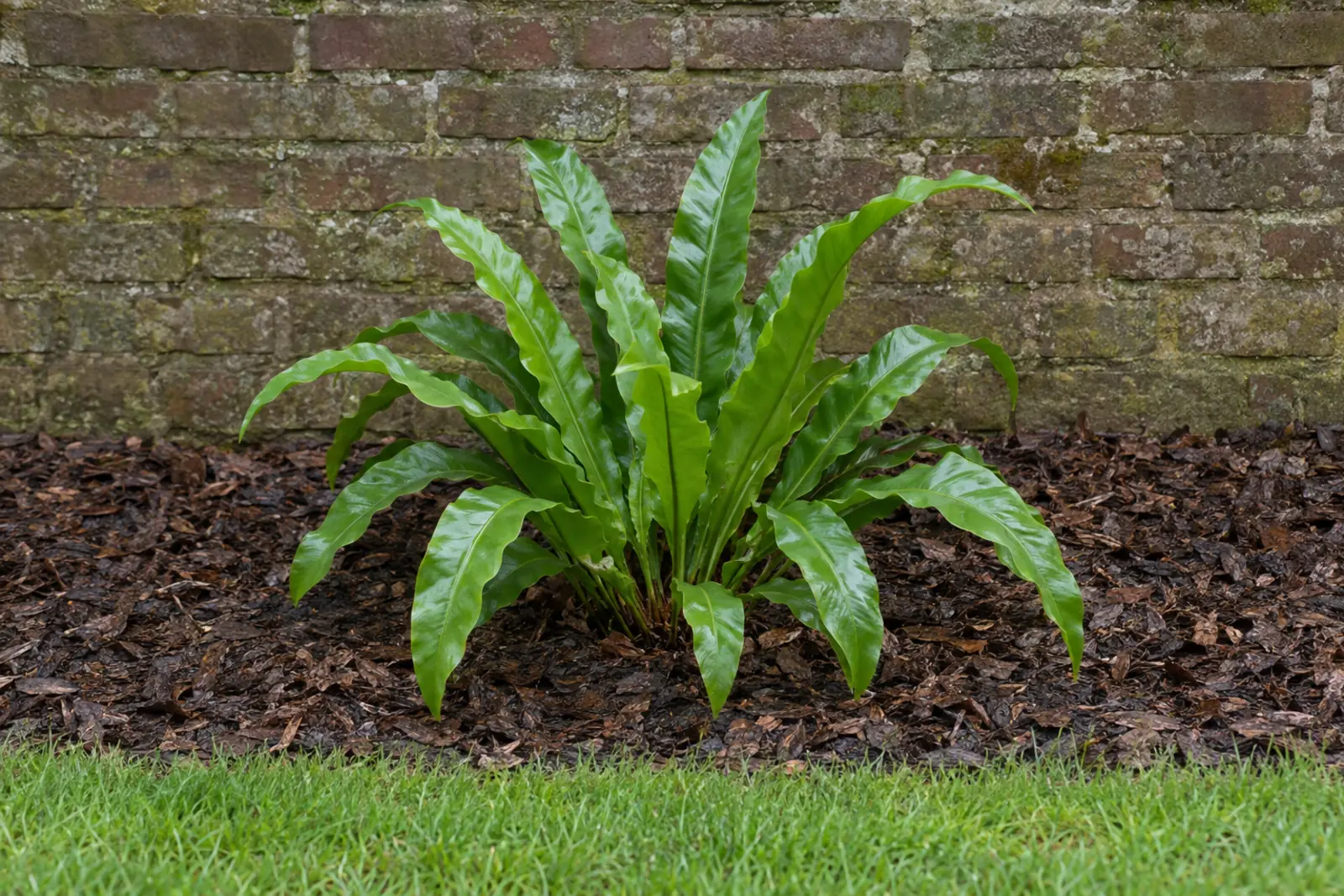
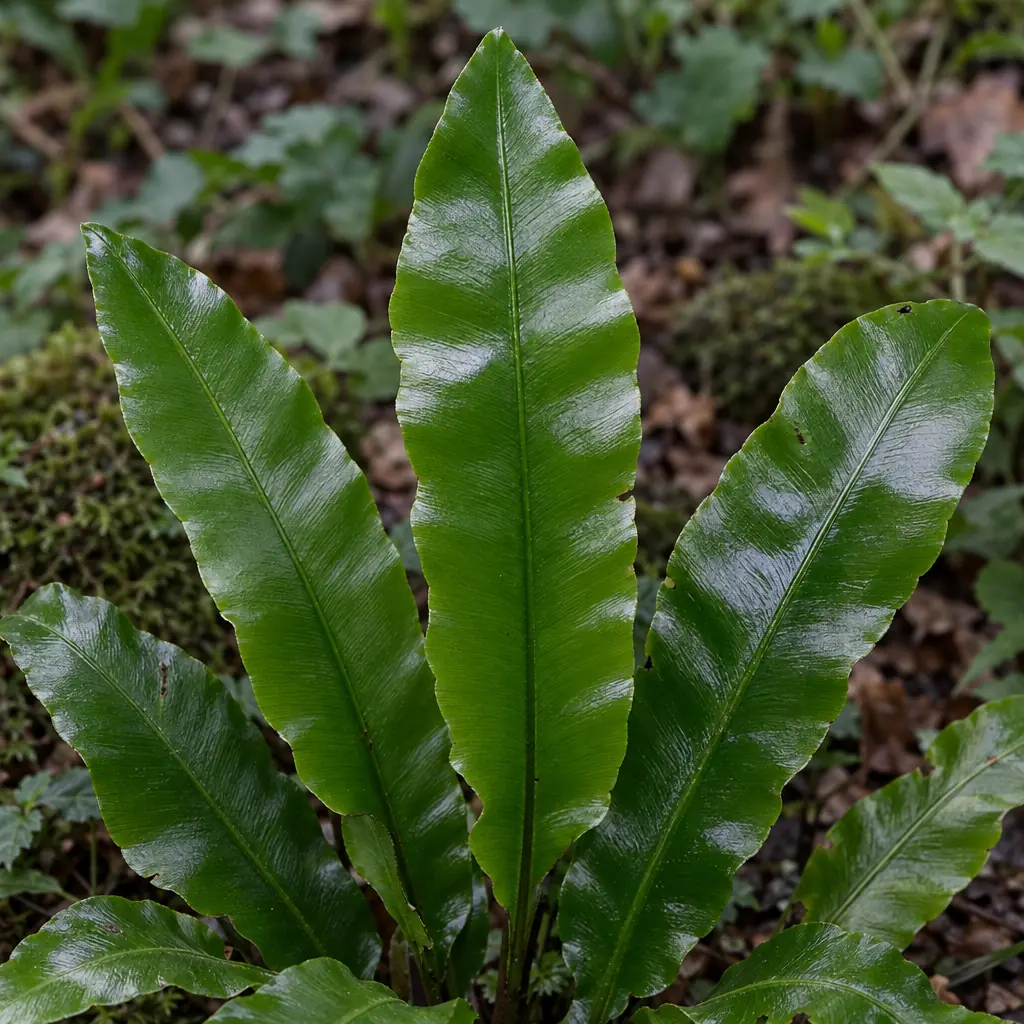
The leaves give it away. Most ferns have fronds cut into many leaflets. Hart's tongue fern has a whole leaf with no cuts in it at all. A leaf is usually 25 to 30 cm long, and more than 50 cm on a lush plant. At the base it is up to 7 cm wide, with two small lobes pointing backwards. Towards the top the leaf narrows to a point. The edge is smooth or slightly wavy, and the surface is glossy.
The leaves grow close together and rise upright in a ring. The short leaf stalk carries brown, almost hair-like scales. In April new leaves come out of the ground rolled up. Under older leaves you see brown stripes in pairs along the side veins. That is where the spores sit.
Garden centres also sell cultivated forms of this species. The Crispum Group has broad leaves with deeply ruffled edges. In the Cristatum Group the tip is crested and branched. For the wild hart's tongue fern, choose a plant with an unbroken edge, at most slightly wavy, and a single pointed tip.
Where does hart's tongue fern grow best?
Hart's tongue fern needs shade or partial shade. The sun should reach it for three hours a day at most. The soil should be moist but not waterlogged, rich in humus and ideally rich in lime. Clay, loam and sand all work. In the wild the fern grows on old, damp walls of locks, canals and quays. You also find it on dead wood in woods, and along shaded ditches.
This fern struggles in two kinds of spot:
- An open spot in the harsh midday sun. Bright sunlight around noon damages the leaves.
- A sandy border that dries out in summer. The fern needs soil that keeps its moisture.
The leaves stay on through the winter. So a corner planted with hart's tongue fern still holds a green clump in January.
To see how many hart's tongue ferns fit in a corner by the fence, place them in the app on your own plot. The app draws the plant at a grown plant's width, not at pot size. Then set the width to 0.5 m.
Planting and caring for hart's tongue fern
Nurseries sell this fern as a potted plant. You can plant it at any time of year, as long as the ground is not frozen. Spring and autumn work best, because a fern then settles in before hot or cold weather arrives. Bury only the roots, and leave the base of the leaves above the soil.
Allow nine plants per square metre, about 33 cm apart. On planting day there is still bare soil between the young plants. After a few years the leaves of neighbouring plants touch. Water regularly through the first year, and each spring spread a layer of compost around the base.
| When | What to do |
|---|---|
| In early spring, before the curled new leaves open | Cut off brown and torn leaves close to the ground |
From March through July, many birds are on the nest. When you work in a dense corner of the garden in those months, look around carefully first.
What goes wrong with hart's tongue fern?
The leaves turn yellow and look scorched. The fern gets too much sun. In autumn, move it to a spot with more shade.
The leaf tips dry out and turn brown. The fern has been short of water. In dry weeks, water around the base, not into the middle of the clump.
The leaves are brown after a hard winter. Hart's tongue fern does not cope well with a very severe, long frost. Cut the brown leaves away in spring.
There are holes in the young leaves. Slugs and snails like to eat the young leaves. On a damp evening, check around the clump.
The plant will not flower. That is how it should be. Hart's tongue fern never carries flowers and spreads by spores.
What do birds and insects get from hart's tongue fern?
Which insects or birds make use of hart's tongue fern is not well described.
Is hart's tongue fern poisonous or edible?
There are no reports of poisoning by hart's tongue fern. A number of ferns contain substances that can cause cancer. Many ferns also contain thiaminase, an enzyme that breaks down vitamin B in your body. Hart's tongue fern is not used as food.
The photos on this page were made with AI, based on real photos and descriptions of this plant.
Frequently asked questions
How big does hart's tongue fern get?
Hart's tongue fern grows 15 to 60 cm tall and up to half a metre wide. The plant only reaches that size after 5 to 10 years.
Can hart's tongue fern grow in the sun?
Preferably not. Hart's tongue fern needs shade or partial shade. If the sun reaches it for more than three hours a day, the leaves turn yellow and scorch.
Is hart's tongue fern evergreen?
Yes, the leaves stay on the plant all winter. The plant does not cope well with a very severe, long frost, though.
When do you cut back hart's tongue fern?
In early spring, before the new leaves unroll. Then cut away only the dead and ragged leaves at the base.
Is hart's tongue fern poisonous?
There are no reports of poisoning by hart's tongue fern. That does not make the plant edible, and it is not used as food.
Sources (18)
- Duistermaat, Sparrius & Denters, Standaardlijst van de Nederlandse flora 2020 (Gorteria 43)
- NDFF Verspreidingsatlas — Asplenium scolopendrium
- Flora van Nederland — Tongvaren
- Wilde planten in Nederland en België — Tongvaren
- RHS — Asplenium scolopendrium (hart's tongue fern)
- RHS — Asplenium scolopendrium Crispum Group 'Golden Queen'
- RHS — Asplenium scolopendrium Cristatum Group
- RHS — Ferns: growing guide
- RHS — Perennials: planting
- Plants For A Future — Asplenium scolopendrium
- Nederlandse Varenvereniging, Wat zijn varens
- Vogelbescherming — Snoeien in het broedseizoen, mag dat?
- Heijnen Planten — Tongvaren, 5-10 cm (prijs en planttijd)
- Cruydt-Hoeck — Tongvaren (prijs)
- Plantentuin Esveld — Asplenium scolopendrium (prijs per maat)
- PlantBezorgd — Tongvaren (prijs per maat)
- Directplant — Tongvaren (aantal per m²)
- Wikimedia Commons — Leaf: photo by Nicolas Weghaupt (CC0)